



AI search behavior in Malaysia is shifting toward longer, question-shaped queries answered directly inside ChatGPT, Google AI Overviews, and voice assistants. Malaysian businesses win by writing content that answers one specific question per section, in plain language, instead of burying the answer under a long introduction.
- Quick Takeaways
- How AI Search Queries Differ From Typed Search
- What Malaysian Customers Are Actually Asking
- A Framework for Mining the Real Questions
- Common Mistakes Malaysian Businesses Make
- How to Structure Content So AI Can Lift It
- FAQ
Quick Takeaways
- ChatGPT reached 900 million weekly active users in February 2026, more than doubling from 400 million a year earlier (Source: TechCrunch).
- Google’s AI Overviews peaked at 24.61% of tracked queries in July 2025 and settled near 15.69% by November 2025 (Source: Semrush).
- AI Overviews now appear on 10.33% of navigational queries, up from under 1% in January 2025, meaning even branded searches get summarized before a click happens (Source: Semrush).
- 35.4 million people were online in Malaysia by October 2025, a 98% internet penetration rate (Source: DataReportal).
- Content written to answer one question directly, in one self-contained block, is what AI systems actually quote. Content buried under a long introduction gets skipped instead.
How AI Search Queries Differ From Typed Search

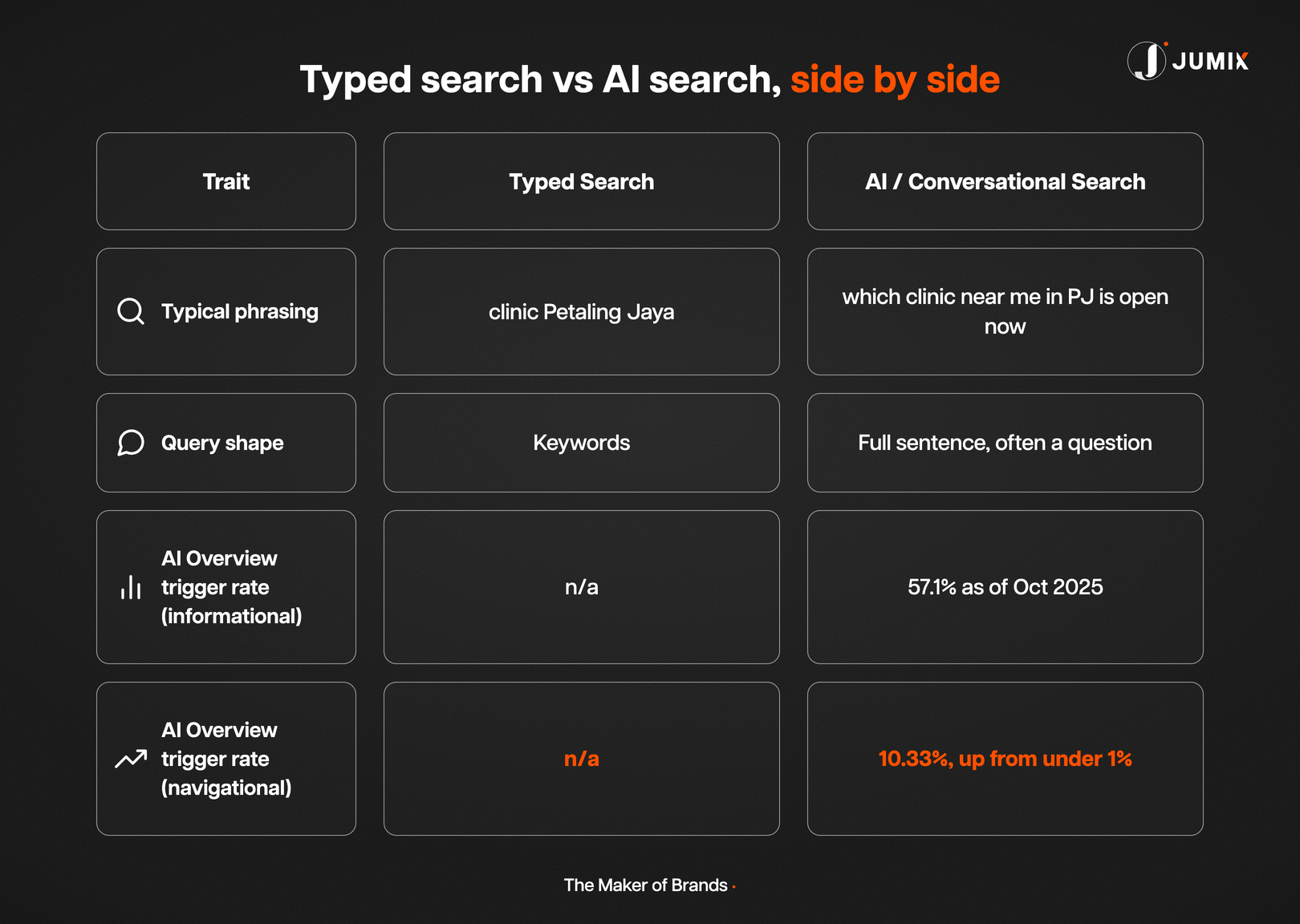
Type a query into Google and you write “clinic Petaling Jaya.”
Ask ChatGPT or Google’s AI Mode the same thing and you write a full sentence: “which clinic near me in PJ is open now and does walk-in blood tests.”
That gap is the whole story.
Google’s own AI Overviews study, run across 10 million keywords, found that AI Overviews now cover a much wider range of intent than they did at launch.
Informational queries triggered an AI Overview 91.3% of the time in January 2025. By October 2025, that had dropped to 57.1%, not because AI Overviews got rarer, but because they spread into commercial, transactional, and navigational searches too (Source: Semrush).
Navigational queries, the ones where someone is searching for a specific brand or page, went from 0.74% to 10.33% over the same stretch.
Even people looking for you by name now get a machine-written summary before they see your actual page.
ChatGPT’s own growth backs this up.
Weekly active users went from 400 million to 900 million in a single year, closing in on a billion people who now default to asking a chatbot instead of typing three keywords into a search box (Source: TechCrunch).
Those businesses pulling ahead right now are asking one plain question of every page they own: does this answer the actual sentence someone said out loud?
Most Malaysian business sites aren’t written that way yet. See our AEO and GEO framework for Malaysian websites for the full playbook behind this shift.
What Malaysian Customers Are Actually Asking

Here’s what the abstract stats look like on an actual Malaysian business site.
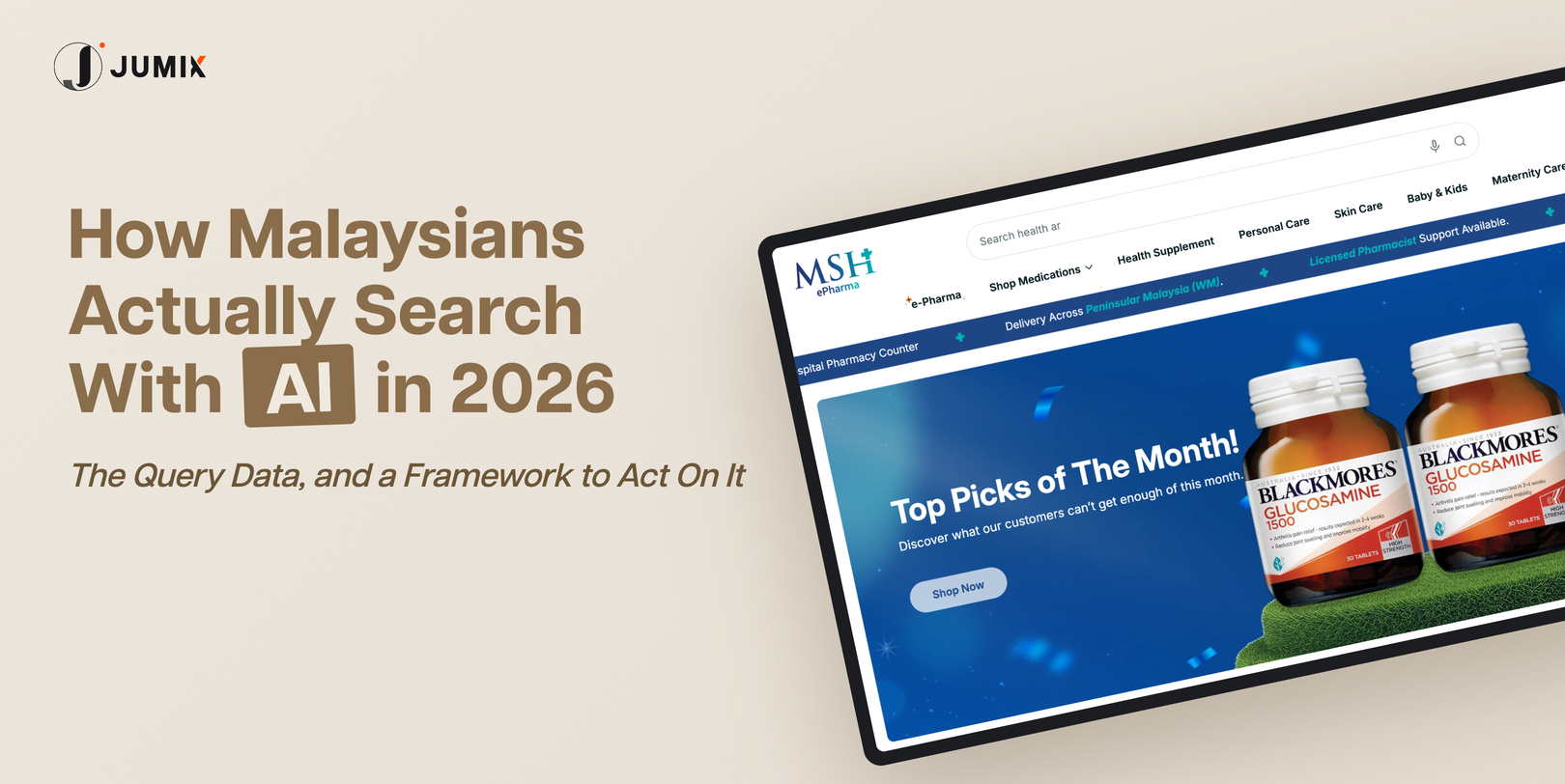
When we built MSH ePharma for MAHSA Specialist Hospital, the real question we had to answer was “can I trust a website to sell me a prescription drug, and what happens if I don’t have one.”
We answered both directly on the page: hospital-backed credibility up front, a telehealth consultation flow for anyone without a prescription, and clear steps for controlled medications that need pharmacist verification.
That’s the exact shape of question an AI assistant would summarize, and the exact shape most pharmacy sites bury under a product catalogue instead.
Penang Dental Surgery is a smaller version of the same pattern.
Patients Googling a dentist are quietly asking “will this hurt, and can I just message someone instead of calling.” The clinic’s site answers with a WhatsApp number as the primary contact, separate from the main clinic line, and plain-language service names instead of clinical jargon.
Patients type “braces cost Malaysia” into Google, never “orthodontic malocclusion correction.”
If your content still speaks in your own internal vocabulary, neither Google nor ChatGPT has a clean sentence to lift from your page.
They’ll answer the question anyway, just from a competitor who wrote it in plain words.
A Framework for Mining the Real Questions
You don’t need a research budget to find out what people are actually asking about your business.
You need to look in five places you probably already have.
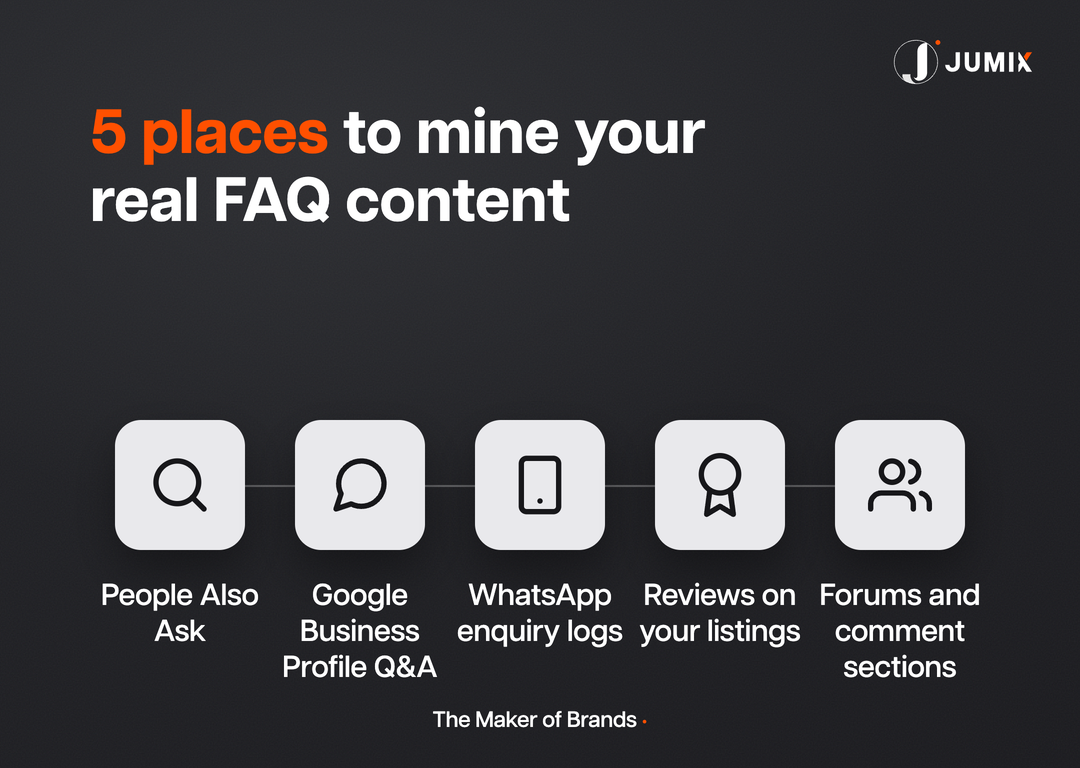
- Google’s “People also ask” box. Search your own primary keyword and screenshot every question that appears. These are already ranked by real query volume.
- Your Google Business Profile Q&A tab. Customers post questions there directly, often the exact phrasing they’d use talking to a chatbot.
- Your WhatsApp and customer service logs. Pull the last 100 enquiries. The repeated ones are your highest-value FAQ content, word for word.
- Reviews on your own listings. Complaints and praise both reveal the decision factors customers weigh before buying.
- Competitor comment sections and forums. Reddit threads and Facebook group questions about your category show what people ask when nobody’s selling to them yet.
Write each one as its own short, self-contained answer, one that never leans on a reader having scrolled past three other sections first.
It should make sense as the only sentence someone ever reads from your site, because for an AI-generated summary, it often is.
Common Mistakes Malaysian Businesses Make
I see the same mistakes on almost every Malaysian SME site we audit.
- Answering the question in paragraph four. AI systems pull from the first clear sentence that resolves the query. If your answer is buried under a company history and a mission statement, it gets skipped.
- Writing prices as “contact us for a quote.” A customer asking an AI assistant “how much does X cost in Malaysia” gets a real number from whoever published one, in RM, on their page. If that’s not you, the enquiry goes elsewhere.
- Putting comparison data only inside an image. A pricing table rendered as a PNG looks fine to a human. It’s invisible to a system reading your HTML for extractable facts.
- Letting old FAQ pages go stale. A FAQ written in 2023 answers 2023’s questions. New e-invoice rules, new payment gateways, and new competitors change what people actually ask within a year.
None of these are hard to fix.
They’re just easy to miss when you’re writing for a human scrolling, not a machine summarizing.
How to Structure Content So AI Can Lift It
Voice assistants reinforce the same lesson from a different angle.
27.6% of internet users worldwide, aged 16 to 64, use a voice assistant weekly (Source: Backlinko).
A voice assistant reads the first clean, factual answer it can parse and speaks that one out loud, skipping everything else on the page.
The table below is the quick reference we hand clients when we rebuild their content for this.
| Content Format | Extractable by AI? | Why |
|---|---|---|
| Plain paragraph that states the answer first | Yes | Direct claim, no scrolling required to find it |
| Numbered or bulleted list | Yes | Already broken into discrete, liftable facts |
| FAQ block with Q&A pairs | Yes | Mirrors how AI assistants phrase their own answers |
| HTML table with real data | Yes | Rows and columns parse cleanly as structured facts |
| Pricing or comparison data inside an image only | No | Text inside a picture isn’t machine-readable text |
| Long introduction before the actual answer | No | The answer is too far from the question to extract confidently |
This is also why schema markup matters more now, not less.
It’s the label that tells a crawler “this specific block is the answer,” instead of leaving it to guess. Our guide on preparing your website for Google’s AI Overviews covers the technical side of this in more depth.
If most of your traffic is still local, the same logic applies to local SEO for Klang Valley businesses: voice and AI queries skew heavily toward “near me” phrasing, so your Google Business Profile answers need the same directness as your website copy.
FAQ
Do I need to rewrite my whole website for AI search?
No. Start with your 5 highest-traffic pages and restructure just the opening paragraph of each section to answer the question first. That covers most of the AI-citation opportunity without a full rebuild.
Is voice search actually used in Malaysia, or is it mostly hype?
Malaysia has 98% internet penetration and one of the highest smartphone usage rates in Southeast Asia (Source: DataReportal), and voice assistants ship as a default feature on nearly every phone sold here. Usage is real even without a Malaysia-specific survey to point to.
How do I find out what questions my customers are really asking?
Pull your last 100 WhatsApp or customer service enquiries and count the repeats. That single exercise usually reveals your best FAQ content faster than any keyword tool.
Does optimizing for AI search mean I can stop doing SEO?
No. AI Overviews and chatbot answers are still built from indexed, crawlable content. Good technical SEO is the foundation AI citation sits on top of, not a replacement for it. We break this down further in why GEO doesn’t mean SEO is dead.
How long should an answer be for AI to quote it?
Short enough to stand alone. 1 to 3 sentences that fully answer the question, with no reference back to an earlier paragraph, works best.
AI search just changes who gets to answer the customer’s question first.
The businesses winning right now wrote down the exact question a nervous, price-conscious Malaysian customer actually asks, and answered it in one clean sentence.
Pull your own WhatsApp logs this week. You’ll probably find your next 10 FAQ entries sitting there already.
If you’d rather have someone audit your site for what’s actually extractable right now, Jumix’s advanced SEO service covers exactly this.





Comments are closed for this article!