



Google AI Overviews answer many searches before anyone clicks a link, and that is cutting organic click-through rates on top-ranking pages by as much as 58% (Source: Ahrefs, 2026). The fix is knowing which of your pages are exposed, and building demand Google cannot summarize away, not chasing rank #1 harder.
- Quick Takeaways
- What Google AI Overviews Changed
- Which of Your Pages Are Actually at Risk
- Should You Still Chase Rank #1?
- Building a Citation Moat Instead of Just Ranking
- Why the Stakes Are Higher in Malaysia
- FAQ
Quick Takeaways
- AI Overviews now cut organic click-through rates on the #1 result by up to 58% year over year (Source: Ahrefs, 2026).
- Zero-click searches now make up roughly two-thirds of all Google queries (Source: SparkToro, 2026).
- Pages cited inside an AI Overview see more than double the clicks per impression compared to pages that rank but aren’t cited (Source: Seer Interactive, 2026).
- Informational queries are still the most AI-Overview-heavy, but commercial and branded queries are the fastest-growing category (Source: Search Engine Journal, 2025).
- Malaysia’s internet penetration sits at 97.1% of households, so fewer clicks per search still means a huge, mobile-first audience worth capturing (Source: Department of Statistics Malaysia, 2025).
What Google AI Overviews changed

A Google AI Overview is a summarized answer that sits above the normal search results.
It reads several pages, writes a summary, and shows it before a user scrolls past.
The user gets an answer. Your page gets skipped.
Ahrefs tracked 300,000 keywords from December 2023 to December 2025 and found click-through rates for the #1 organic result fell as much as 58% on queries where an AI Overview appeared (Source: Ahrefs, 2026).
SparkToro’s analysis of Similarweb data puts zero-click searches at roughly 68% of all Google queries in early 2026, up from 60% in 2024 (Source: SparkToro, 2026).
Google’s AI Mode is still small in Malaysia by volume, but it passed 1 billion monthly users worldwide within months of launch (Source: SparkToro, 2026).
Trackers disagree on exactly how many searches trigger an AI Overview. Semrush’s own monthly tracking moved from 6.5% in January 2026 to nearly 25% by July (Source: Semrush, 2026).
The exact number matters less than the direction. AI Overviews are moving into query categories they used to avoid, not shrinking.
Ranking #1 used to guarantee a click. It no longer does.
Which of your pages are actually at risk
Not every page on your website faces the same risk.
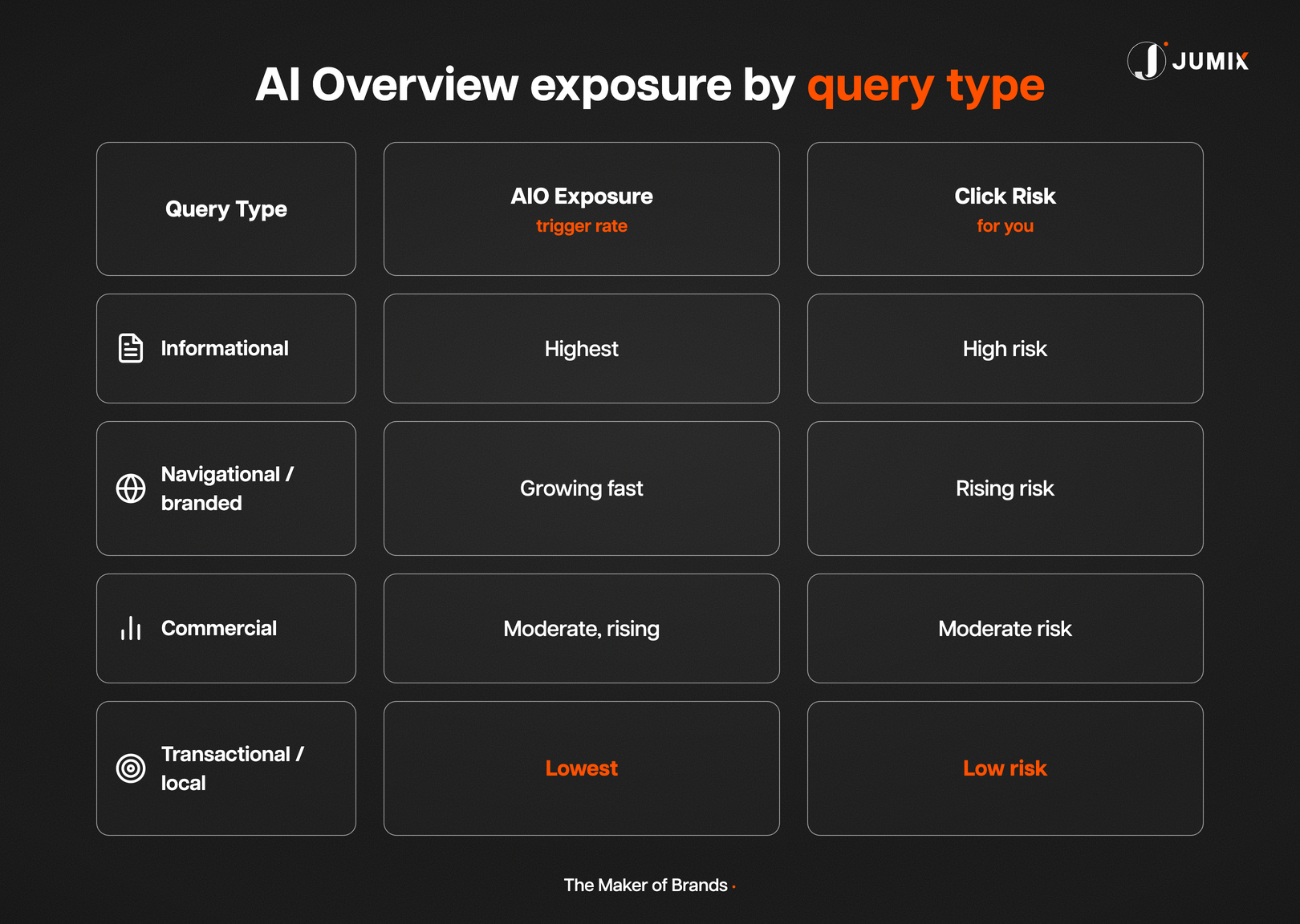
AI Overviews attach to specific query types at different rates. Knowing where your content sits tells you where to spend effort.
| Query type | Example | AI Overview exposure | What it means for you |
|---|---|---|---|
| Informational | “how does e-invoicing work” | Highest | Google will likely summarize this content regardless of your ranking. |
| Navigational / branded | “Jumix web design portfolio” | Growing fast | Own the brand terms first. This is now contested territory too. |
| Commercial | “best e-commerce platform for Malaysian SMEs” | Moderate, rising | Comparison and pricing content still earns clicks when it is specific. |
| Transactional / local | “web design agency Petaling Jaya” | Lowest | Buyer intent this close to action still favors real websites over summaries. |
Peec AI’s study of 500,000 prompts found AI Overviews appeared on about 87% of commercial, buying-intent queries, and 88.5% of decision-stage prompts like “best X for Y” comparisons (Source: Search Engine Journal, 2025).
Broader studies that include informational and navigational queries land much lower, from 20% to 42%. Commercial intent used to be the safer category. It no longer is.
The safe zones are shrinking. Nothing is fully immune.
Audit your own top 20 landing pages against this table. Sort them by query type, not by traffic volume.
A blog post explaining “what is SEO” competes with an AI summary written from a dozen sources. A page selling “SEO packages Kuala Lumpur” competes with three other agencies, and a summary cannot book the client for you.
Should you still chase rank #1?

Two facts sit in tension here, and how you answer this question depends on your industry.
Rank #1 clicks fell 58%. Pages cited inside an AI Overview see more than double the clicks per impression compared to pages that rank but are not cited (Source: Seer Interactive, 2026).
Rank #1 alone is a smaller prize than it used to be. Being cited inside the summary is the new prize.
Here is the decision logic we use with clients at Jumix.
- If the query is broadly informational, stop chasing rank alone. Write for citation instead: answer the question in the first 40 words, and structure it so an AI system can lift it cleanly.
- If the query is transactional or local, rank still matters. These queries rarely trigger a full AI Overview, and the buyer is close to a decision.
- If the query is branded, defend it. A competitor bidding on your brand name inside an AI summary is a new threat that did not exist two years ago.
A generic how-to post explaining a common tech problem is the easiest thing for an AI Overview to summarize and replace.
A product page with real stock, real pricing and a real “add to cart” button is not. The pages closest to a purchase decision are the pages an AI summary cannot replace.
Building a citation moat instead of just ranking
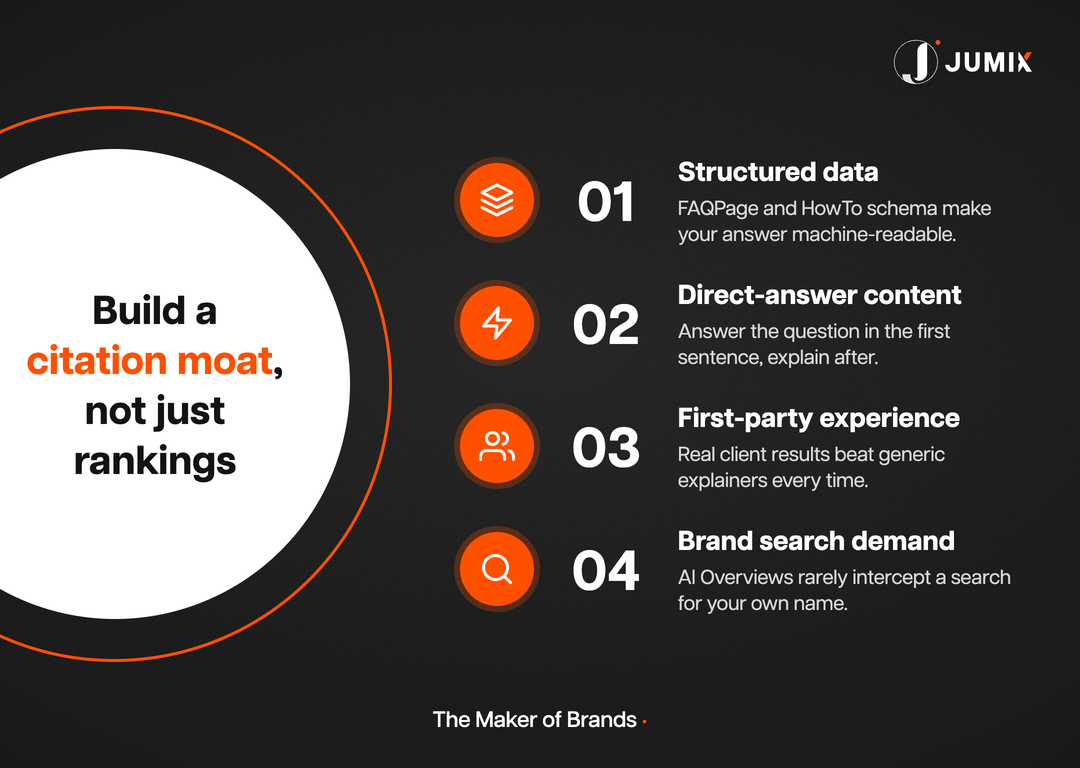
A citation moat is content built to be lifted, quoted and trusted, not just crawled.
Four things move the needle.
Structured data. FAQPage, HowTo and LocalBusiness schema give Google a clean, machine-readable version of your answer. It costs nothing beyond setup time.
Direct-answer content. Answer the question in the first sentence. Explain the reasoning after. AI systems pull the direct answer, not the throat-clearing before it.
First-party experience. A generic explainer competes with a hundred identical explainers. A real client result, a real number, a real photo does not.
Brand search demand. AI Overviews rarely intercept a search for your business name. Every campaign that gets someone to search “[your brand] review” or “[your brand] pricing” routes around the problem entirely.
None of this replaces a good website. It changes what the website has to do.
Why the stakes are higher in Malaysia
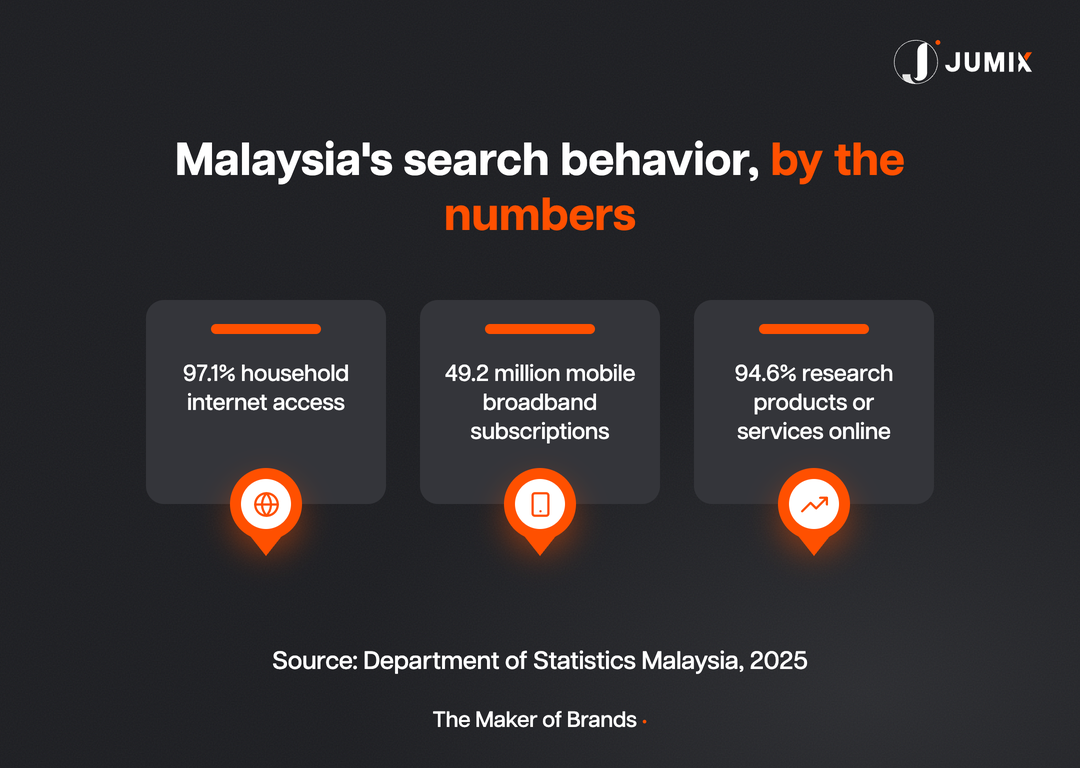
Malaysian household internet access reached 97.1%, and individual internet usage hit 98.3% (Source: Department of Statistics Malaysia, 2025).
Mobile broadband subscriptions passed 49.2 million, and 94.6% of internet users go online specifically to research goods and services.
Fewer clicks per search means a saturated, mobile-first market where the click you do get has to count, not a smaller market.
Malaysian SMEs also tend to publish thinner, more generic content than global competitors chasing the same informational queries. That content is the first to lose ground to an AI summary.
The businesses holding up are the ones with specific, local, hard-to-summarize detail: exact pricing in ringgit, named case studies, service areas, and booking flows a summary cannot complete for the user.
We rebuilt The Pillow House around exactly that kind of specificity, replacing generic hospitality copy with real room details and local context that no AI summary could substitute for a booking.
FAQ
Will Google AI Overviews eventually replace websites completely?
No. AI Overviews summarize information. They cannot process a payment, book an appointment, or close a sale. Transactional and local pages still need a real website behind them.
How do I know if my page was used in an AI Overview?
Google Search Console does not label AI Overview citations separately yet. Search your target queries manually and note whether your domain appears inside the summary or its linked sources.
Does adding schema markup guarantee a citation inside an AI Overview?
No. Schema makes your content easier to parse and slightly more likely to be selected. It is not a guarantee, and any tool claiming otherwise is overselling.
Should I stop investing in SEO because of AI Overviews?
No. Redirect the investment. Spend less on broad informational content that AI can summarize, and more on transactional pages, structured data and brand search demand that AI Overviews rarely touch.
Are commercial and branded searches really becoming more AI-Overview-heavy?
Yes. Commercial, buying-intent queries now trigger AI Overviews nearly as often as informational ones, around 87% in some studies (Source: Search Engine Journal, 2025). No query category is fully safe long term.
Conclusion
Google AI Overviews changed the math. The mission is the same as it always was.
A click is worth more when fewer of them are available. That means fewer, better-targeted pages beat a pile of generic content chasing traffic an AI summary will absorb anyway.
Sort your own pages by query type, defend your brand searches, and put real detail where AI cannot substitute for a human decision. Read more on preparing your website for AI search and winning at AEO and GEO in 2026.
At Jumix, we build SEO strategy around this shift rather than against it. If you are not sure which of your pages are exposed, our team can map it for you.




Comments are closed for this article!