




A brand consultancy sells strategy: positioning, research, and the direction your brand should take before a single visual gets made. A branding agency sells execution: the logo, the identity system, the guidelines, and the rollout. Some Malaysian firms do both under one roof. Knowing which one you actually need before you call stops you from paying for research you’ll ignore, or buying a logo with no strategy behind it.
- Quick Takeaways
- What a Brand Consultancy Actually Does
- What a Branding Agency Actually Delivers
- Consultancy vs Agency, Side by Side
- When You Need Strategy Before Anything Else
- When You Need Execution, Not More Analysis
- Mistakes Malaysian Businesses Make Choosing Between Them
- FAQ
Quick Takeaways
- A brand consultancy’s output is a strategic document: positioning, audience definition, and a messaging framework, usually with no visual design attached.
- A branding agency’s output is tangible: logo files, a color and type system, guidelines, and rollout across your real touchpoints.
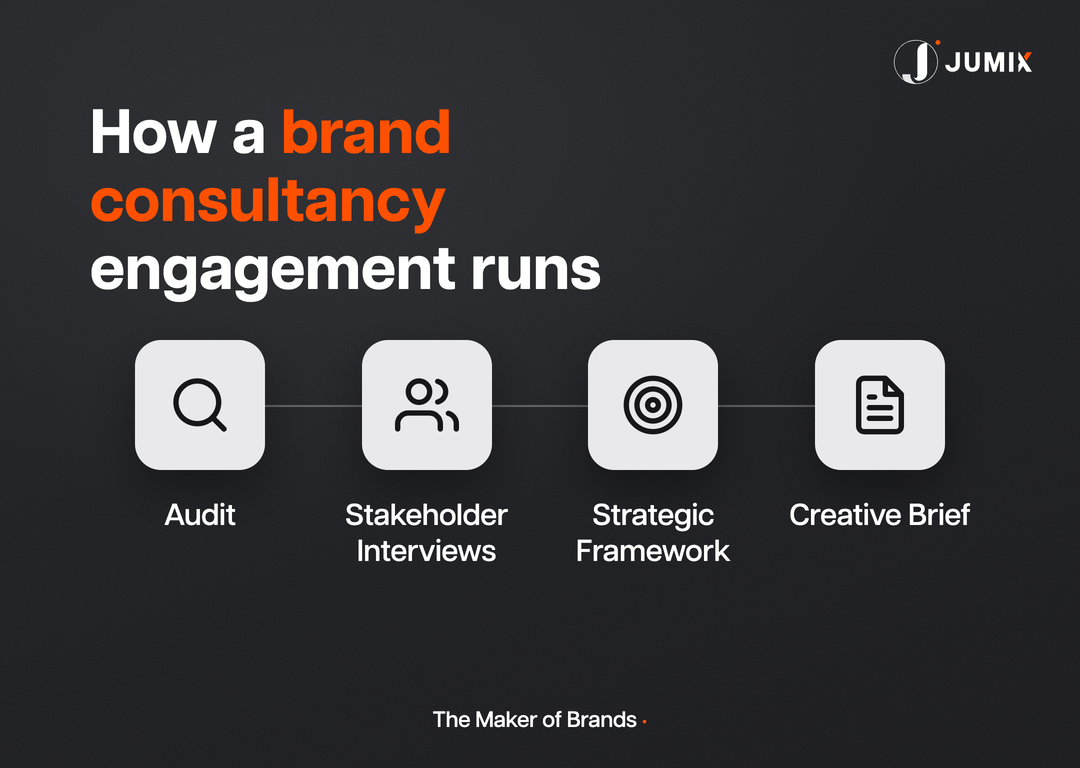
- Consultancy engagements run diagnostic first, audit and stakeholder interviews before any recommendation. Agency engagements run execution first, brief straight into design.
- You need a consultancy first when the business itself is unclear: who it serves, what it competes on, why the current positioning stopped working.
- You need an agency directly when the strategy already exists and the gap is visual, not verbal.
“Brand consultancy” and “branding agency” get used interchangeably in Malaysia.
They’re not the same engagement, and buying the wrong one wastes both money and time.
This breaks down what each one actually does, so you can scope the right conversation from the first call.
What a Brand Consultancy Actually Does

A brand consultancy operates one level above design.
The work starts with an audit. Your business, your industry, your stakeholders. Why customers currently choose you, or skip you.
The Place Brand Observer frames it as examining processes and systems, not just marketing output (Source: The Place Brand Observer, 2016).
From that audit comes a strategic framework. Who you serve, what you compete on, and the language that should show up everywhere from a sales pitch to a job posting.
Deliverables are usually documents, not designs: a positioning statement, an audience definition, a messaging framework, sometimes a brand architecture map if you run multiple product lines.
No logo comes out of a pure consultancy engagement. That’s the part founders miss when they call one expecting a rebrand.
SQAI is a holding company for two manufacturing groups, Qdos and Suiwa. Its subsidiaries already had their own websites. There was no story tying them together as one entity.
Before any design work, we had to define how a holding company communicates scale and credibility to people who’d never heard the parent name. That’s consultancy-shaped thinking, wearing an agency’s toolkit.
A consultancy that skips this and jumps straight to mood boards is just design with an extra meeting.
What a Branding Agency Actually Delivers

A branding agency turns a direction, however defined, into something you can put on a website, a packaging box, or a signboard.
The brief comes in, concepts get produced, one round gets refined, and files get handed over. It’s execution-heavy work, closer to production than diagnosis.
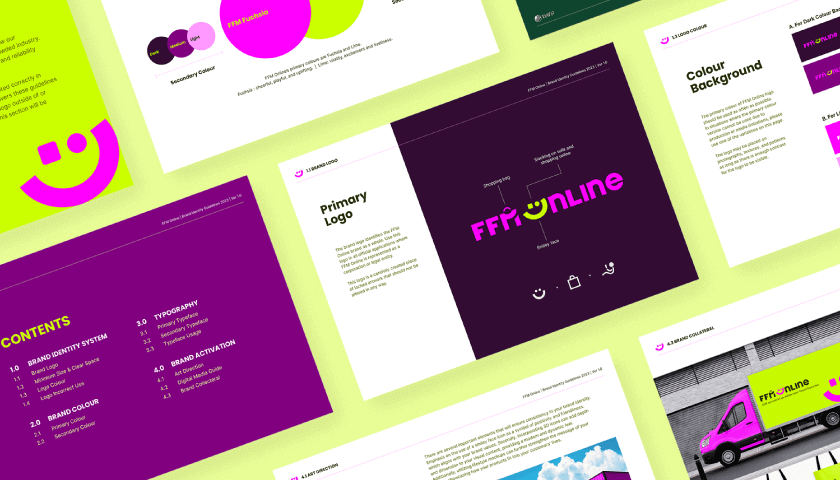
A full-service agency’s deliverables run wider than most people expect. A logo. A color and typography system. An imagery style, a guidelines document, and often the rollout itself across a website, packaging, or social templates.
Many Malaysian branding agencies, Jumix included, bundle a lighter strategy pass into the engagement. Clients don’t get sent to a separate consultancy first. It’s enough positioning work to make sure the visual system says something true, short of a full audit.
That blend matters. Most Malaysian SMEs don’t have the budget or the patience for two separate engagements run back to back.
What an agency won’t do, and shouldn’t pretend to, is a deep stakeholder audit across your whole organization. That’s a different scope, a different price, and usually a different kind of firm.
Once you’ve settled on an agency, vetting one properly is its own decision. Our buyer’s framework for vetting a branding agency covers the questions to ask before you sign.
Consultancy vs Agency, Side by Side
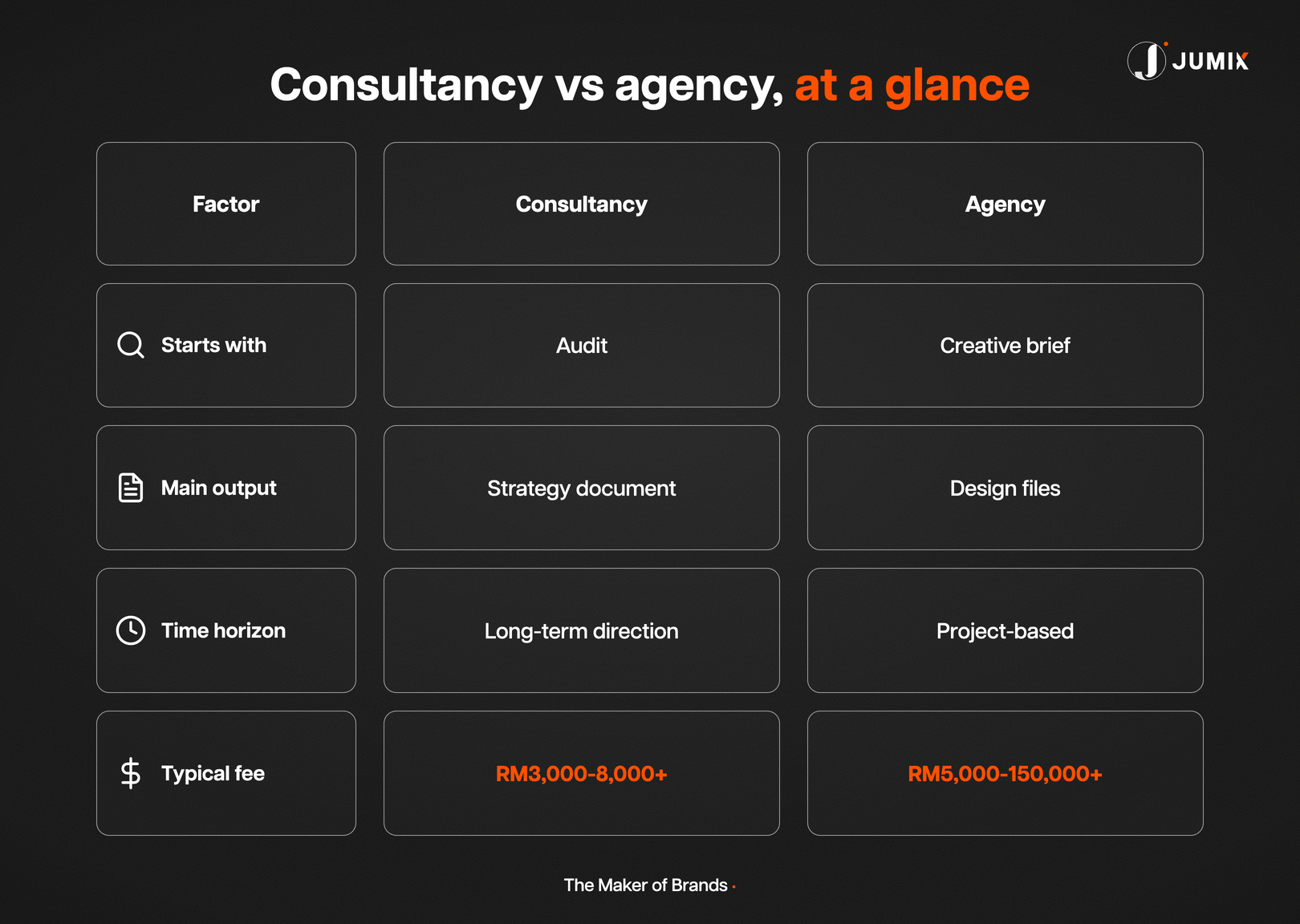
Put the two side by side and the split gets obvious fast.
| Factor | Brand Consultancy | Branding Agency |
|---|---|---|
| Primary output | Positioning document, messaging framework | Logo, identity system, guidelines, rollout |
| Process starts with | Audit and stakeholder interviews | Creative brief |
| Who’s in the room | Founders, C-level, often cross-functional teams | Marketing lead, founder, design team |
| Time horizon | Long-term direction, revisited every few years | Project-based, weeks to a few months |
| Typical Malaysian pricing | RM3,000 to RM8,000 for an audit; more for full strategy work | RM5,000 to RM150,000+ depending on scope |
| Ends with | A framework you hand to a designer | Finished files ready to use |
Our own cost breakdown for branding work in Malaysia covers those RM figures in more depth if you want the full tiers: how much branding costs in Malaysia.
When You Need Strategy Before Anything Else
A consultancy earns its cost when the business itself is the unclear part, not the visuals.
That’s true if you’re merging two companies and need one identity to represent both. It’s true if you’re entering a new market and don’t yet know how that audience perceives you. It’s true if a rebrand already failed once, and nobody can say exactly why.
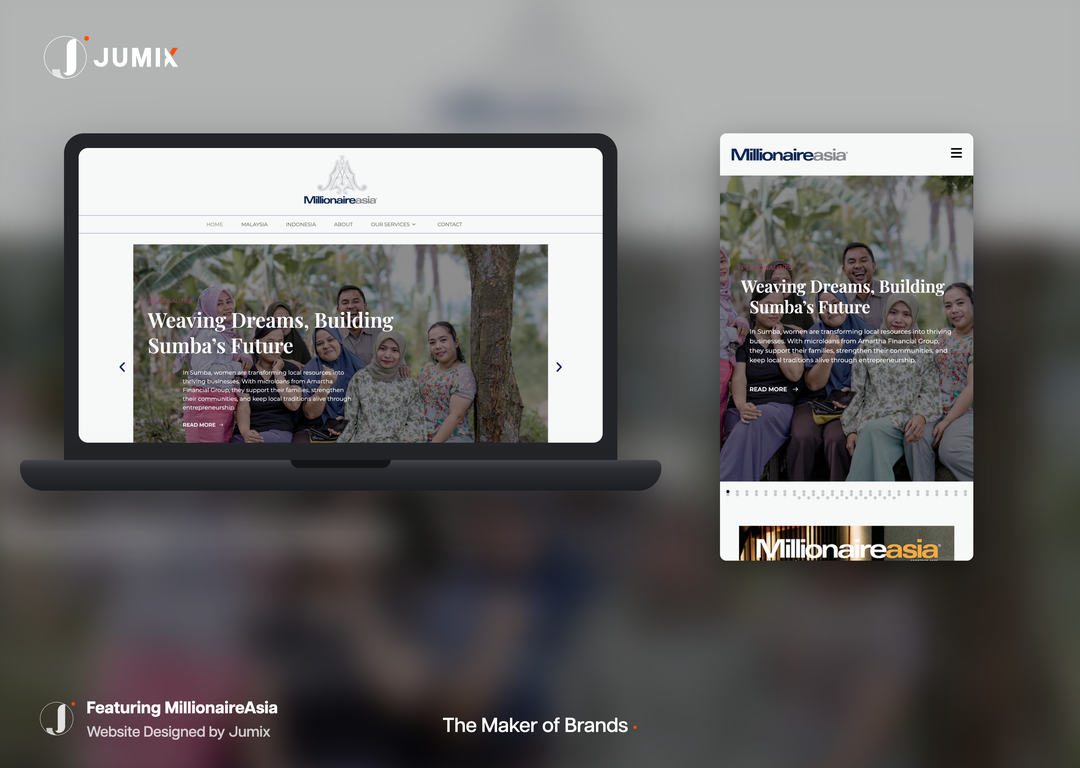
MillionaireAsia covers three markets: Malaysia, Indonesia, and the wider region. Their old site no longer matched the brand’s real scale.
Publications, events, membership, and consultancy verticals all needed one coherent story first. Get that story wrong, and the prettiest website in the world still confuses a high-net-worth reader.
If you can’t answer “who exactly are we for, and why do they pick us over the option next door” in one sentence, that’s the sign. Fix the sentence before you fix the logo.
When You Need Execution, Not More Analysis
Most Malaysian SMEs land here, not in the consultancy column.
You know who you serve. You know your pricing, your tone, roughly what you stand for. What’s missing is a visual system that says it consistently across a website, packaging, and social.
MillionaireAsia‘s rebuild resolved the strategic direction inside the same engagement. The bulk of the work was still execution. Refined art direction, an editorial-style layout, and an information architecture built for a premium, multinational audience.
If you’ve already done the thinking, in-house or through years of running the business, hiring a consultancy again just adds a document you already know. Go straight to the agency.
Mistakes Malaysian Businesses Make Choosing Between Them
A few mistakes come up over and over.
First, hiring a consultancy and expecting a logo. The engagement ends with a framework, not a file. If nobody executes that framework, you paid for a document sitting in a folder.
Second, hiring a full agency and skipping the strategy conversation, because it feels like an extra cost. The identity system gets built fast. It looks fine. It says nothing specific about the business.
Third, comparing a consultancy’s quote against an agency’s quote as if they’re the same line item. A RM4,000 audit and a RM40,000 full identity rollout are different products, not competing bids. A founder chasing “the cheaper one” ends up with neither done properly.
Fourth, treating the consultancy’s framework as optional reading once the agency gets briefed. A designer working off a positioning document they never opened produces exactly what you’d expect: something that looks fine and says nothing.
If it were my money, I’d ask any firm one question before signing: what’s the actual deliverable, and what format does it arrive in. A vague answer there is the real red flag, not the price.
FAQ
Can one firm do both consultancy and agency work?
Yes. Many Malaysian branding agencies bundle a lighter strategy phase into a full identity project, instead of two separate firms. Ask what that phase specifically includes. Don’t assume it matches a standalone consultancy audit.
Is a brand consultancy worth it for a small business?
Usually not as a standalone engagement. Most small Malaysian businesses already know their audience and pricing. A lighter strategy pass inside a design engagement covers what’s needed. A full consultancy earns its cost mainly during a merger or a repositioning.
How much does a brand consultancy cost in Malaysia?
A standalone audit typically runs RM3,000 to RM8,000. Full strategy work costs more. It scales with how many stakeholders need interviewing.
What comes first, the consultancy or the agency?
Consultancy work, if you need it at all, always comes first. An agency that builds a visual system before positioning is set ends up designing around guesswork. That usually means a second rebuild later.
Can I skip the consultancy and just brief an agency directly?
Yes, if you can already state your positioning in one sentence. Most established SMEs can. Startups entering a genuinely new category usually can’t. Neither can businesses recovering from a failed rebrand. That’s the signal to answer the strategy question first.
Conclusion
The split isn’t complicated once you name it. A consultancy answers what your business stands for. An agency makes that answer visible.
Most Malaysian businesses already know the answer to the first question, even if it’s never been written down. For them, an agency that bundles real strategy into the design process is the faster, cheaper path to the same result.
The businesses that genuinely need a standalone consultancy first are the ones facing a merger, a repositioning, or a market nobody on the team understands yet.
At Jumix, we run that lighter strategy pass inside every branding engagement, so clients aren’t paying for two separate firms to answer one question. If you’re not sure which side of that line your business sits on, our branding services page is a reasonable place to start the conversation.





Comments are closed for this article!