




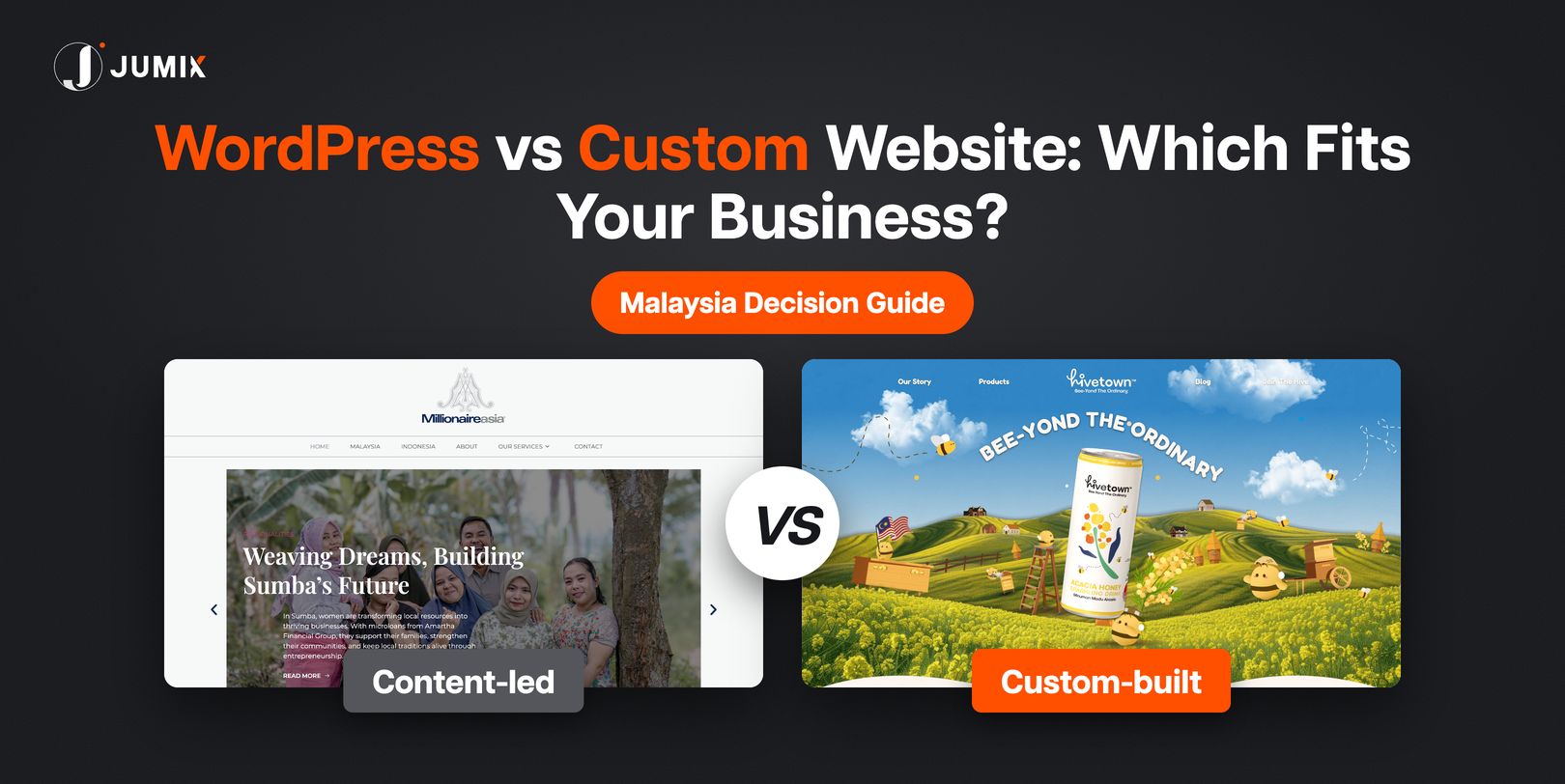
A WordPress website is built on a ready-made content system that your team can edit without code. A custom-built website is coded from scratch for your exact needs. For most Malaysian SMEs with content-heavy sites, WordPress costs 30% to 50% less and is easier to hand over. Custom code wins when you need unusual interaction design, strict performance control or functions no plugin offers.
- Quick Takeaways
- WordPress vs custom website in Malaysia: what is the difference?
- When does WordPress win for a Malaysian business?
- When does a custom-built website win?
- Which one is safer and cheaper to keep running?
- How do you decide in 5 minutes?
- FAQ
Quick Takeaways
- WordPress runs 39.6% of all websites and 58.3% of sites built on a content system (W3Techs, October 2026).
- In Jumix project pricing, a WordPress build typically costs 30% to 50% less than a fully custom-coded one in Malaysia.
- Plugins caused 91% of new WordPress vulnerabilities in 2025 (Patchstack, 2026).
- Custom code removes plugin exposure but still needs patching and ties your site to whoever wrote it.
- Choose WordPress when your team edits content often. Choose custom when the design or function has no off-the-shelf answer.
One question settles most of the WordPress vs custom website debate in Malaysia: who will touch the site after launch?
Here is how I’d work through the rest.
WordPress vs custom website in Malaysia: what is the difference?
A WordPress website starts from a finished content system. You get a login, a page editor, a media library and a plugin store on day one. A designer then shapes a theme around your brand.
A custom-built website, which people often call a “normal website,” starts from an empty folder. A developer writes every page, template and function by hand. Nothing exists that you did not ask for.
The real difference is who carries the work. WordPress carries it in free software. Custom code carries it in the developer’s hours. You can read how Jumix approaches the first option on our WordPress web design in Malaysia page.
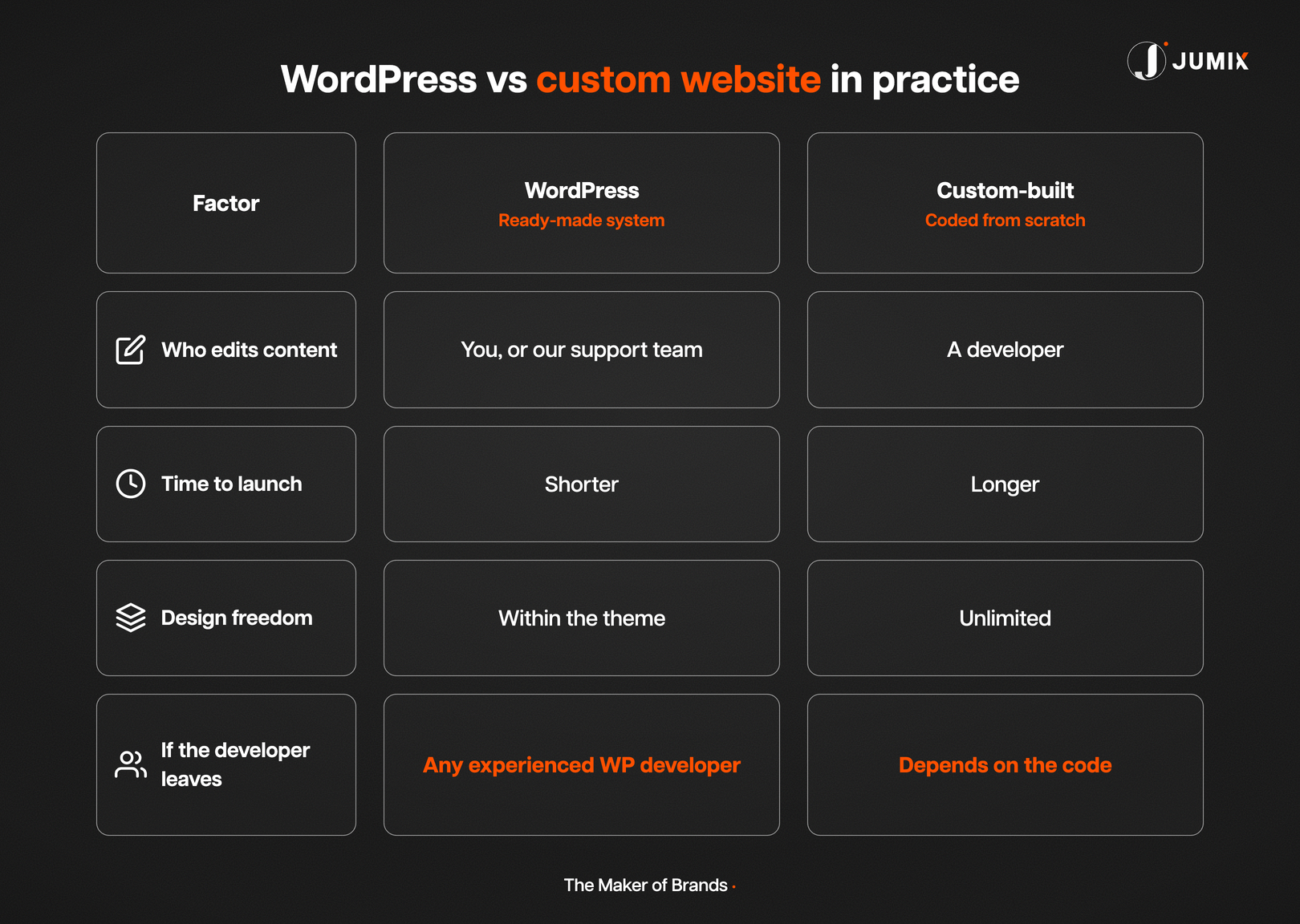
| Factor | WordPress | Custom-built |
|---|---|---|
| Typical build cost in Malaysia | Typically 30% to 50% less than custom (Jumix pricing) | RM20,000 to RM50,000+ for a fully custom design |
| Who edits content | You (if you have access), or send the content to our support team | A developer, unless a content system is added |
| Time to launch | Shorter, since the foundation exists | Longer, since everything is written new |
| Main security exposure | Plugins and themes | Your own code and its dependencies |
| Handover if the developer leaves | Any experienced WordPress developer can take over | Depends on how well the code is documented |
(Source: Jumix project pricing, see how much a website costs in Malaysia.)
One more fact belongs here. WordPress is the most used content system in the world.
It runs 39.6% of all websites and holds 58.3% of the content system market (Source: W3Techs, October 2026). Popularity means a large pool of developers who can fix your site.
When does WordPress win for a Malaysian business?

WordPress wins when the site changes often and your own staff make the changes. A new promotion, a blog post, a price update, a staff photo. Each takes minutes in a dashboard.
It also wins on budget. A clinic, a law firm or a trading company rarely needs bespoke code. They need clear pages, fast loading and a WhatsApp button that works.
Content-heavy sites are the third case. If you publish articles or product pages every week, a built-in editor and SEO plugins save real hours.
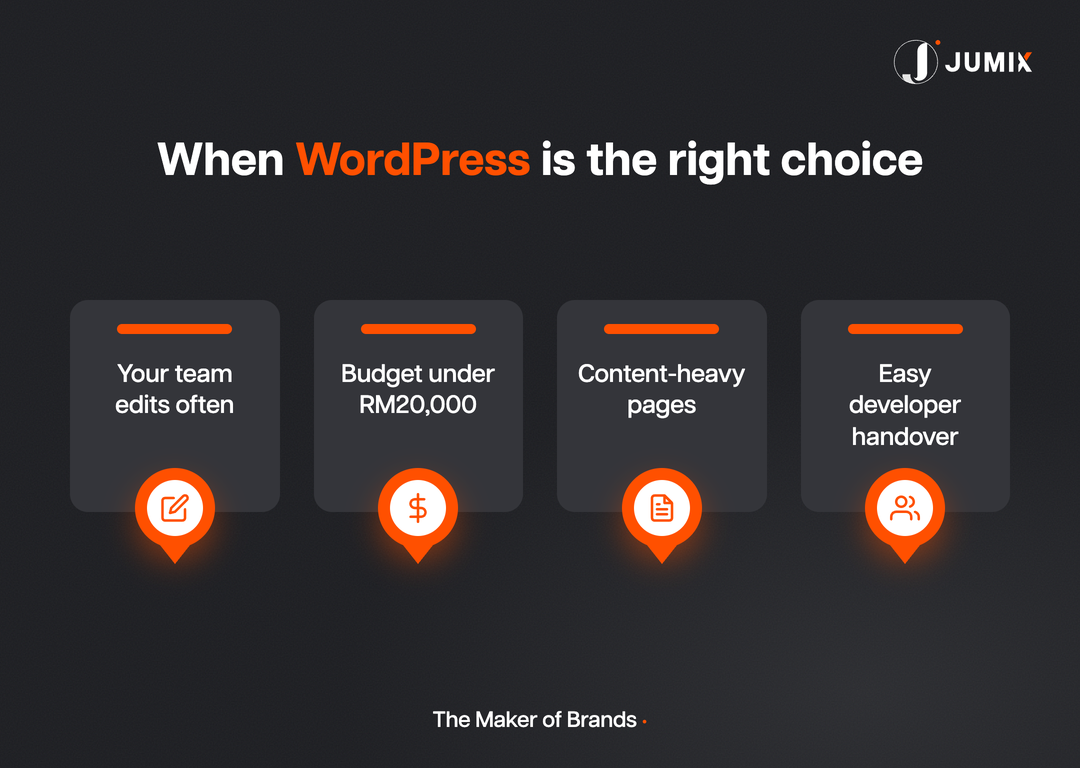
My view: if your site is mainly pages, posts and enquiry forms, paying extra for custom code is like buying a lorry to carry groceries. The extra capacity never gets used.
Consequence: for most Malaysian SMEs, WordPress is the sensible starting point.
When does a custom-built website win?
Custom code wins when the design itself is the product. Scroll-driven animation, a mascot that follows the visitor, a booking flow no plugin handles. These need a developer’s hands.
HiveTown is a good example. The honey drink brand wanted animated bee mascots and unique graphics to match its premium, playful identity. We built the site fully custom, because a stock theme could not carry that personality.
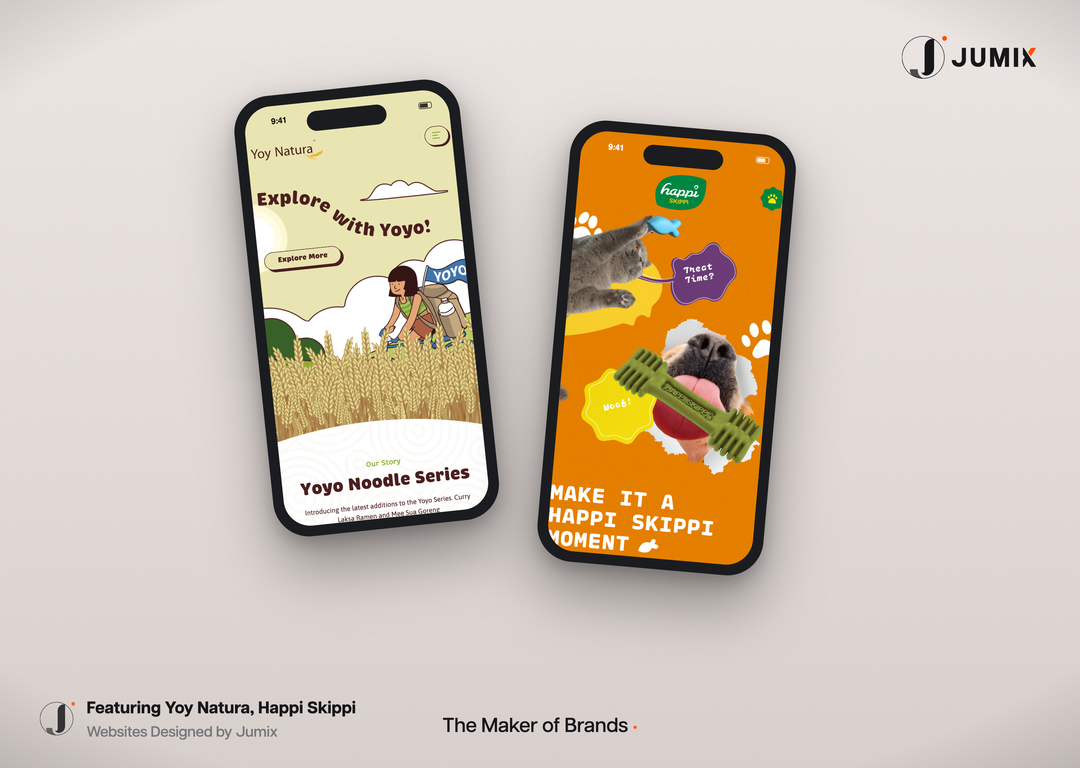
Yoy Natura needed the same level of personality. Its mascot Yoyo animates as users scroll, and draggable stickers add play. Custom illustrations replaced the usual product-heavy layout.
Custom also wins on strict performance control. You load only the code each page needs. No plugin adds scripts you never asked for.
The trade is clear. You pay more up front and depend on the builder later. Brand-led businesses often accept that trade. A plain company profile site rarely should.
Which one is safer and cheaper to keep running?
Neither is maintenance-free. They fail in different ways.
WordPress is a large target. Patchstack found 11,334 new vulnerabilities across the WordPress ecosystem in 2025, a 42% rise on 2024 (Source: Patchstack State of WordPress Security 2026).
Plugins caused 91% of them and themes caused 9%. Only 6 involved WordPress core (Source: Patchstack, 2026).
Speed matters too. The median time to first exploit was 5 hours for heavily targeted flaws (Source: Patchstack, 2026). A site that updates once a quarter is exposed for months.
Your plugin list carries the risk, since the WordPress core holds up well. Install fewer plugins and keep PHP on version 8.3 or newer, which is what WordPress recommends (Source: WordPress.org requirements).
Custom code has no plugin store, and your own code and its libraries still need patching. If nobody is paid to do it, nobody does it.
The bigger custom risk is handover. When the original developer disappears, the next one must learn the whole codebase. I wrote about that in our web designer disappeared recovery framework.
In Jumix pricing, upkeep runs 15% to 25% of the build cost each year on either path. A small SME site on WordPress typically runs RM100 to RM500 a month in care. Our website maintenance cost guide breaks that down.
Consequence: whichever you pick, put the upkeep in writing before launch.
How do you decide in 5 minutes?
Answer these 4 questions in order. Stop at the first clear yes.
- Does the design need motion or functions no plugin offers? If yes, choose a custom-built website.
- Is your budget under RM20,000? If yes, choose WordPress.
- Will your own staff edit the site every month? If yes, choose WordPress.
- Do you have someone paid to maintain code long term? If no, choose WordPress.
The two options also mix. A custom-built design can sit on a WordPress theme, so your team still gets the dashboard. A fully hand-coded site can add its own content system too. Ask your developer which version they are quoting.
Most Malaysian SMEs need a clear, fast, editable site with a WhatsApp button that works. That points to WordPress.
If you are still weighing platforms like Shopify or Wix, our best website platform guide for Malaysian businesses covers those too.
FAQ
What is the difference between a WordPress website and a normal website?
A WordPress website runs on a ready-made content system with a dashboard for editing pages. A normal, custom-coded website is written by a developer from scratch, so edits usually need a developer unless a content system is added.
Is WordPress cheaper than a custom website in Malaysia?
Yes. In Jumix project pricing, WordPress sites typically cost 30% to 50% less than fully custom-coded sites in Malaysia. Fully custom designs commonly run from RM20,000 to RM50,000 or more.
Is WordPress secure enough for a business website?
Yes, when it is maintained. WordPress core had only 6 reported vulnerabilities in 2025, while plugins caused 91% of new ones. Keeping plugins few and updated removes most of the risk.
Can I move from WordPress to a custom website later?
Yes. Content, URLs and images can be moved to a custom build. Keep the same URLs and add redirects so search rankings carry over.
Conclusion
Pick based on who edits the site and who maintains it. Then write the upkeep plan down. If you want a straight recommendation for your business, talk to Jumix about our WordPress web design service.





Comments are closed for this article!