



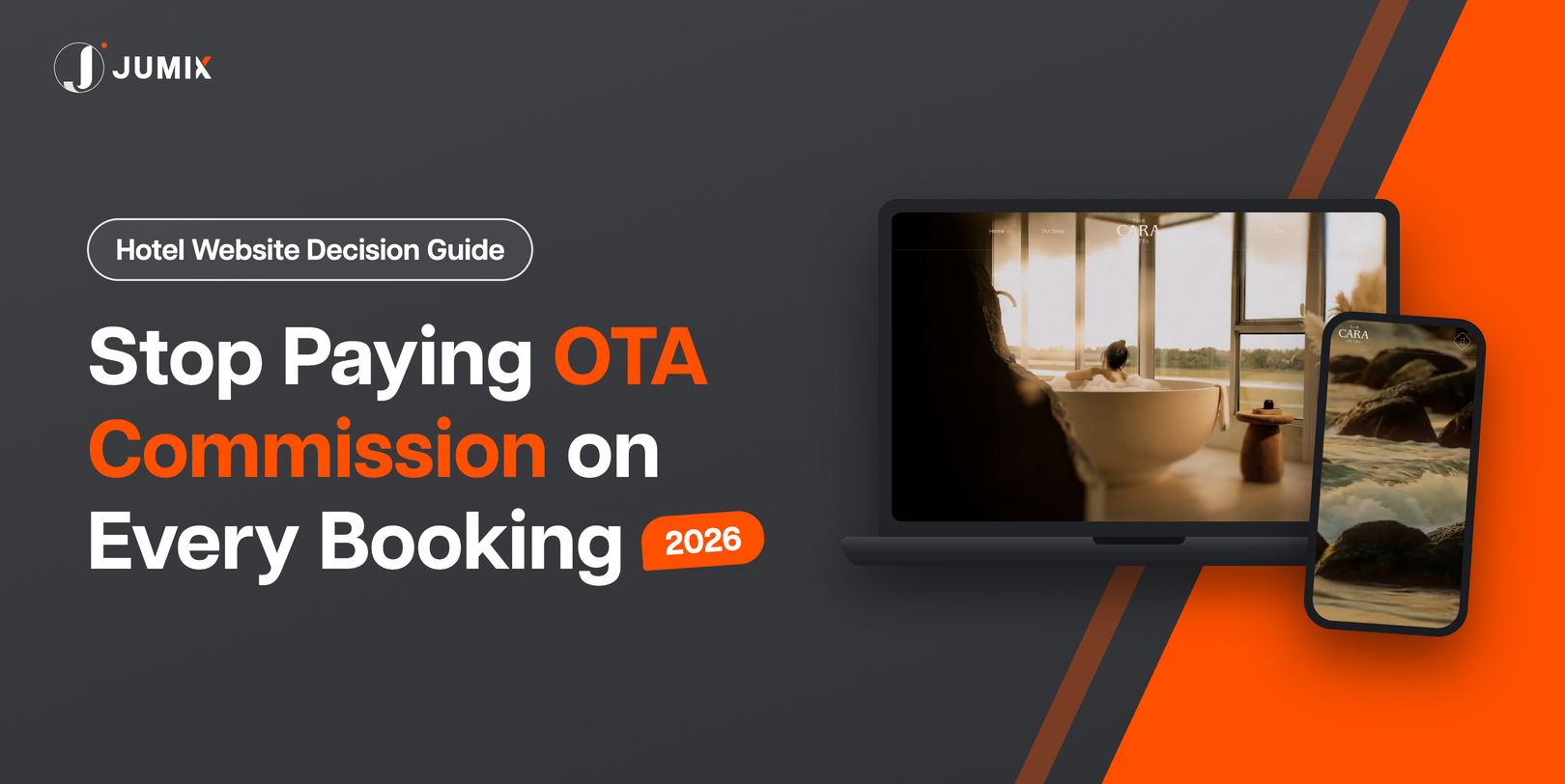
Hotel website design in Malaysia earns its cost back the moment it takes one booking an OTA would have taken a 15% to 30% cut of. The properties that win direct bookings pair real photography with a working booking engine, a mobile-first layout, and visible trust signals, so guests choose to book direct instead of through Agoda or Booking.com.
- Quick Takeaways
- What OTA Commission Really Costs a Malaysian Hotel
- Hotel Website Design Malaysia: What Converts Bookings
- Direct Booking vs OTA Listing: The Trade-off
- Common Mistakes Malaysian Hotels Make With Their Website
- What This Looks Like for Real Malaysian Properties
- FAQ
Quick Takeaways
- OTA commission runs 15% to 30% or more per booking, up from roughly 10% a decade ago (Source: Cloudbeds, 2026).
- Booking.com’s commission varies by property, with Preferred Partner Program listings paying more, and it only gets charged once the guest’s stay is finished (Source: Booking.com, How We Work, 2026).
- 18% of travelers who start their search on an OTA end up booking directly with the hotel, up 3.3 percentage points year on year (Source: SiteMinder Changing Traveller Report 2026).
- Malaysia logged 21.1 million international arrivals in the first half of 2026, up 2.5% from the same period in 2025 (Source: The Edge Malaysia, citing Motac).
- A hotel website only needs four things to compete with an OTA listing: real photos, a working booking engine, a mobile-first layout, and visible trust signals.
What OTA Commission Really Costs a Malaysian Hotel
Every OTA booking comes with a toll gate.
Booking.com and Agoda take a cut of every room night sold through them.
Commission runs 15% to 30% or more per booking, depending on the platform and how much negotiating room your property has (Source: Cloudbeds, 2026). A decade ago, the average sat closer to 10%.
Booking.com’s own documentation confirms commission varies by property, with Preferred Partner Program listings paying more. Either way, it only gets charged once the guest’s stay is finished (Source: Booking.com, How We Work, 2026).
Run the math on a RM300 room night.
At 20% commission, that’s RM60 gone before you’ve paid for electricity, laundry, or the front desk shift that checked the guest in.
A direct booking through your own site costs a payment gateway fee of roughly 2% to 3%, not 20%.
That gap is the entire business case for a hotel website.
Hotel Website Design Malaysia: What Converts Bookings
Most hotel websites fail for one reason.
They’re built like a brochure, not a booking tool.
A site that actually wins direct bookings needs four things working together. That’s what our hotel website design projects keep coming back to.
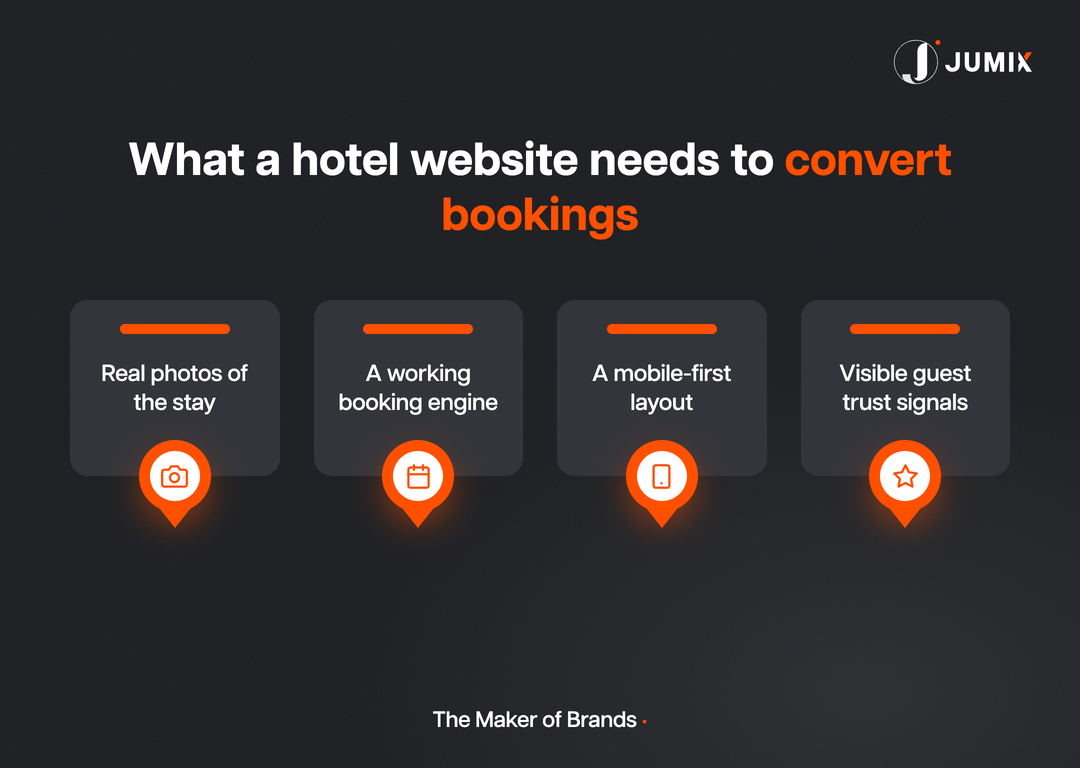
Real photos of the actual stay. Not stock images of a generic pool. Guests compare your site against OTA listings full of guest-submitted photos, so yours has to feel more real, not less.
A booking engine that works without a phone call. If checking availability means messaging the front desk on WhatsApp during office hours, you’ve already lost the guest who was ready to pay at 11pm.
A mobile-first layout. Most travel searches start on a phone, often late at night, after the day’s plans change. If a guest has to pinch and zoom to see a room rate, they’ll close the tab and open Agoda instead.
Trust signals an OTA listing can’t carry. Reviews, a real address, your own brand story. These make a stranger comfortable paying you directly instead of paying a platform they already trust.
Miss any one of these and you’re asking guests to take a risk the OTA removes for free.
We’ve seen the same pattern outside hospitality too. The same trust-building job shows up in our property website design framework. Any business asking a stranger to commit money before they’ve seen the place in person faces the same four problems.
Direct Booking vs OTA Listing: The Trade-off
Put the two side by side and the decision gets easier.
| Factor | Direct Booking (Your Website) | OTA Listing (Booking.com, Agoda) |
|---|---|---|
| Commission per booking | About 2% to 3% payment gateway fee | 15% to 30%+ commission (Source: Cloudbeds, 2026) |
| Guest contact details | Hotel keeps them | Platform keeps them |
| Rate changes | Instant, no approval needed | Bound by the platform’s rate parity rules |
| Payout timing | Set by your own payment gateway | Only charged once the guest’s stay is finished (Source: Booking.com, 2026) |
| Story and photos | Full control | Fixed listing template |
Keep the OTA listings running. Just stop treating them as your only front door.
SiteMinder’s own research backs this up. 18% of travelers who begin searching on an OTA end up booking direct with the hotel instead (Source: SiteMinder Changing Traveller Report 2026). That share grew 3.3 percentage points in the past year.
The OTA brings the guest to the door. Your website is what gets them to walk through it instead of paying someone else to open it.
Common Mistakes Malaysian Hotels Make With Their Website
Letting OTA photos become the only photos guests ever see. If your own site reuses the same five images from your Booking.com listing, there’s no reason to visit it.
Hiding the room rate behind a WhatsApp enquiry. Guests comparing prices at midnight won’t wait for office hours to open. They’ll book the platform that shows a number.
Treating the website as a static brochure. A page that doesn’t link to a booking engine or a Google Business Profile is a dead end, not a funnel.
Ignoring load speed on mobile. A slow site loses guests before they ever see a room photo, let alone a rate.
Each of these mistakes quietly pushes a guest who was ready to book direct back toward the OTA that charges you for the privilege.
What This Looks Like for Real Malaysian Properties
I’ve watched this play out with actual Jumix hotel clients.
Brickhouse Bukit Tinggi relied entirely on Airbnb and Agoda before we built their site. Guests only ever saw the villa as a listing, never as a brand with its own story.
Once the website launched, enquiries got more intentional. Guests arrived already understanding the villa and event space, not just the price per night.
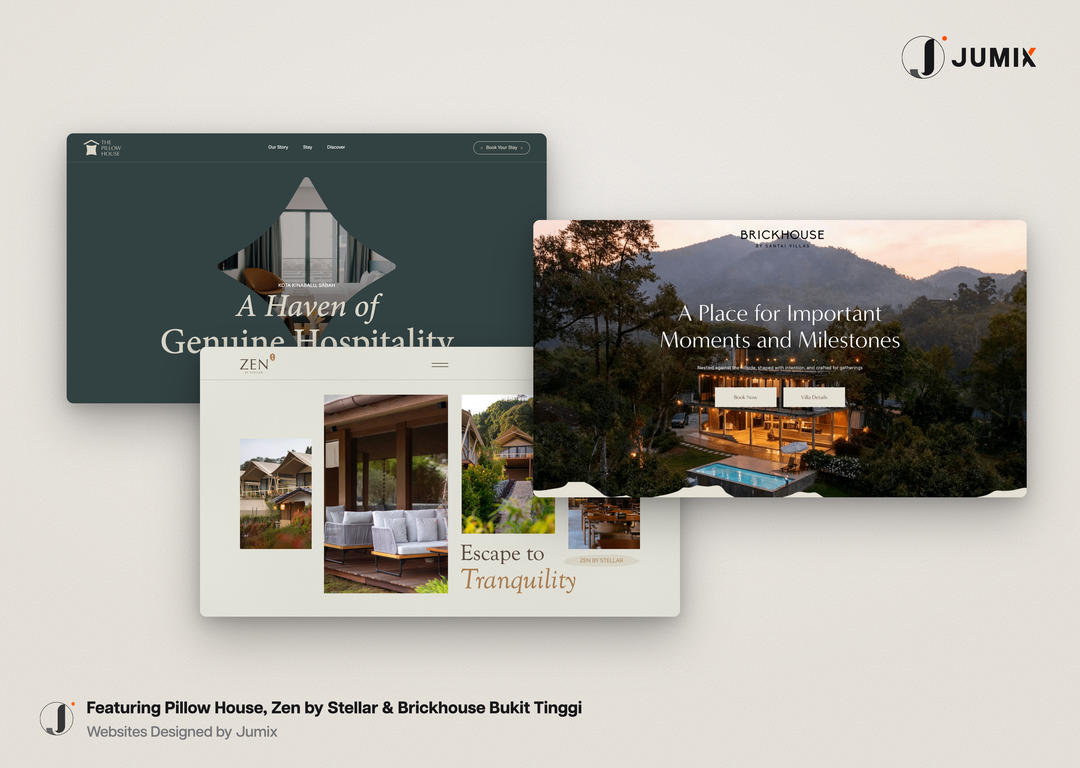
Zen by Stellar faced a different problem. A luxury glamping resort in Cameron Highlands can’t sell Onsen bathing and highland serenity through a generic OTA template. The website had to make guests feel the retreat before they booked it.
Same story at The Cara Hotel in Sabah. Their Wabi Sabi philosophy needed a site that felt slow and intentional, not a booking widget bolted onto a stock template.
And at The Pillow House in Kota Kinabalu, the lesson was simpler. For a boutique hotel, the website is the lobby. If it looks cheap, guests assume the rooms will too.
These properties kept their OTA listings running. They stopped depending on them to tell their story.
FAQ
Does a hotel in Malaysia still need its own website if it’s already listed on Booking.com and Agoda?
Yes. OTA listings bring visibility, but commission runs 15% to 30% or more per booking (Source: Cloudbeds, 2026). A website lets the same guest book direct at a fraction of that cost. It also lets the hotel keep the guest’s contact details for the next stay.
How much does a hotel website cost in Malaysia?
A custom hotel website with a working booking engine typically runs RM8,000 to RM20,000 in Malaysia. Photography needs, the number of room types, and whether the booking engine connects to a channel manager all move the price. If you already have a site and it’s the problem, our website redesign cost guide breaks down what a rebuild runs instead.
What should a hotel website include besides a “Book Now” button?
Real photos of the actual rooms and grounds, a mobile-first layout, visible guest reviews, and clear information on amenities and location. A booking button with nothing backing it up just sends guests back to Google to compare you against the OTA listing.
Will building a website hurt bookings coming through Booking.com or Agoda?
No. SiteMinder’s Changing Traveller Report 2026 found that 18% of travelers who start searching on an OTA end up booking directly with the hotel (Source: SiteMinder, 2026).
The OTA brings awareness. The website converts that awareness into a cheaper booking.
How long does it take to build a hotel website in Malaysia?
A custom hotel website with a booking engine typically takes 3 to 6 weeks. The exact timeline depends on how much original photography and copywriting the property needs.
The bottom line
OTA listings bring guests who’ve never heard of your property to your door.
The problem is paying a 20% toll on every single one of those guests, forever. Your own website doesn’t give them a reason to book direct.
Fix the four things that actually matter: real photos, a working booking engine, a mobile-first layout, and visible trust. Guests who find you on an OTA will still check your own site before they pay. Give them a reason to finish there instead.
Jumix’s hotel website design team builds that into the site from day one. Every booking an OTA sends your way becomes a chance to win the next one direct.




Comments are closed for this article!