



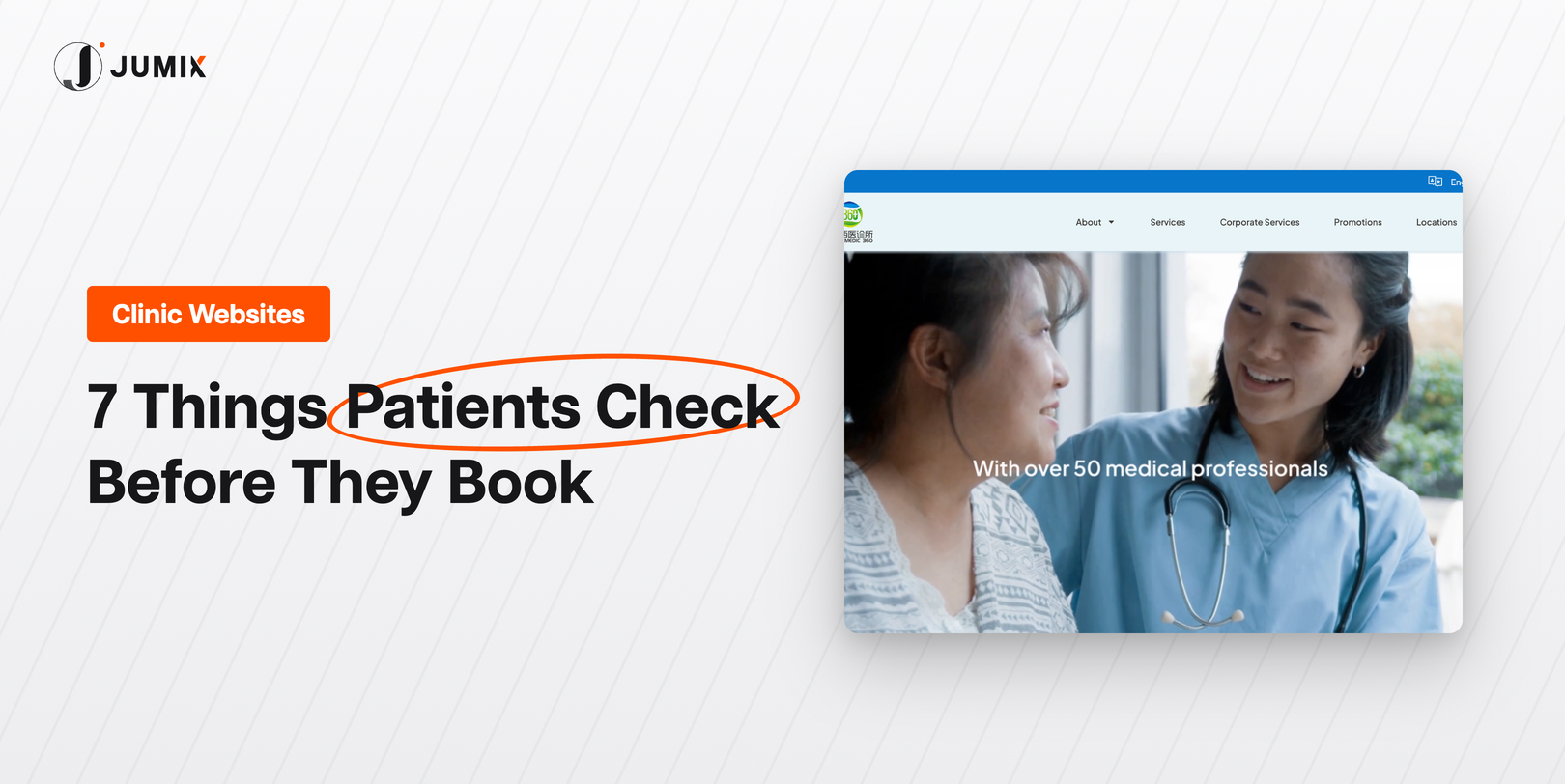
Malaysian patients check seven things before booking through a clinic website: the doctor’s MMC registration, a stated price, real reviews, a working WhatsApp line, mobile usability, plain-language service names, and a booking flow that skips the phone call. Miss two or three of these and the patient closes the tab before your number ever rings.
- Quick Takeaways
- Clinic Website Design in Malaysia: What Patients Check First
- What Your Clinic Website Can (and Can’t) Say
- Why WhatsApp Beats a Contact Form
- Why Showing the Price Works
- Common Mistakes Clinic Websites Make
- FAQ
Quick Takeaways
- Patients check for the doctor’s MMC registration number and qualifications before they trust anything else on a clinic website.
- Visible reviews or a Google rating badge answer the trust question a patient is already checking in another tab.
- WhatsApp Messenger ranks as Malaysia’s top communication app, ahead of Messenger and Telegram (Source: SimilarWeb).
- 98.0% of Malaysians are online, and most of that browsing happens on a phone, not a desktop (Source: DataReportal, Digital 2026: Malaysia).
- Showing an exact price on the homepage removes the single biggest hesitation before a Malaysian patient books.
A patient finds your clinic through Google or an Instagram ad. They open the site on a phone, in a waiting room somewhere else, or in bed at 11pm.
They’re checking if you’re real, if you’re licensed, and if they can book without picking up the phone.
Good clinic website design in Malaysia starts with what patients actually check before they commit. I’ve watched this pattern repeat across every clinic site my team has built, from a single dentist to an 11-branch GP group.
Clinic Website Design in Malaysia: What Patients Check First

Malaysian patients move through a clinic website in under a minute before deciding to book, leave, or check a competitor instead. Here’s what they’re actually scanning for, in order.
1. The doctor’s MMC registration number, on the page. Every registered medical practitioner in Malaysia carries a Malaysian Medical Council registration number. Patients who’ve read about unlicensed “aesthetic” providers now check for it before anything else on the page.
No number, no trust. That patient is gone before the page finishes loading.
2. Real clinic photos, not stock images. Stock photos of a smiling model in a white coat read as a warning sign now, not reassurance. Patients want the actual waiting room, the actual doctor, the actual equipment, the same way a well-built aesthetic clinic website earns trust before a single treatment is booked.
A slightly imperfect real photo beats a polished stock one every time.
3. A price, stated somewhere on the page. Malaysian patients research cost before they research doctors, especially for elective or non-emergency visits. A page with no numbers reads as “call to find out,” and most people won’t call.
Clinics that publish a real price convert visitors who would otherwise bounce off to compare elsewhere.
4. Reviews or ratings, visible without a click. Patients checking a clinic almost always have a reviews tab open somewhere. A Google rating badge or a handful of real testimonials answers a question the patient is already asking in another browser tab.
If your site doesn’t show reviews, they’ll go find them anyway. Just not on your site, and not with you in control of the story.
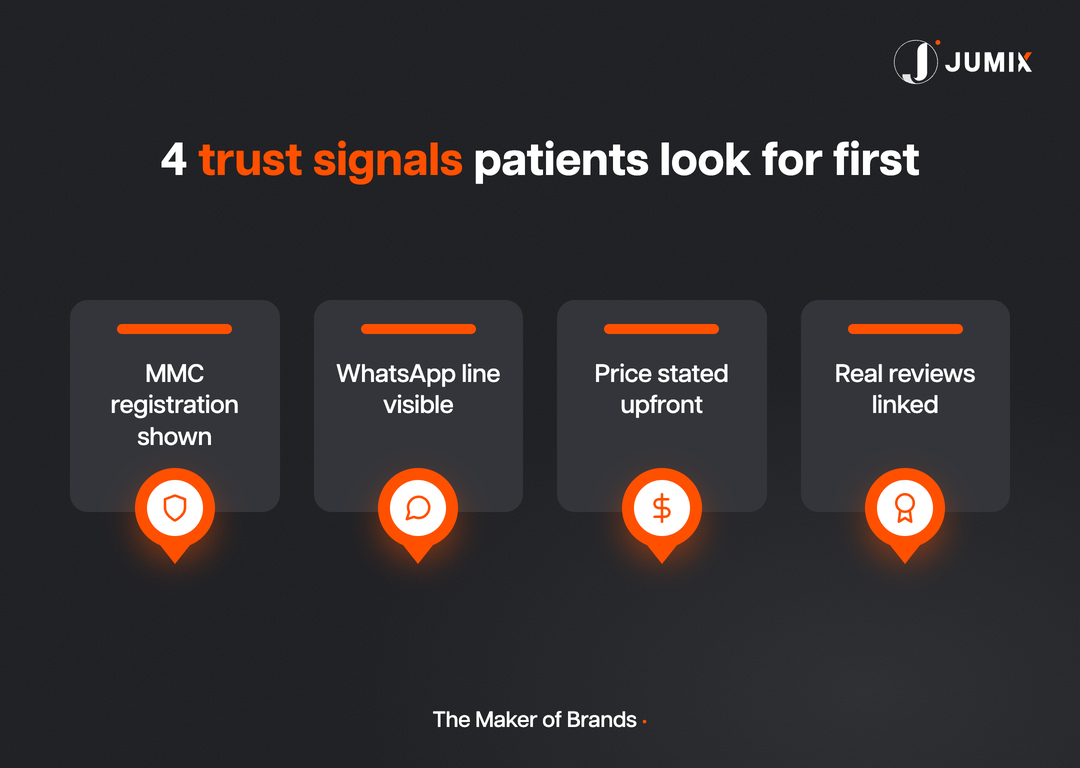
5. A WhatsApp number, not just a contact form. WhatsApp Messenger ranks as Malaysia’s top communication app (Source: SimilarWeb). A contact form promising a reply “within 24 hours” loses to a green icon that answers in minutes.
A quick question deserves a quick answer from a person, not a ticket number in a queue.
6. A site that actually works on a phone. 98.0% of Malaysians are online, and most of that time happens on mobile, not desktop (Source: DataReportal, Digital 2026: Malaysia). A clinic site that needs pinching and zooming loses patients before they reach the booking button.
Test your own site on your own phone, on weak reception, before you trust it. The basics of mobile-first web design apply just as much to a clinic as to any other Malaysian business.
7. Booking that’s actually possible without a phone call. Some clinics still route every enquiry through a phone line during office hours only. Patients browsing at midnight or during a meeting won’t call back later. They’ll book wherever they can act immediately.
A visible WhatsApp line, or a form patients can fill out at 2am, closes bookings a phone-only clinic misses entirely.
What Your Clinic Website Can (and Can’t) Say
Malaysia regulates doctor marketing more tightly than most industries. Under the MMC Code of Professional Conduct, a registered practitioner must not advertise with the intention of soliciting patients, and self-promotion counts as misconduct even when the claim is true, such as calling yourself the “most experienced” (Source: RDS Law Partners, on the MMC Code of Professional Conduct). That single rule shapes what a compliant clinic website actually looks like.
Clinics as a whole carry a parallel set of rules on top of what individual doctors must follow, covering how a facility, not just a practitioner, may present itself online.
| What you can show | What crosses the line |
|---|---|
| Factual descriptions of services and procedures | Claims like “best,” “guaranteed results,” or “pain-free” |
| Doctor’s qualifications, MMC number, and experience | Before-and-after photos used as promotional bait |
| Clinic hours, location, and contact details | Patient testimonials written to solicit new business |
| General health education content | Discounts, promotions, or “limited time” pricing language |
Read this as the format for clinic marketing in Malaysia, not a workaround to route past. A clean, factual page outperforms a sales pitch here anyway. Patients read restraint as credibility, not as a clinic with nothing exciting to say.
Why WhatsApp Beats a Contact Form
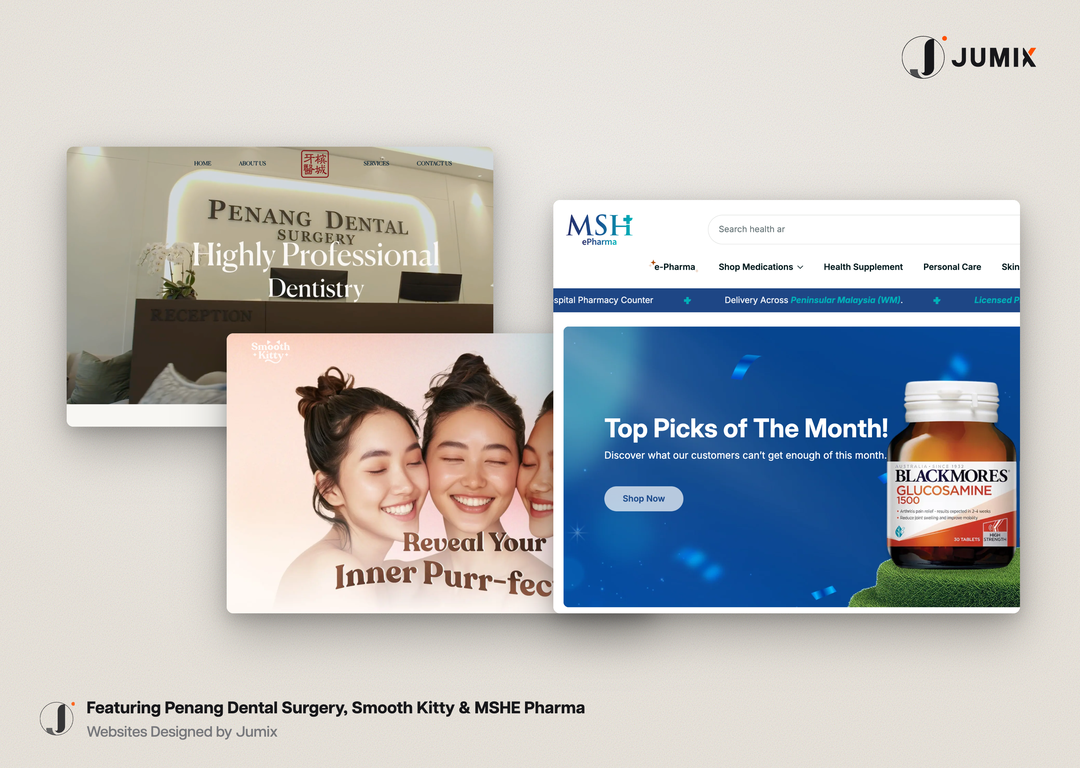
When we built Penang Dental Surgery‘s website, we gave their WhatsApp number its own line, separate from the main clinic number.
Dental anxiety is real. Patients researching braces or a root canal are often nervous, sometimes embarrassed about their oral health, and hesitant to commit to a formal phone call.
WhatsApp let them ask a small question first, on their own terms, before booking anything. For a 40-year-old practice built on quiet reputation, that one change did more for enquiry volume than a redesign of the homepage ever could.
If it were my money, I’d rather pay for a WhatsApp Business number than a receptionist spending half the day on confirmation calls. One scales. The other doesn’t.
Why Showing the Price Works

Take Klinik Medic 360. They run 11 branches across KL and Selangor. Their homepage leads with a real screening price, RM40, shown with the original price crossed out next to it.
That single number does more conversion work than any headline could. It answers a patient’s first question before they even scroll.
Patients who can’t estimate cost within 15 seconds tend to leave the page. They don’t email to ask. They just move on to the next result.
Not every procedure has a fixed price, and that’s fine. A starting price or a clear range still beats silence. Silence is what sends patients to a competitor who at least gave them a number to work with.
Common Mistakes Clinic Websites Make
Most of these come from the clinic’s own internal language, not from bad intentions, and they show up across specialties, from GP clinics to beauty and aesthetics practices.
- Burying the WhatsApp number in a footer instead of the header, where patients look first.
- Writing service names in clinical terms patients don’t search for, like “rhytidectomy” instead of “facelift.”
- Publishing before-and-after photos as marketing, which the MMC treats as advertising, not education.
- Skipping mobile testing, so the booking button sits off-screen on a real phone.
- Hiding pricing entirely, forcing every enquiry through a phone call the patient never makes.
Each one is a small fix. Together, they’re the difference between a site that books patients and one that just displays a phone number nobody dials.
FAQ
Can a Malaysian clinic advertise on Google or Facebook ads?
Doctors and clinics face tighter restrictions than most businesses. The MMC Code of Professional Conduct bars advertising intended to solicit patients, so paid ads promoting a named doctor or promising results carry real risk. Factual, educational content is safer ground.
Do patients really check for MMC registration numbers?
Patients increasingly check credentials before booking, especially after news coverage of unlicensed aesthetic providers. Showing the MMC number and qualifications upfront removes that doubt before it forms.
Should a clinic website show exact prices?
Yes, for standard procedures and packages. Patients researching cost before booking leave sites with no numbers at all. Complex or highly variable treatments can show a starting price or a range instead of an exact figure.
Is WhatsApp better than an online booking form for a clinic?
For most Malaysian clinics, yes. WhatsApp handles the majority of instant messaging in the country, and patients expect a real-time reply. A booking form still works for structured appointment slots, but a WhatsApp line should sit next to it, not replace it.
How fast should a clinic website load on mobile?
Most patients browse on a phone, often on mobile data rather than office wifi. A site that takes more than a few seconds to load loses patients before they ever see the MMC number, the price, or anything else on the checklist.
The Bottom Line
Patients decide whether to book your clinic before they ever speak to your front desk.
They’re scanning for an MMC number, a WhatsApp line, a stated price, and proof that real people got treated here before them.
Miss enough of these and the tab closes. Get them right and the booking happens without a single phone call.
We’ve built this checklist into clinic sites for groups running 11 branches and for single-doctor practices, and the pattern holds either way: transparency converts, vague marketing doesn’t.
If your clinic website still routes every question through a phone call, that’s the first thing I’d fix. Jumix builds web design for Malaysian clinics around exactly this checklist, from the MMC number in the header to the WhatsApp line that actually gets answered.




Comments are closed for this article!