




Most Malaysian online stores need 3 payment methods, not 1: FPX or DuitNow for bank transfers, a card processor for Visa/Mastercard, and DuitNow QR or Touch ‘n Go eWallet for e-wallet buyers. Billplz and HitPay offer the lowest local FPX rates (around RM0.75-RM1.50 flat or roughly 1.8% + RM0.40), while Stripe charges 3% + RM1.00 and suits stores that also take international cards.
- Quick Takeaways
- What Payment Methods Malaysian Shoppers Actually Use
- FPX vs DuitNow: What’s the Difference
- Gateway Comparison: Fees, Setup Costs, and Settlement
- E-Wallets: Do You Need Touch ‘n Go, GrabPay, and Boost All 3
- Hidden Costs to Check Before You Sign
- Which Gateway Fits Which Type of Store
- Mistakes to Avoid When Choosing a Gateway
- FAQ
Quick Takeaways
- FPX moves money straight from a Malaysian bank account and typically costs less than a card transaction.
- DuitNow QR lets one code accept dozens of e-wallets and banking apps, cutting the number of buttons on your checkout page.
- SenangPay and Fiuu post the cheapest local FPX rates; Stripe costs more but adds international card support.
- Touch ‘n Go eWallet alone covers most Malaysian e-wallet shoppers; GrabPay and Boost are additions, not replacements.
- Setup fees and annual maintenance charges (common with iPay88/ADAPTIS) can outweigh a slightly better per-transaction rate for a small store.
Every new online store owner asks me the same question during onboarding: “Which payment gateway should I use?” And every time, the honest answer is that it’s not really one gateway. It’s a stack.
Miss one piece of that stack and you don’t get an error message. You get a shopper who reaches checkout, doesn’t see a way to pay that they trust, and closes the tab. Here’s how the pieces actually fit together, and what they cost.
What payment methods Malaysian shoppers actually use
A Malaysian checkout page that only accepts credit cards is turning away a large share of its own traffic. Online banking transfers (FPX), e-wallets, and DuitNow QR now sit alongside cards as default expectations, not extras.

Touch ‘n Go eWallet alone has more than 23 million verified users in Malaysia (Source: money.com.my), and it’s accepted at roughly 1.6 million merchant touchpoints. GrabPay’s footprint outside the Grab app itself sits closer to 200,000 merchants via DuitNow QR (Source: money.com.my). The minimum viable set for a 2026 checkout page is FPX, DuitNow QR, Touch ‘n Go eWallet, and a card option; a store missing any of those 4 is quietly losing conversions.
FPX vs DuitNow: what’s the difference
Both move money directly from a buyer’s bank account, and both skip the card networks entirely, which is why they’re cheaper than card processing. The difference is in the experience and the reach.
- FPX redirects the buyer to their online banking login, confirms the transfer, then bounces them back to your store. It’s the older, more established rail and every major Malaysian bank supports it.
- DuitNow QR works off a single scannable code that accepts dozens of banking apps and e-wallets at once, cutting the number of separate payment buttons your checkout page needs to display (Source: PayNet, paynet.my).
Neither replaces the other. Most gateways bundle both, and most stores should offer both, since a buyer who prefers scanning a QR code with their banking app is a different shopper from one who wants the familiar bank-login redirect.
Gateway comparison: fees, setup costs, and settlement
Rates change, so verify current pricing directly with each provider before signing. What doesn’t change as fast is the shape of the trade-off: local processors are cheaper per transaction, global processors add reach and multi-currency support.
| Gateway | FPX / bank transfer rate | Card rate | Setup / annual fee | Best for |
|---|---|---|---|---|
| SenangPay | RM1 or 1.5%, whichever is higher | Available via partners | From RM199 | High-volume FPX, local-only stores |
| Fiuu | Approx. RM0.80 | Approx. 1.6%-2.0% | From RM500 | New stores wanting one dashboard for FPX, cards, and e-wallets |
| Stripe | 3% + RM1.00 | 3% + RM1.00 | None | Stores also billing international cards |
| iPay88 / ADAPTIS | Varies by plan | Approx. 1.8%-2.4% | From RM499 | Larger stores negotiating a custom enterprise rate |
(Sources: Senangpay, senangpay.com; Stripe, stripe.com; Fiuu (special rate via Jumix), fiuu.com; ADAPTIS (special rate via Jumix), nttdatapay.com)
My suggestion is that most stores under RM50,000 a month in revenue should start with a local processor like Fiuu or Billplz and only look at Stripe once international cards actually show up in the order log, not before.
E-wallets: do you need Touch ‘n Go, GrabPay, and Boost all 3
Not all 3. Malaysia is effectively a 2-wallet country for most online stores: Touch ‘n Go eWallet as the default everyone already has installed, plus DuitNow QR to catch everything else in a single code.
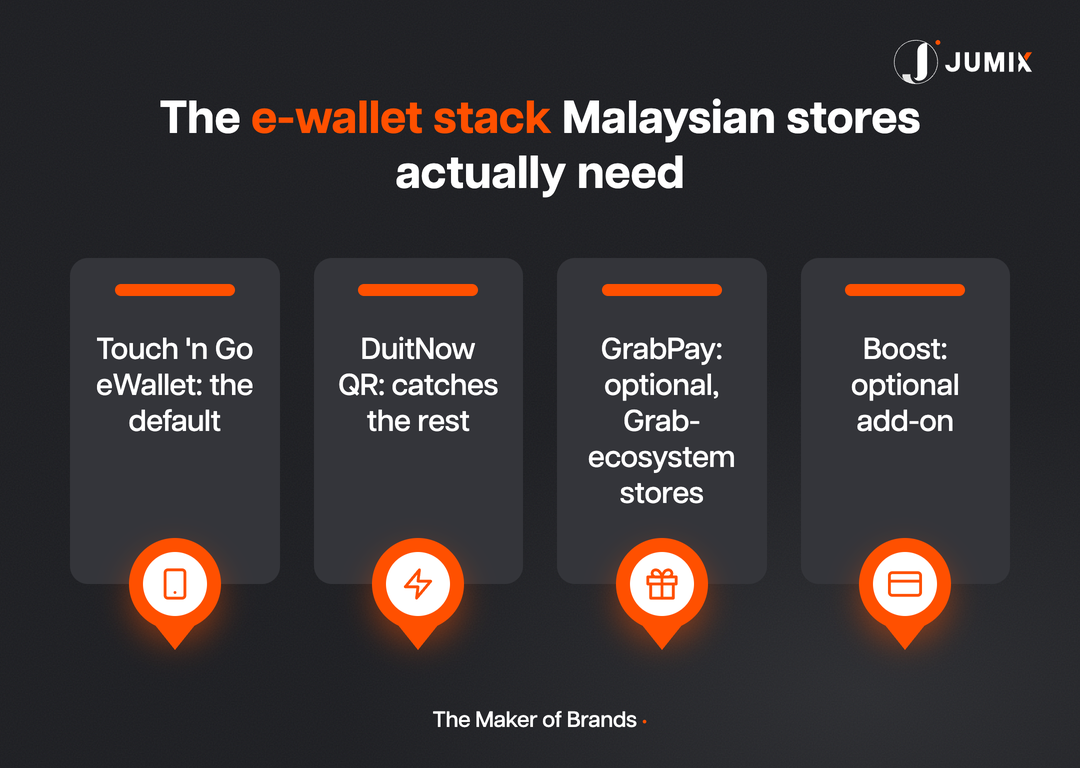
GrabPay and Boost both ride on DuitNow QR once you’ve set that up, so adding them as separate, standalone buttons rarely earns their keep. The exception is a store already living inside the Grab ecosystem (GrabFood, GrabMart listings), where a dedicated GrabPay button can reduce friction for shoppers who arrive with Grab credit already loaded.
Hidden costs to check before you sign

- Setup and annual fees. A gateway with a lower headline rate but a RM500+ setup fee can cost more in year one than a slightly pricier processor with none.
- Settlement speed. Next-business-day payouts keep cash flow moving; some providers settle weekly, which strains a small store’s working capital.
- Refund and chargeback fees. Ask this directly. Some processors charge a flat fee per refund on top of returning the customer’s money.
- Currency conversion. If you plan to sell beyond Malaysia, check the FX margin, not just the headline processing rate.
- Minimum monthly volume. A few enterprise-tier gateways quietly require a minimum transaction volume to keep the negotiated rate.
Ask for the full fee schedule in writing before you integrate anything. A sales call quote and the actual contract terms don’t always match.
Which gateway fits which type of store
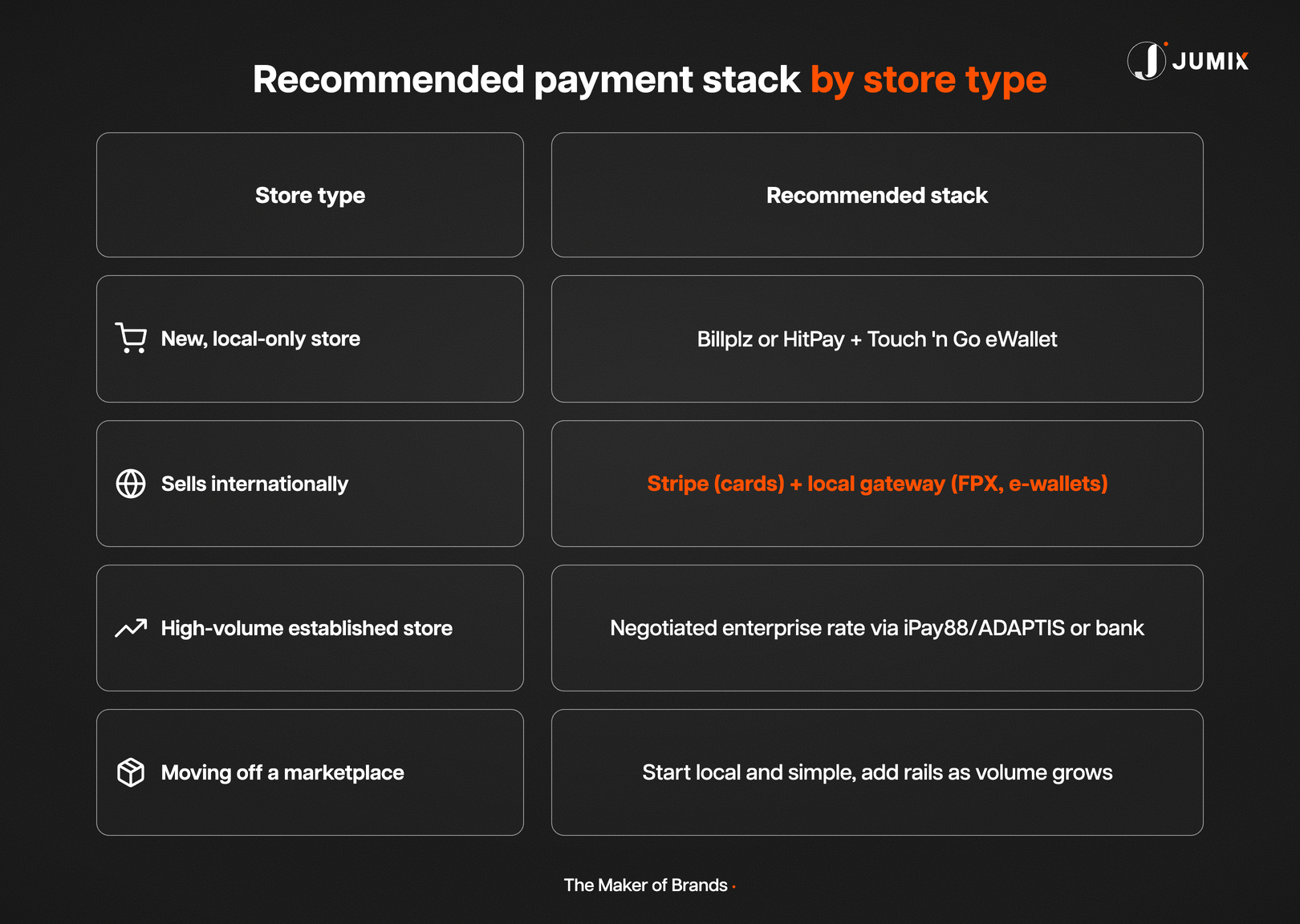
- New store, local buyers only. Billplz or HitPay for FPX and DuitNow QR, plus Touch ‘n Go eWallet. Low or no setup cost, fast enough to launch this week.
- Store selling internationally. Stripe or a similar global processor for card payments, layered with a local gateway for domestic FPX and e-wallet traffic. Running both isn’t unusual.
- High-volume established store. Worth a direct conversation with iPay88/ADAPTIS or a bank’s merchant services team about a negotiated rate; the annual fee stops mattering once volume is high enough.
- Marketplace seller moving to your own store. Start local and simple. You’re not replacing Shopee’s built-in payments with a complex multi-processor setup on day one.
Mistakes to avoid when choosing a gateway
- Picking a gateway before checking what your platform actually supports. Shopify, WooCommerce, and custom builds each have different native integrations; confirm compatibility first.
- Comparing only the headline percentage rate. Setup fees, refund fees, and settlement speed change the real cost more than the percentage alone.
- Offering cards only. A large share of Malaysian online shoppers will abandon checkout if FPX or an e-wallet option isn’t visible.
- Never testing the actual checkout flow. Run a real RM1 transaction yourself before launch. Broken redirects lose sales silently.
- Ignoring the payout schedule. A cheaper gateway that settles weekly can hurt a small store’s cash flow more than a slightly higher rate with next-day payouts.
If it were my money, I’d rather pay an extra 0.5% on a gateway that settles next-day than save that 0.5% and wait a week for cash I already earned.
FAQ
What’s the cheapest payment gateway for a small online store in Malaysia?
SenangPay Starter plan has very low setup or annual fee and a flat FPX rate on its Starter tier, making it one of the lowest-cost entry points for a store focused on local bank-transfer payments.
Do I need both FPX and DuitNow QR?
Yes. They serve different buyer habits: FPX suits shoppers comfortable with a bank-login redirect, while DuitNow QR suits shoppers who prefer scanning a code with their banking or e-wallet app. Most gateways bundle both.
Is Stripe worth it for a Malaysian store that only sells locally?
Usually not as the only gateway. Stripe’s 3% + RM1.00 FPX rate runs higher than local processors like SenangPay or Fiuu. It becomes worth adding once international card payments are a real part of your order volume.
Can I use more than one payment gateway on the same store?
Yes, and many established Malaysian stores do, running a local gateway for FPX and e-wallets alongside a global processor for international cards. Most ecommerce platforms support multiple active gateways at once.
How long does it take to set up a payment gateway for a new online store?
Local gateways like SenangPay or Fiuu can typically be verified and live within a few business days for a straightforward business. Enterprise processors requiring custom underwriting can take several weeks.
Conclusion
A payment gateway decision isn’t really about picking a winner. It’s about building a stack: FPX or DuitNow for bank transfers, Touch ‘n Go eWallet and DuitNow QR for e-wallet shoppers, and a card processor sized to how much of your business is actually local.
Get the fee schedule in writing, test the real checkout flow before launch, and revisit the setup once your order volume changes. If you’d rather have someone map the right stack to your specific store instead of guessing from a comparison table, Jumix’s eCommerce solution team builds this into every store we launch.
Related reading: Ecommerce Website Malaysia Guide 2026: Payment Gateways, Design Trends and Must-Have Features, How Malaysian Businesses Are Moving From Shopee to Their Own Online Store, How Much Does a Shopify Website Cost in Malaysia, and Malaysia Ecommerce Company Guide 2026.






Comments are closed for this article!