



Property website design in Malaysia works when the site does what a PropertyGuru or iProperty listing can’t: prove credibility, capture the enquiry before a competing agent does, and hold buyer data you actually own. The framework below covers what agents, developers and property lawyers each need, in what order, and why a portal profile alone leaves leads on the table.
- Quick Takeaways
- What Buyers Check Before Contacting an Agent
- The Portal Dependency Problem
- The Agent vs Developer Website Framework
- Listing Pages That Convert
- Property Website Design Malaysia Checklist
- Common Mistakes
- FAQ
Quick Takeaways
- Malaysia’s residential overhang hit 32,801 unsold completed units worth RM16.37 billion in Q1 2026, up 7.6% from the previous quarter (Source: NAPIC).
- Agent fees in Malaysia are capped at 3% of the transacted price with a RM1,000 minimum, so a portal-only agent competes with every other agent renting the same listing at a similar rate (Source: Valuers, Appraisers and Estate Agents Rules 1986).
- From June 2026, PropertyGuru added a unified workflow so agents post one listing across both PropertyGuru and iProperty at once, meaning both platforms now draw from the same enquiry pool (Source: PropertyGuru Agent News).
- An agent website and a developer website solve different problems. Building both the same way wastes budget on one side.
- The highest-converting property websites put an enquiry path within one screen of every listing, not buried in a contact page.
What Buyers Check Before Contacting an Agent

Buyers call an agent to confirm a search they’ve already done.
By the time someone reaches out, they’ve already checked the price against their loan repayment.
They’ve looked at the location on a map. They’ve searched the agent’s name.
If your only online presence is a portal profile shared with 40 other listings, that search turns up nothing.
A dedicated website answers three questions before the enquiry form loads.
- Can I afford this? Price, loan estimate range, and any current promotion, stated plainly.
- Is this the right area? Nearby schools, transit, and amenities, not just a Google Maps pin.
- Can I trust this agent or developer? Recent transactions, credentials, and real photos of completed units.
Miss any one of these and the buyer goes back to the portal to find someone who answered it.
The same principle drives most of our lead generation work across industries: answer the objection before it’s asked, and the enquiry becomes a formality.
The Portal Dependency Problem
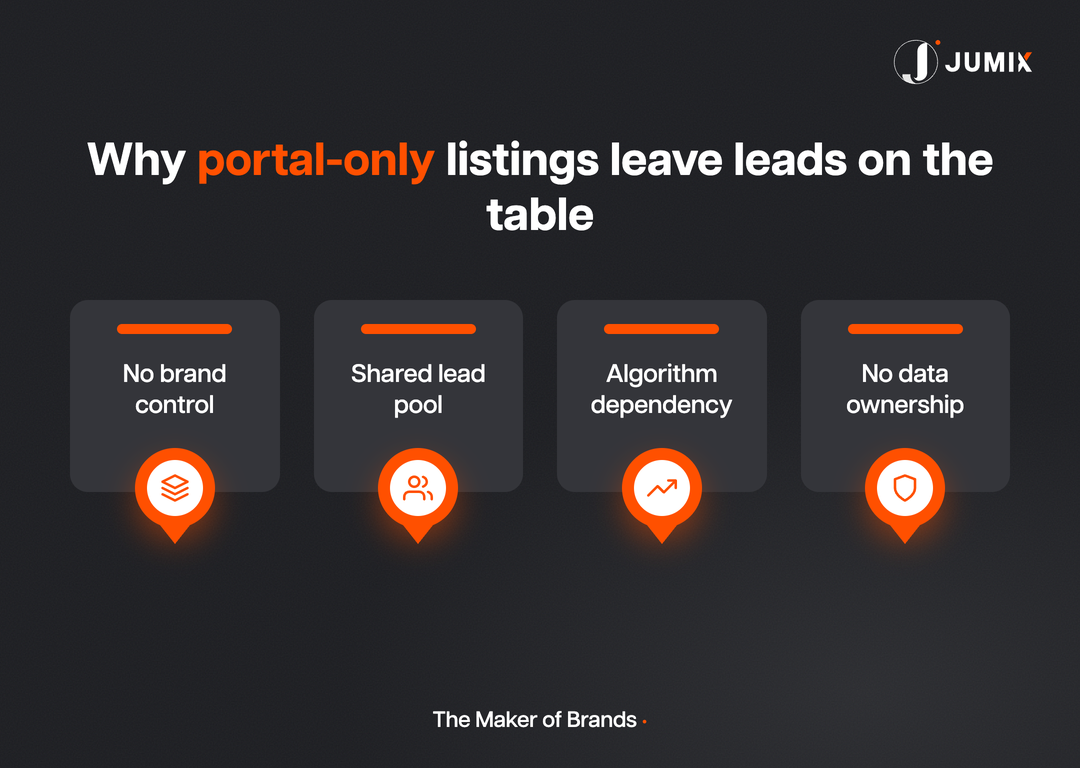
PropertyGuru and iProperty aren’t optional. Most buyers still start there.
The problem is what happens after the click.
A portal listing puts your unit next to a competitor’s near-identical unit, priced lower, on the same page.
The buyer compares. The portal wins either way. You might not.
From June 2026, PropertyGuru rolled out a unified posting workflow: list once, publish across both PropertyGuru and iProperty. (Source: PropertyGuru Agent News) They’re still two platforms, drawing from the same enquiry pool, on the portal’s terms.
That’s more reach for the portal, shared across every agent on it.
Every enquiry still lands inside the portal’s system first, on the portal’s terms.
The residential overhang data makes this sharper. Unsold completed units reached 32,801 in Q1 2026, worth RM16.37 billion. (Source: NAPIC)
More unsold stock means more listings fighting for the same buyer attention on the same portal page.
A website you own is the one channel where you set the comparison, not the portal’s search results page.
The Agent vs Developer Website Framework
An individual agent and a property developer are not building the same website.
Treat them the same and you either under-build the developer site or over-build the agent’s.
| Priority | Agent Website | Developer Website |
|---|---|---|
| Primary goal | Personal credibility and repeat enquiries | Unit sales for one or a few active projects |
| Content focus | Track record, testimonials, listings across multiple properties | Floor plans, launch pricing, project timeline |
| Urgency signal | Recent closed deals, response time | Booking fee deadlines, unit availability count |
| Typical page count | 6 to 10 pages | 4 to 6 pages, one per active project |
| Lead form | General enquiry plus WhatsApp | Unit-specific enquiry with loan calculator |
An agent site needs to work for years across many listings. A developer site needs to sell out one project, then get retired or replaced.
Build the agent site for longevity. Build the developer site for speed.
Aaron Lee, a real estate lawyer in Penang, faced a version of this problem in legal services. His challenge wasn’t visibility, it was lead quality.
We built a landing page with a qualification form that captured case details before the first call. Unqualified enquiries dropped, and consultation time went to buyers who were actually ready to act.
The same logic applies to property listings. A form that asks budget range and preferred move-in timeline filters a browser from a buyer before you ever pick up the phone.
Listing Pages That Convert
Most property websites in Malaysia copy the portal layout: a photo gallery, a price, a contact form at the bottom.
That structure works on a portal because the portal supplies the traffic and the trust.
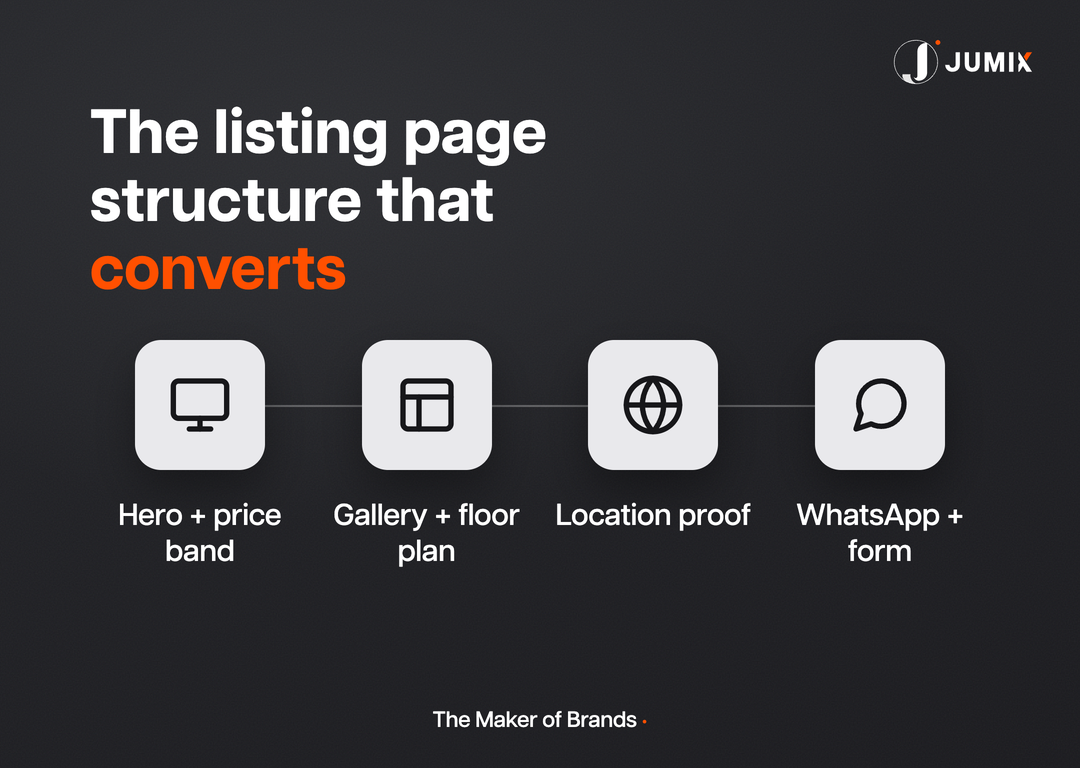
On your own site, you have to build the trust yourself, in order, before the contact form.
- Hero and price band. The unit, the starting price, and one clear call to action above the fold.
- Gallery and floor plan. Real photos or renders, never a stock interior. Buyers spot the difference.
- Location proof. An embedded map plus written distance to schools, transit, and shopping, not just a pin.
- Comparable transactions or availability. Recent sale prices for agents, remaining unit count for developers.
- WhatsApp and form. Both, side by side. Malaysians will message before they’ll fill a form.
Skip step 3 and the buyer opens a new tab to check the location themselves. Most don’t come back.
We’ve seen this play out in Penang directly. Our breakdown on getting more leads from a website covers the same structure problem outside the property niche.
Property Website Design Malaysia Checklist
Before a property website goes live, confirm these five items are in place.
- Search-friendly listing URLs. Each unit or project gets its own indexable page, not a popup or PDF.
- WhatsApp click-to-chat on every listing. Not just the homepage footer.
- Recent transaction or sales proof. Testimonials, closed deals, or a live availability counter.
- Google Business Profile linked to the site. Local search sends more buyers than most agents realize.
- Mobile load time under 3 seconds. Buyers browse listings on the drive home, on patchy signal.
A Google Business Profile tied to a fast, well-structured site is what turns a local search into a viewing appointment. Our local SEO framework for Malaysian businesses covers the setup in more depth.
Common Mistakes Malaysian Property Websites Make

I’ve reviewed enough property websites to spot the same three mistakes on repeat.
One PDF brochure standing in for the whole site. A downloadable brochure isn’t indexable. Google can’t rank what it can’t read, and neither can an AI answer engine.
A contact form with no phone or WhatsApp option. Forms feel formal for a decision this size. Give buyers the option to message first.
No sense of urgency or availability. A listing with no unit count, no closing date, and no recent activity reads as stale, even if the unit is genuinely still available.
Fix these three and most property websites in Malaysia would outperform their portal listing alone.
The same trust-building logic shows up outside real estate too. Our clinic website trust checklist covers a parallel high-consideration purchase, where hesitation kills the enquiry before it starts.
FAQ
Do I still need a PropertyGuru or iProperty listing if I have my own website?
Yes. Portals still bring the widest reach for first discovery. Your own website is where that visitor becomes a qualified lead you control.
How many listings does a property website need before it’s worth building?
One active project is enough for a developer. For an agent, a website earns its keep once you’re managing more than 3 to 5 active listings, since a portal profile alone can’t display a full track record.
What should a property developer’s website include that an agent’s doesn’t need?
A loan and booking fee calculator, a construction progress timeline, and a live remaining-unit counter. These build urgency for a single project in a way an agent’s multi-listing site doesn’t need to.
Is WhatsApp really more effective than a contact form for property leads?
For Malaysian buyers, yes. A form feels like a commitment. A WhatsApp message feels like a question. Offer both, but put WhatsApp first.
How does the current property overhang affect how I should build my listing pages?
With unsold stock rising, buyers have more choice and more room to negotiate. Listing pages need to answer objections upfront, price transparency, comparable sales, and availability, rather than waiting for a phone call to address them.
Conclusion
A property portal listing gets you found, but the trust-building and the buyer data both stay with the portal once the enquiry closes.
Build the site to fit what you actually sell. An agent needs longevity and a track record. A developer needs urgency around one project.
Get the listing structure right, put WhatsApp ahead of the form, and answer the buyer’s location and affordability questions before they ask.
That’s the difference between a website that sits next to your portal profile and one that actually converts. Jumix’s web design service builds that structure around how Malaysian property buyers actually search and decide.




Comments are closed for this article!