





Schema markup is code you add to your website that tells Google and AI systems exactly what your business is, what you sell, and where you’re located. Add LocalBusiness, Organization, and Product schema in JSON-LD format. Skip FAQPage schema for the rich snippet, since Google retired it in May 2026, but keep FAQ content on the page because AI systems still read it.
- Quick Takeaways
- What Schema Markup Actually Does
- Which Schema Types Malaysian Businesses Actually Need
- Why Google Retired FAQ Rich Results (and What to Do Now)
- Does Schema Actually Get You Cited by ChatGPT?
- The 15-Minute Setup
- Common Schema Mistakes
- FAQ
Quick Takeaways
- Schema markup is JSON-LD code. Google recommends it over Microdata or RDFa. (Source: Google Search Central)
- LocalBusiness schema only needs two required fields: name and address. Everything else is optional but useful.
- Google stopped showing FAQ rich results for every site except government and health pages in August 2023, then removed them entirely on May 7, 2026. (Source: Google Search Central Blog)
- Most Malaysian SME websites still carry no schema at all. That gap is a free advantage for the businesses that fix it.
- Schema removes friction for AI systems. It does not guarantee a citation on its own.
What Schema Markup Actually Does

A website is text and images to a person.
To a machine, it’s mostly noise.
Schema markup fixes that.
It’s a small block of code, written in JSON-LD, that labels your content in a format search engines and AI models already understand.
Instead of Google guessing that “Klinik Sihat Sentosa” on your homepage is your business name, schema states it directly: this is an Organization, this is its name, this is its phone number.
Google’s own documentation is blunt about the format. JSON-LD is the only markup format it recommends. Microdata and RDFa are harder to maintain and easier to break. (Source: Google Search Central)
Two Microsoft and Google engineers confirmed the same thing on stage in March 2025: their large language models read schema to understand what a page is about, separate from how it ranks in classic search. (Source: Search Engine Land)
That’s the real value in 2026.
Schema is how you hand your business facts to a machine, instead of hoping it reads your homepage correctly.
Which Schema Types Malaysian Businesses Actually Need
Schema.org lists hundreds of types.
Most Malaysian SMEs need four.
- Organization — your business name, logo, and social profiles. Add this once, site-wide.
- LocalBusiness — for any business with a physical address or service area. Required fields are just name and address, but add telephone, openingHoursSpecification, and priceRange if you have them. (Source: Google Search Central)
- Product — for ecommerce. Price, availability, and reviews, one block per product page.
- FAQPage — for question-and-answer content. Keep reading before you add this one.
Here’s how they compare on effort and payoff.
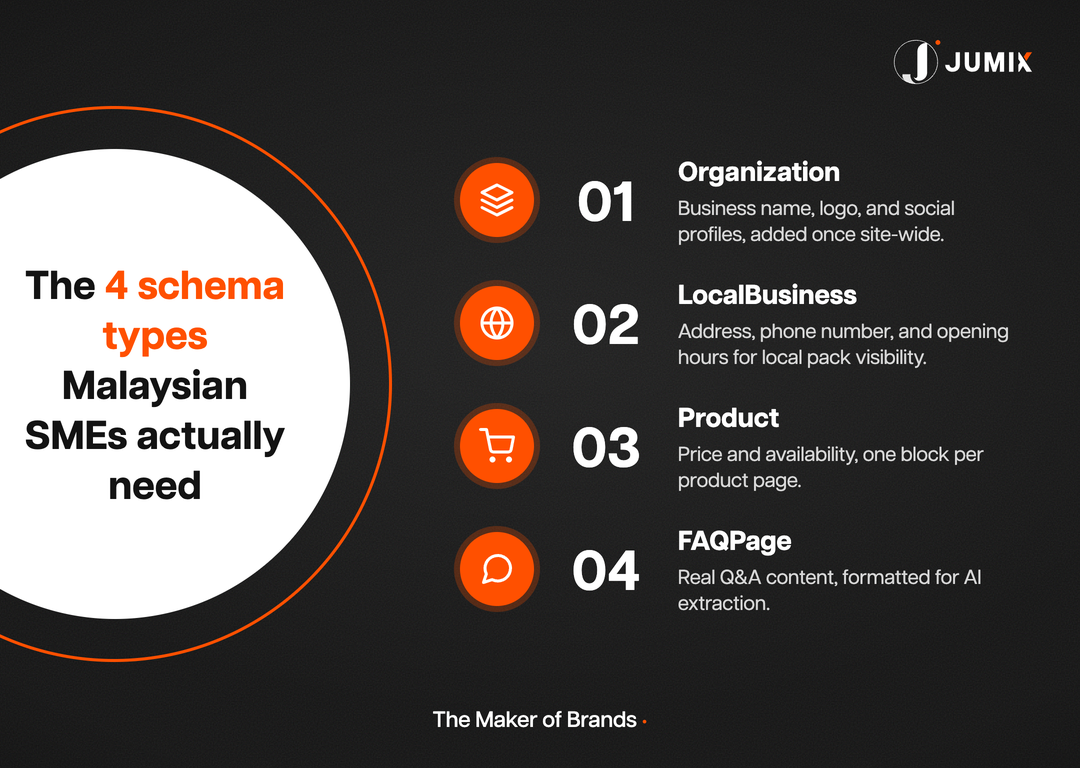
A quick visual before the full breakdown.
| Schema type | Where it goes | Setup effort | What it’s for now |
|---|---|---|---|
| Organization | Every page (site-wide) | Low, one-time | Entity identity for Google and AI |
| LocalBusiness | Homepage / contact page | Low | Local pack, Maps, local AI answers |
| Product | Every product page | Medium, per SKU | Price and availability in search and shopping |
| FAQPage | Pages with real Q&A content | Low | AI extraction only, no rich snippet |
Notice priceRange must stay under 100 characters, and geo coordinates need at least five decimal places if you use them. Small details. Google’s validator will flag both.
Why Google Retired FAQ Rich Results (and What to Do Now)

Most schema guides you’ll find online are outdated on one point.
They tell you FAQPage schema earns you extra space in Google’s search results, with your questions shown as expandable dropdowns.
That stopped being true for almost every business in August 2023.
Google restricted FAQ rich results to well-known government and health websites, citing abuse. Marketers had bolted generic FAQ blocks onto every page just to grab more space in search results. (Source: Google Search Central Blog)
Then, on May 7, 2026, Google closed the loophole completely.
FAQ rich results no longer appear for any site, government or otherwise.

So should you rip FAQPage schema off your website?
No.
Keep it, but change what you expect from it.
FAQPage schema was never really about the dropdown in Google. It was always about structure.
A clean question-and-answer block is exactly the shape ChatGPT, Gemini, and AI Overviews look for when they lift an answer to cite. Removing the rich snippet doesn’t remove that value.
The lesson for Malaysian SMEs: don’t build your schema strategy around chasing a specific Google feature. Build it around making your facts machine-readable, and let the features come and go.
Does Schema Actually Get You Cited by ChatGPT?
Here’s where most schema articles oversell.
Roughly 71% of pages cited by ChatGPT carry structured data, and about 65% of pages cited in Google’s AI Mode do too. (Source: Walker Sands)
That sounds like proof.
It’s correlation, not a lever you can pull.
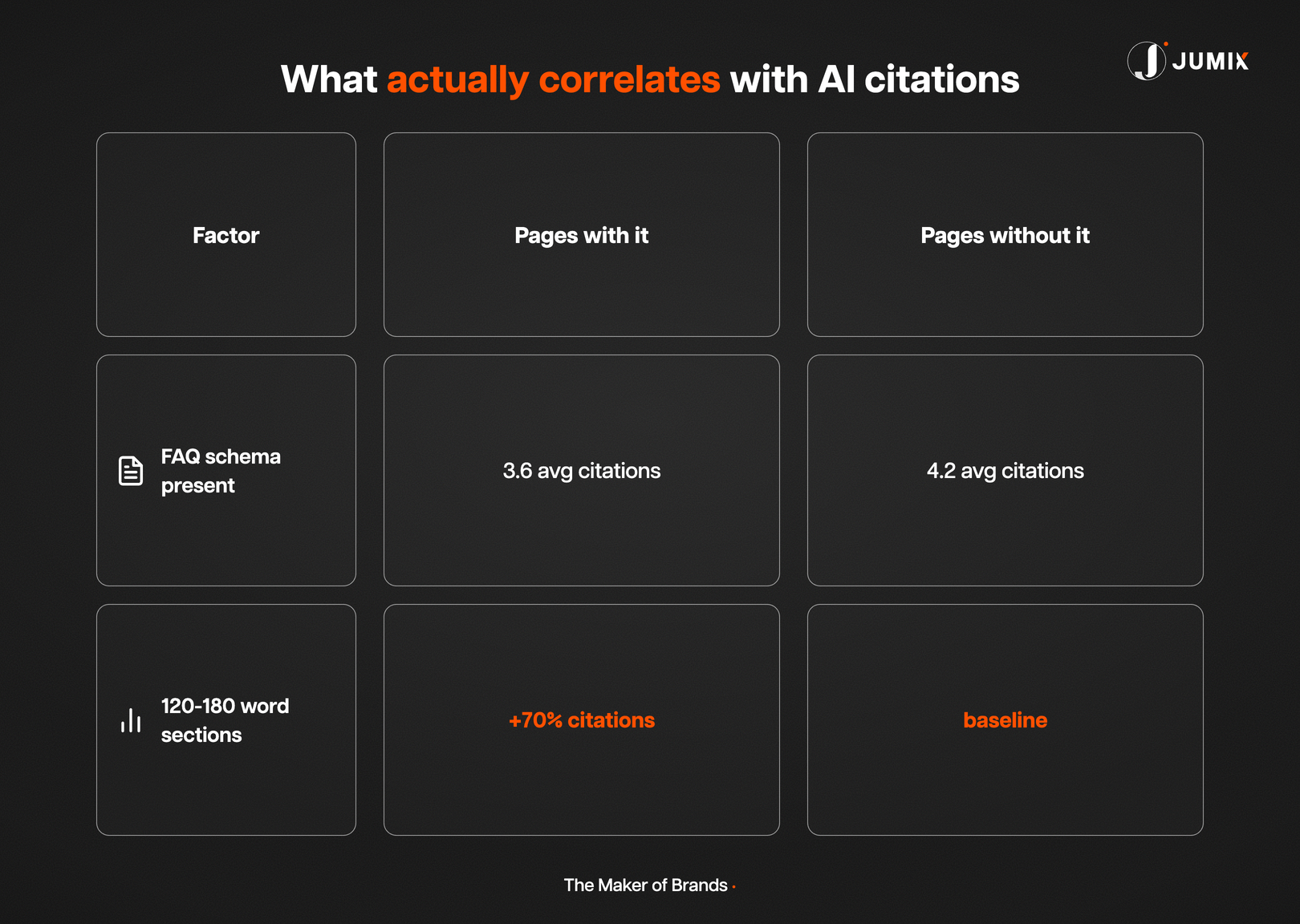
Separate research digging into individual pages found something more sobering: pages with FAQ schema averaged 3.6 citations, while pages without it averaged 4.2. (Source: SEranking)
Schema alone didn’t win the citation.
What did correlate strongly: content broken into sections of 120 to 180 words per heading earned about 70% more citations than pages with cramped, sub-50-word sections. (Source: SEranking)
So here’s the honest framing.
Schema removes friction. It doesn’t manufacture relevance.
An AI system that can instantly confirm your business name, location, and services from clean markup is more likely to trust and quote the content around it.
But if the content itself is thin, vague, or copied from a competitor’s page, no amount of JSON-LD saves it.
Treat schema as the last 10% of a page that’s already well-structured and well-written. Not the whole strategy.
The 15-Minute Setup
You don’t need a developer for this.
Here’s the fastest path for a Malaysian SME on WordPress.
- Install an SEO plugin that generates schema automatically. Yoast SEO and Rank Math both build Organization and basic WebPage schema out of the box. This alone covers the site-wide baseline.
- Fill in your Organization profile once. Business name, logo, social profile URLs. Most plugins ask for this during setup and never again.
- Add LocalBusiness fields on your contact or homepage. Name, address, phone number, and opening hours. If you serve customers at a physical address, this is non-negotiable.
- Add Product schema per SKU if you sell online. Shopify and WooCommerce both support this through free plugins. Price and stock status matter most.
- Write real FAQ content, then mark it up. Three to six genuine questions your customers actually ask, answered in two or three sentences each. Skip generic filler questions.
- Validate before you publish. Run the page through Google’s Rich Results Test. Fix every error, not just warnings.
Fifteen minutes covers steps one through three for most small sites.
Product and FAQ schema take longer if you have real catalog depth, but the setup pattern per page stays this simple.
Common Schema Mistakes
We’ve audited dozens of Malaysian SME sites during redesign projects.
The same three mistakes show up again and again.
- Marking up fake FAQs. Questions nobody asks, written purely to stuff keywords. Google’s spam policies flag this, and AI systems ignore hollow content anyway.
- Schema that contradicts the visible page. A phone number in your LocalBusiness markup that doesn’t match the one shown on the page. This is the single fastest way to lose trust with a validator, and with Google.
- Setting it once and never updating it. Opening hours change. Prices change. Stale schema is worse than no schema, because it actively feeds wrong facts to whatever reads it.
Jumix built Klinik Medic 360‘s multi-branch site around exactly this kind of accuracy. Real prices, shown plainly, matched across every page and every branch listing. (See the local SEO service for how we structure this for clinic groups.)
Accuracy compounds. Get it right once, and every system reading your site benefits.

Most Malaysian SME websites still carry zero structured data. That gap is closing slowly, which means the businesses that fix it now keep the advantage longer.
For deeper context on why AI visibility now matters as much as classic rankings, see our guide on winning AEO and GEO in 2026 and how to prepare your site for AI search.
FAQ
Is schema markup still worth doing if FAQ rich results are gone?
Yes. Organization, LocalBusiness, and Product schema never depended on the FAQ rich snippet. They still drive local pack visibility and shopping features, and all schema types help AI systems parse your page correctly.
Do I need a developer to add schema markup?
Not for the basics. Yoast SEO and Rank Math generate Organization and WebPage schema automatically. LocalBusiness and Product fields are usually simple form inputs in the same plugins.
Will schema markup improve my Google ranking directly?
Not on its own. Schema is not a ranking factor by itself. It helps Google and AI systems understand and trust content that’s already well-written, which indirectly supports visibility.
What’s the difference between Organization and LocalBusiness schema?
Organization describes your business as an entity: name, logo, social links. LocalBusiness extends that with a physical address, phone number, and hours. Use Organization site-wide and add LocalBusiness if you serve customers at a location.
How do I check if my schema markup is working?
Run your page through Google’s Rich Results Test or the Schema Markup Validator. Both flag missing required fields and formatting errors before you publish.
Conclusion
Schema markup isn’t about chasing one Google feature.
It’s about handing your business facts to every machine that reads your site, in a format none of them can misread.
Start with Organization and LocalBusiness this week. Add Product schema if you sell online. Keep FAQPage schema for AI extraction, not for a rich snippet that no longer exists.
Most Malaysian SME competitors still haven’t done any of this.
Jumix builds this structured data layer into every website we ship, alongside the local SEO work that makes it count. If your site was built years ago without any of this, it’s a fifteen-minute fix with a payoff that keeps compounding.





Comments are closed for this article!