



Malaysian online sellers with annual turnover above RM1 million must issue e-invoices through LHDN’s MyInvois system, following a phased rollout that reached RM1 million turnover businesses on 1 January 2026. Sellers under that threshold are exempt unless they are linked to a larger related company. For sales on Shopee, Lazada or TikTok Shop, LHDN places the e-invoice obligation on the platform itself, not the seller.
- Quick Takeaways
- Who Actually Needs to Comply in 2026
- The E-Invoice Compliance Checklist
- Consolidated vs Individual E-Invoices
- Marketplace Sellers vs Your Own Online Store
- Common E-Invoice Mistakes Online Sellers Make
- FAQ
Quick Takeaways
- The mandatory e-invoice threshold was raised from RM500,000 to RM1 million turnover on 6 December 2025, canceling the planned final phase for smaller sellers (Source: Free Malaysia Today).
- Sellers under RM1 million turnover are exempt, unless they are a subsidiary or related company of a business at or above that threshold.
- Phase 4 sellers (RM1 million to RM5 million turnover) get a penalty-free relaxation period until 31 December 2027, with full enforcement starting 1 January 2028 (Source: LHDN e-Invoice Guidelines).
- Any single transaction exceeding RM10,000 needs an individual e-invoice. It cannot be folded into a monthly consolidated one.
- For marketplace sales, the e-invoice obligation rests with the platform provider, not the seller (Source: LHDN e-Invoice FAQs).
- Missing a required e-invoice carries a fine of RM200 to RM20,000 per instance under the Income Tax Act 1967 (Source: LHDN e-Invoice FAQs).
Who Actually Needs to Comply in 2026
LHDN rolled out e-invoicing in phases, sorted by annual turnover.
Businesses above RM100 million went first, back in August 2024. Each phase since has moved down the turnover scale.
- Phase 1, 1 August 2024: turnover above RM100 million.
- Phase 2, 1 January 2025: turnover RM25 million to RM100 million.
- Phase 3, 1 July 2025: turnover RM5 million to RM25 million.
- Phase 4, 1 January 2026: turnover RM1 million to RM5 million.
A fifth phase was originally planned to pull in sellers turning over RM500,000 to RM1 million. The Cabinet scrapped that plan on 6 December 2025 and raised the whole exemption line to RM1 million instead (Source: Free Malaysia Today).
Phase 4 is the last mandatory phase on the current plan. There is no more scheduled rollout below RM1 million.
Practically, that means most solo Shopee and Instagram sellers are off the hook for now.
One exception matters for growing sellers. A business under RM1 million is still required to comply if it is a subsidiary or related company of a business already at or above that line.
A soft enforcement window applied to each phase too, though the length varies by phase. Phases 1 to 3 each got roughly 6 months of penalty-free relaxation before full enforcement.
Phase 4 got a longer runway. LHDN extended its relaxation period to 31 December 2027, with full enforcement starting 1 January 2028 (Source: LHDN e-Invoice Guidelines).
During that window, Phase 4 sellers can still use consolidated e-invoices with general descriptions while they get their systems in order.
Genuine effort still means acting now, even with that runway. Revenue crosses thresholds faster than most sellers expect, especially heading into a strong sales quarter.
That is doubly true for stores stacking payment gateways and checkout apps on top of each other. Our ecommerce website guide for Malaysia covers the checkout side of that setup.
The E-Invoice Compliance Checklist
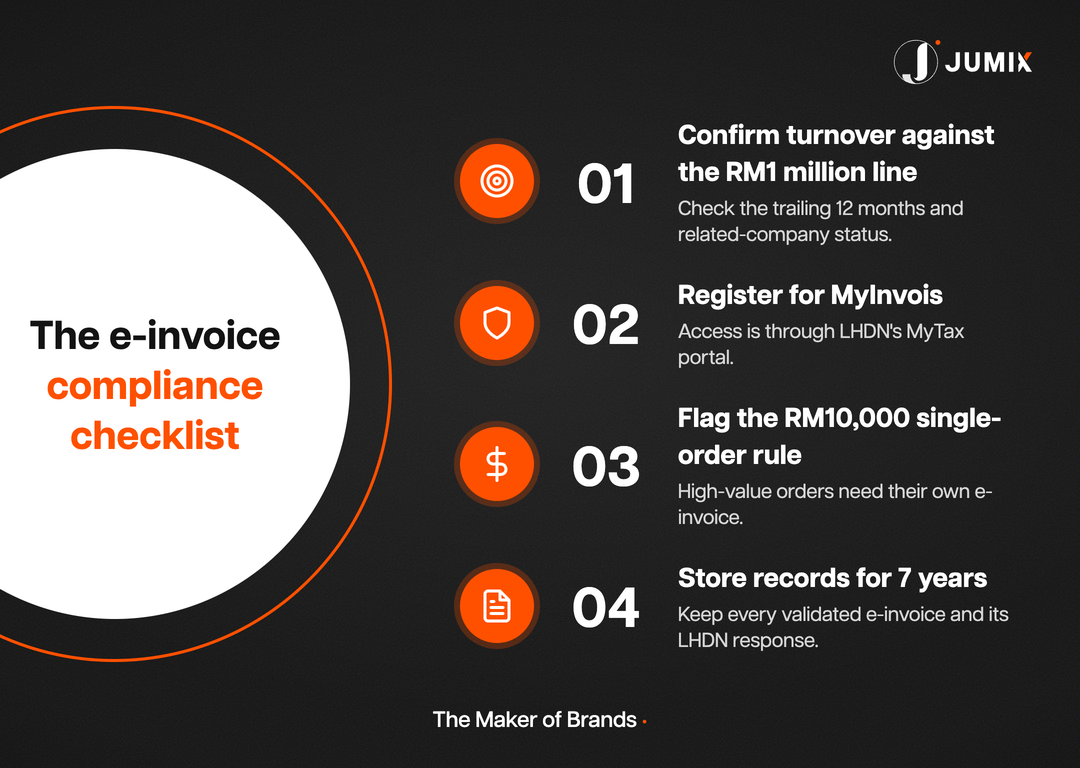
Work through this in order. Each step depends on the one before it.
- Confirm your turnover against the RM1 million line. Check the last 12 months, not just the current calendar year, and check related-company status too.
- Register for MyInvois. Access is through LHDN’s MyTax portal using your existing tax reference number.
- Decide your consolidation approach. Most B2C sellers issue one consolidated e-invoice a month rather than one per order.
- Flag the RM10,000 rule in your checkout flow. Any order above that value needs its own individual e-invoice, issued at the time of sale.
- Confirm who submits on your behalf. Marketplace sellers need to know whether their platform handles submission or whether they still carry that duty.
- Set a 7-day close-out habit. Consolidated e-invoices are due within 7 calendar days after the end of the month.
- Set up 7-year record storage. Every validated e-invoice and its LHDN response needs to stay retrievable for 7 years under section 82 of the Income Tax Act 1967.
7 steps sounds like a lot for a side hustle. Most sellers clear all 7 in an afternoon.
Step one trips up more sellers than the rest combined. Turnover counts everything, not just one channel.
A seller running a Shopee store, a Lazada store, and their own Shopify checkout adds all 3 together. Selling RM400,000 on each platform puts that seller at RM1.2 million total, above the line, even though no single channel crossed it alone.
Consolidated vs Individual E-Invoices
Most online sellers never issue a one-off e-invoice per order. They batch them.
A consolidated e-invoice bundles every qualifying B2C sale from the month into a single document, filed within 7 calendar days after month-end.
An individual e-invoice covers exactly one transaction. It becomes mandatory the moment a buyer asks for one by name, or the order value exceeds RM10,000.
| Factor | Consolidated E-Invoice | Individual E-Invoice |
|---|---|---|
| Covers | All qualifying B2C sales in a month | One single transaction |
| Filing deadline | 7 calendar days after month-end | At the point of sale |
| Triggered by | Default for ordinary B2C sales | Buyer request, or order value above RM10,000 |
| Typical seller | Retail, F&B, small ecommerce | B2B sellers, high-value single orders |
Both paths run through the same MyInvois system. The difference is timing and trigger, not the underlying process.
A worked example makes this concrete. A homeware seller closes 340 orders in March, all under RM500 each.
Every one of those 340 orders folds into a single consolidated e-invoice, filed by 7 April.
One buyer that same month orders a custom RM12,000 furniture set. That single order needs its own individual e-invoice, issued right away, separate from the batch.
341 orders. 2 filings. That is the whole system in practice.
Marketplace Sellers vs Your Own Online Store
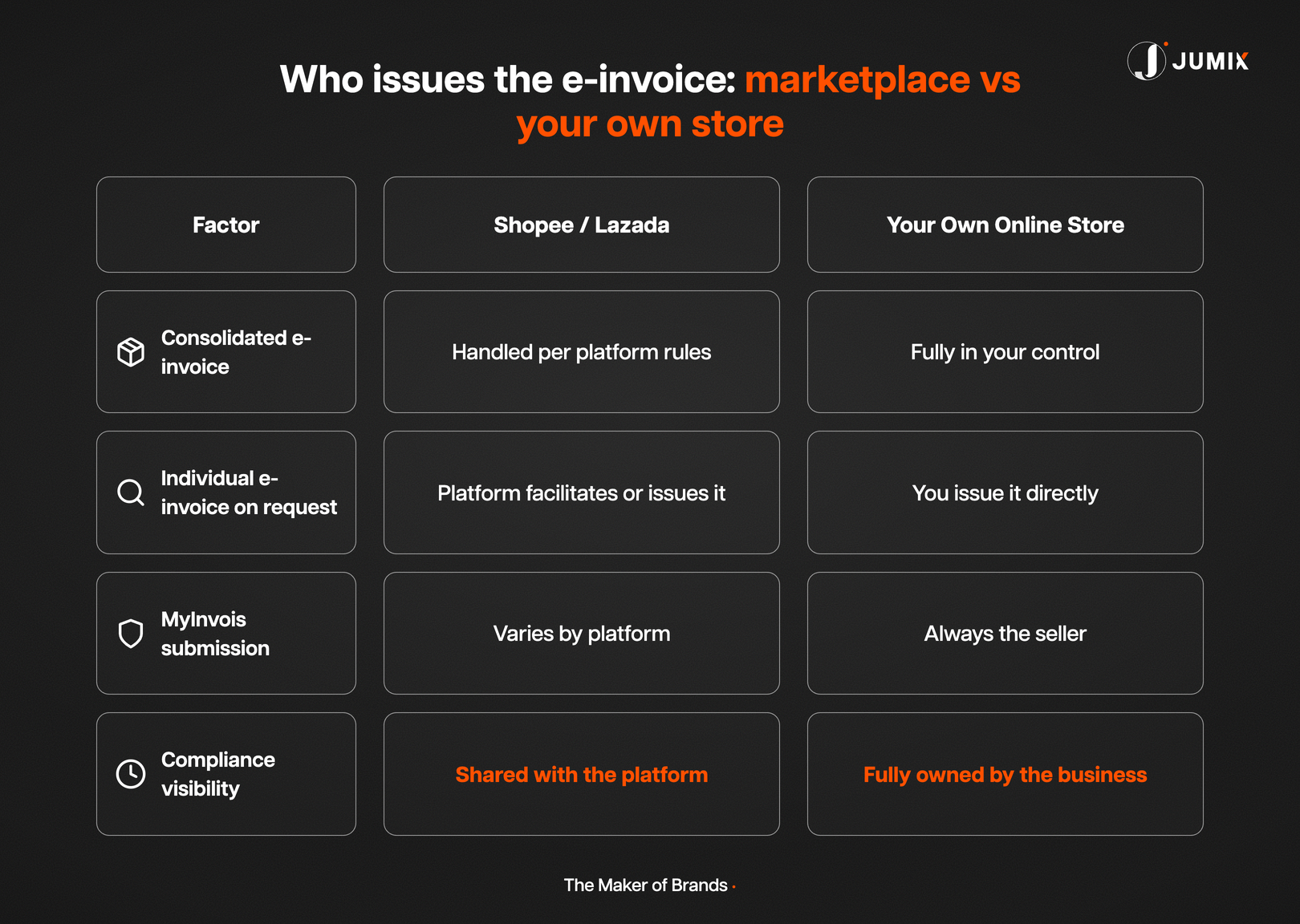
Where you sell changes who does the paperwork.
LHDN is explicit about this. The obligation to issue the e-invoice rests with the e-commerce platform provider, for all transactions conducted on that platform (Source: LHDN e-Invoice FAQs).
That covers Shopee, Lazada, and TikTok Shop alike. A seller on any of them is not the one filing those transactions to MyInvois.
The seller’s duty is narrower: supply the platform with accurate business details so it can issue correctly on your behalf.
How each platform surfaces this to buyers still differs. Shopee, for one, generates the buyer-facing e-invoice through the order details page on request, with its own short deadline after order completion (Source: Shopee Help Center).
Platforms like Shopee, Lazada, and TikTok Shop are also required to issue self-billed e-invoices back to sellers, documenting the platform fees they charge.
Keep every one of those self-billed documents. They double as proof of the fees deducted from a seller’s payout, which matters at tax time regardless of e-invoice status.
TikTok Shop follows the same general pattern as Shopee and Lazada, since LHDN applies the marketplace rules platform-wide rather than negotiating separately with each one.
A self-hosted store removes the ambiguity entirely. The business controls its own checkout and its own MyInvois submissions, on its own schedule.
That control is one more reason sellers keep moving from Shopee to their own online store once volume grows. Compliance is simpler when one party owns the whole checkout.
Our marketplace versus self-hosted comparison covers the wider tradeoff beyond e-invoicing alone.
Common E-Invoice Mistakes Online Sellers Make

- Assuming marketplace coverage extends to your own channels. The platform carries the obligation for sales made on it, and nothing else. Direct WhatsApp, Instagram or own-website orders remain entirely yours to file.
- Missing the RM10,000 single-order rule. A big custom order gets folded into the monthly consolidated batch instead of its own individual e-invoice.
- Waiting until turnover crosses RM1 million to register. MyInvois registration and setup take longer than most sellers budget for during a busy sales month.
- Ignoring related-company status. A small storefront linked to a bigger holding company assumes it is exempt, then finds out it never was.
- Treating the relaxation window as a free pass. LHDN checks for genuine effort, not a completely blank compliance record, even during the extended Phase 4 window.
I would rather a seller registers on MyInvois a month too early than a week too late. The penalty math only runs one direction.
FAQ
Do small online sellers under RM1 million still need to register for MyInvois?
Registration itself is open to everyone, but mandatory compliance only kicks in above RM1 million turnover, or if the seller is linked to a related business that already crossed it.
Who issues the e-invoice for my Shopee or Lazada sales?
The platform does. LHDN places the obligation on the e-commerce platform provider for all transactions conducted on it. Your job is to keep your business details accurate with the platform.
Is there a penalty for issuing a late e-invoice?
Yes. Non-compliance under Section 120(1)(d) of the Income Tax Act 1967 carries a fine of RM200 to RM20,000 per instance, or up to 6 months imprisonment (Source: LHDN e-Invoice FAQs).
Can I issue one e-invoice for all my sales in a month?
Yes, for ordinary B2C sales of RM10,000 or less each. That consolidated e-invoice is due within 7 calendar days after the month ends.
Does selling through a marketplace remove my e-invoice responsibility entirely?
Only for sales made on that platform. Anything you sell through your own website or direct channels stays your responsibility.
Build Compliance Into the Checkout Itself
The RM1 million threshold gives most small Malaysian sellers real breathing room in 2026.
That room runs out the moment turnover climbs, a related company gets added, or a single buyer wants a proper e-invoice. Sellers who set up their consolidation habit and MyInvois access early avoid a scramble later.
A self-hosted store makes that setup far simpler than juggling multiple marketplace rules at once. Jumix’s ecommerce web design service builds that checkout with compliance and growth in mind from day one.




Comments are closed for this article!