



A “free” Wix, Canva or AI website stops being free the moment you need a custom domain, real payments, or basic SEO. Once those are added, most Malaysian businesses land at roughly RM1,600 to RM2,150 a year on a DIY builder, forever, with no ownership of the site itself. A custom website usually costs RM3,000 to RM10,000 once, then RM1,000 to RM3,000 a year to maintain, and you own it outright.
- Quick Takeaways
- What “Free” Website Builders Actually Include
- The Real Annual Cost Once You Need to Sell
- Where DIY Builders Break Down for Growing Businesses
- Common Mistakes Businesses Make With Free Builders
- When a Custom Website Actually Pays for Itself
- FAQ
Quick Takeaways
- The free tiers of Wix, Canva and most AI builders block a custom domain and remove the option to take payments.
- A Wix plan that can actually sell starts at $29 a month, about RM1,600 a year (Source: Wix Pricing).
- Canva’s website builder only works fully inside a Canva Pro subscription, not as a standalone product (Source: Canva Pricing).
- A custom Malaysian business website typically runs RM3,000 to RM10,000 once, then RM1,000 to RM3,000 a year after that.
- DIY builders rent you a website. A custom build is the only version you actually own.
What “Free” Website Builders Actually Include

Free gets you a subdomain to experiment on.
Wix’s free plan gives you a site on a wixsite.com address. There is no custom domain option on it.
Wix branding sits on every page. Storage and bandwidth are capped.
Canva works the same way. The website builder is a feature bundled inside a Canva account, not a separate product (Source: Canva Pricing).
A free Canva site publishes to a canva.site subdomain. You cannot accept payments on it.
AI website builders follow the same pattern almost every time. They generate a working draft fast, then gate the domain, the SEO settings, and checkout behind a paid plan.
None of that makes the free tier useless. It is a real way to test an idea before spending anything.
The problem starts the day the business is ready to be taken seriously. That is the day the bill arrives.
The Real Annual Cost Once You Need to Sell
Selling anything online starts with a real domain and a plan that actually accepts payments.
Enough storage to hold a full catalog matters too, once the product count climbs past a handful of items.
Wix’s Light plan cannot take payments at all. You need Core, at $29 a month, or Business, at $39 a month, to sell (Source: Wix Pricing).
At roughly RM4.60 to the US dollar (after conversion cost and taxes), that is about RM1,600 to RM2,150 a year, every year, forever.
Canva Pro adds custom domains, removed branding, premium templates, and more storage. It sits in a similar monthly range once you factor in the domain and any add-on apps for checkout.
Transaction fees stack on top of the plan price on both platforms. A DIY builder’s checkout app often adds a small percentage per sale on top of whatever the payment gateway already charges.
A business doing RM10,000 a month in sales can lose several hundred ringgit a year to that layer alone. It rarely shows up in the plan comparison page.
A custom website works differently. You pay once for the build, then a smaller amount each year for hosting and upkeep.
Our own breakdown of Malaysian web design pricing puts a proper SME site at RM3,000 to RM10,000 upfront, depending on scope.
| Factor | Wix (Core / Business) | Canva Pro (Website) | Custom Website |
|---|---|---|---|
| Setup cost | RM0, your own time | RM0, your own time | RM3,000 to RM10,000 once |
| Ongoing software cost | ~RM1,600 to RM2,150 a year | ~RM800 to RM1,200 a year (varies by promo) | RM0, no license fee |
| Hosting and maintenance | Included in plan | Included in plan | RM1,000 to RM3,000 a year |
| Site ownership | Locked to the platform | Locked to the platform | Usually owned by the business |
| 5-year total cost | ~RM8,000 to RM10,750 | ~RM4,000 to RM6,000 | ~RM8,000 to RM25,000 |
Figures are approximate and depend on exchange rates and current promotions. Check each provider’s site for the plan you actually need.
Look at that five-year row again. A custom site is not automatically the expensive option.
Where DIY Builders Break Down for Growing Businesses
A DIY builder handles a simple brochure site fine. Growth is where it starts to strain.
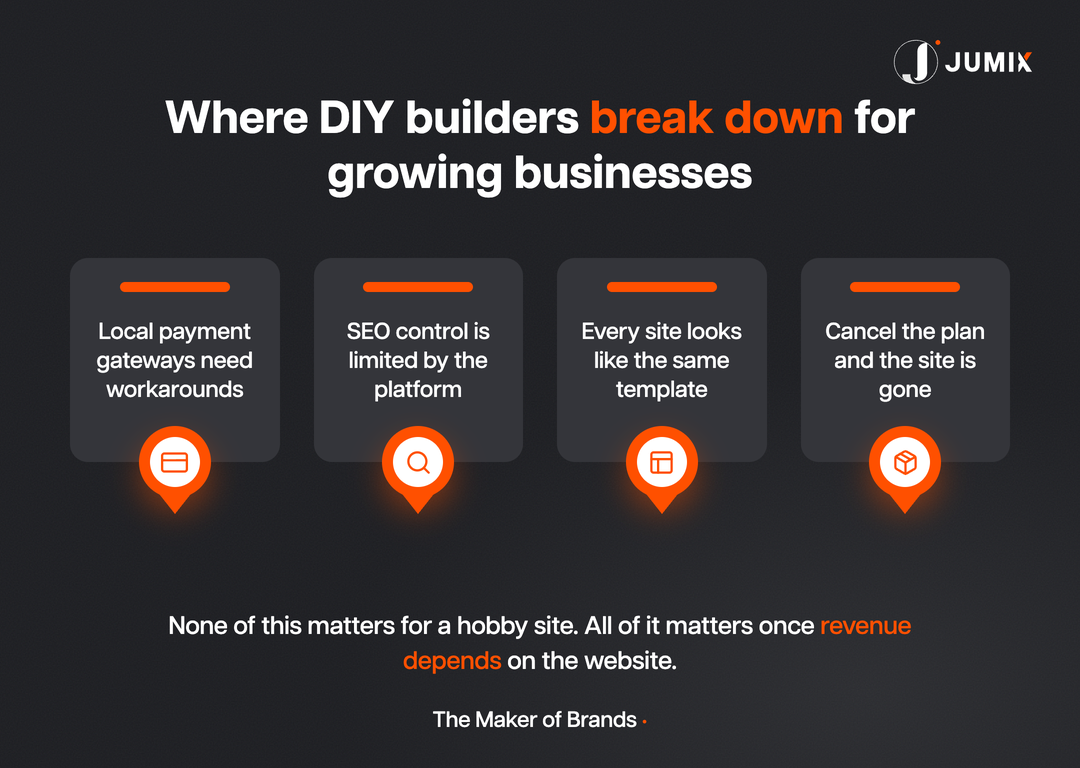
Local payment gateways are the first wall. Wix and Canva support major cards and PayPal well, but wiring in FPX bank transfers or Malaysian gateways like Fiuu and Adaptis usually needs a workaround, not a native option.
SEO control is the second wall. Builder platforms limit how deep you can go on page speed, schema markup, and URL structure, all of which matter for ranking in Malaysia’s crowded search results.
Brand flexibility is the third. Every builder site is assembled from the same block library everyone else is using. Distinct layouts are hard to fake.
Portability is the fourth, and the one people forget. Cancel the subscription and the site is gone. You cannot take a Wix or Canva site with you to another host.
None of these four wreck a hobby site. All four matter the moment revenue depends on the website.
Common Mistakes Businesses Make With Free Builders

- Building the whole catalog before checking payment support. Hundreds of products get uploaded, then the owner discovers FPX needs a paid app or a third-party plugin.
- Treating the free plan as a permanent home. A wixsite.com or canva.site address on a business card looks unfinished, especially to bank and grant reviewers.
- Skipping SEO settings entirely. Meta titles and alt text get left on defaults, so the site never shows up for the exact searches it should win.
- Underestimating the switching cost. Migrating years of content off a closed builder later is slower and pricier than starting on an open platform from day one.
- Assuming “AI-built” means “SEO-ready.” An AI builder can write copy fast. It cannot fix a site structure that search engines struggle to crawl.
Every one of these is fixable early. Almost none of them are cheap to fix two years in.
I have seen the payment gateway mistake more times than I would like. A business builds out a full catalog, then finds out DuitNow support needs a paid app they did not budget for.
Check the payment options before uploading a single product. That order matters more than people expect.
When a Custom Website Actually Pays for Itself
A DIY builder is the right call for testing an idea, running a personal portfolio, or a side project with no revenue target.
A custom build earns its cost back once the brand needs to look established, not experimental.
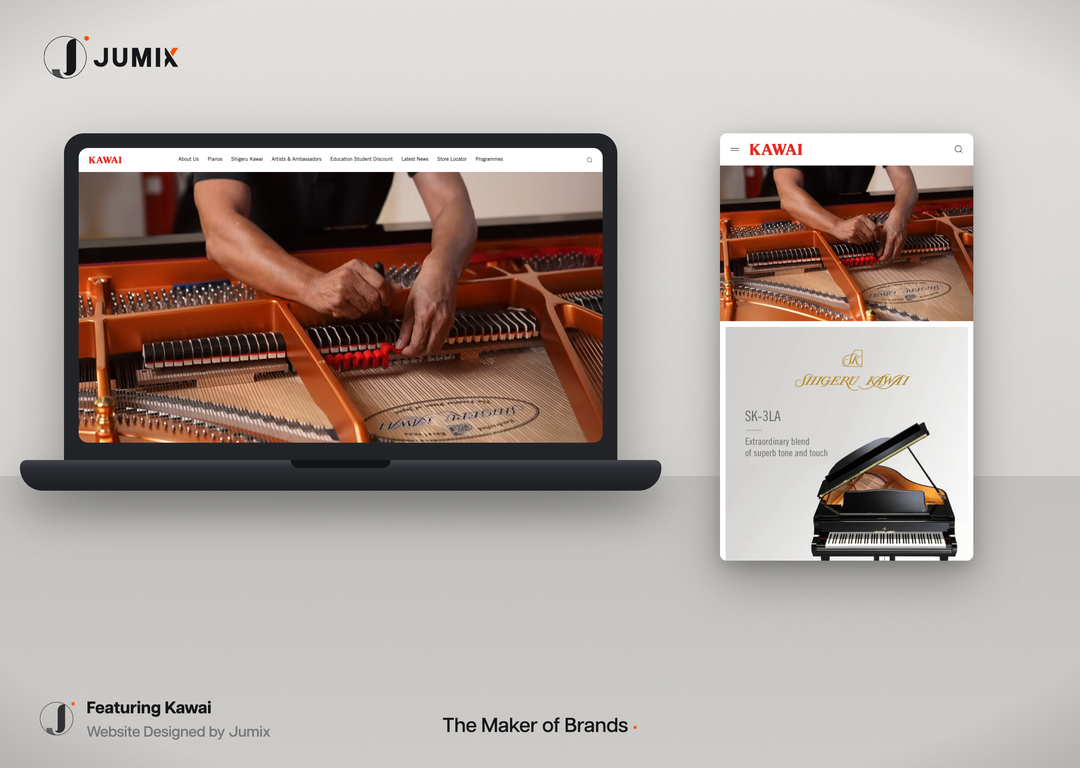
Take Kawai Malaysia. Their Shopify store worked as a product listing but never as a brand experience, which is a hard ceiling for a heritage piano maker selling to retail customers, educators, and dealerships at once.
We rebuilt it as a storytelling platform instead of a catalog, restructured around all three audiences, and let the craftsmanship carry the pricing.
Maintenance works differently too on a custom build. Updates, security patches, and speed tuning happen on a schedule the business controls, not on whatever release calendar the builder platform decides that quarter.
A generic template could not have carried that. Premium products cannot afford to look like everyone else’s checkout page.
If it were my money, I would run the free plan for the first three months to validate the offer, then move to a custom build the moment real revenue shows up. Paying rent on a subdomain past that point is money spent standing still.
Self-hosting decisions compound the same way. Our hosting comparison for Malaysian businesses covers what changes once you own the platform outright.
For stores specifically, the calculation shifts further once transaction volume grows. Our guide on ecommerce website costs in Malaysia breaks down where that money actually goes.
FAQ
Is Wix or Canva actually free forever?
The base tier is free forever, but it blocks a custom domain and payments. Most businesses outgrow it within months.
Can I accept FPX or DuitNow payments on Wix or Canva?
Most plans support it only through a third-party app or a workaround. A custom build can wire directly into a Malaysian gateway instead.
Is an AI website builder cheaper than hiring a web designer in Malaysia?
In year one, usually yes. Across three to five years, the subscription fees on a paid AI builder plan often approach what a modest custom site costs once, with none of the ownership.
Can I move my Wix or Canva site to a custom host later?
Content, product listings, and design have to be rebuilt from scratch on the new platform. That rebuild is a real cost people forget to budget for.
Does the MSME Digital Grant Madani cover a custom website build?
Yes, through an approved Digitalisation Partner, up to 50% of eligible spend or RM5,000, whichever is lower (Source: BSN Malaysia).
Ownership Is the Real Price Tag
Free builders work like a rental agreement dressed up as a gift.
Wix and Canva earn their keep for testing an idea fast and cheap. The moment a Malaysian business needs local payments, real SEO, or a brand that looks established, the subscription fees start closing in on what a custom build costs, while the site itself stays rented, not owned.
Run the numbers over five years before deciding. A single month rarely tells the real story.
If your business has outgrown its free plan, Jumix’s web design pricing page lays out exactly what a custom build costs, with nothing hidden behind a monthly fee.




Comments are closed for this article!