




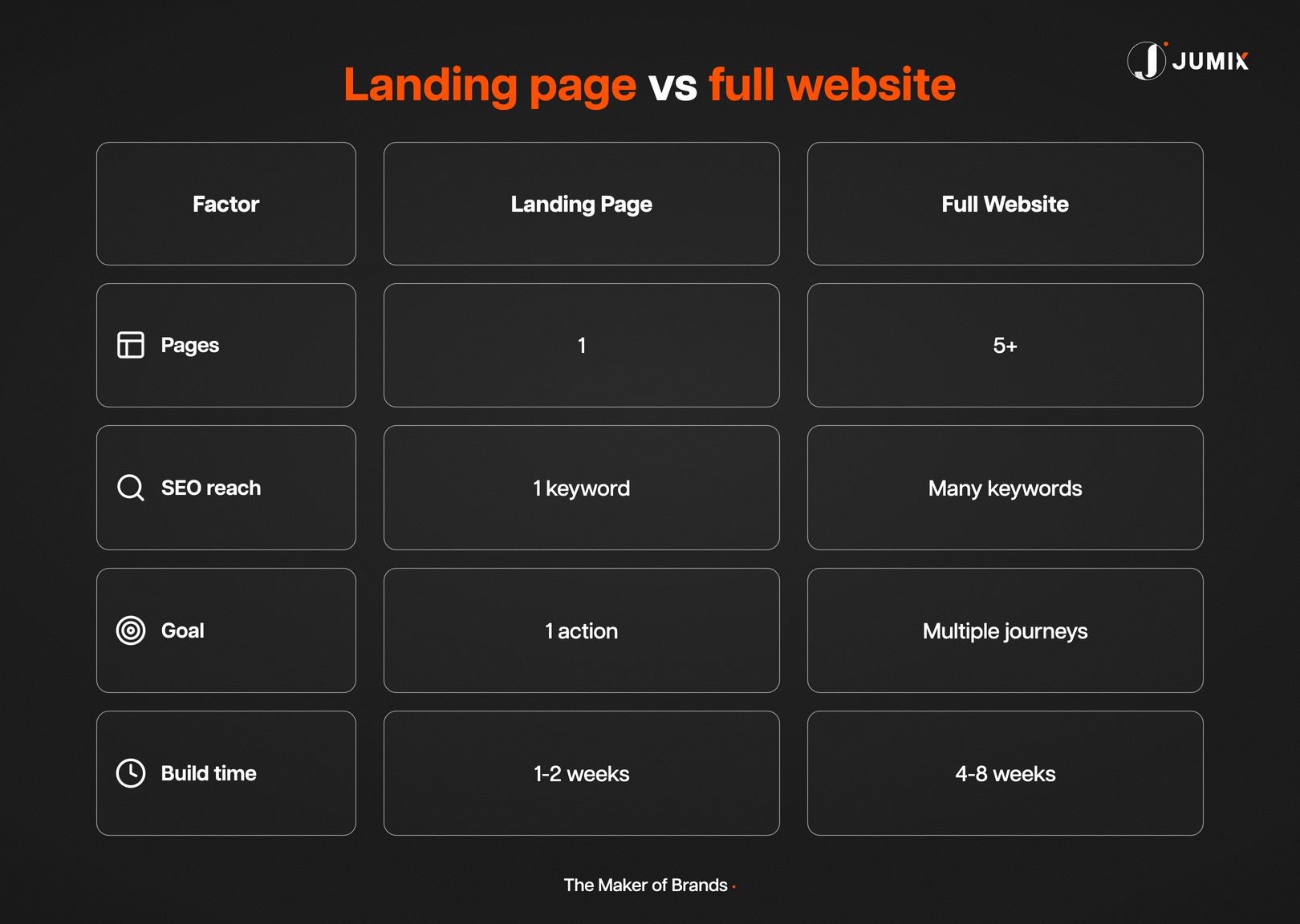
A landing page is one page built for a single offer and one action. A website is a multi-page hub that covers your whole business, your services and your SEO reach. Malaysian businesses running paid ads or launching one product should start with a landing page; everyone else needs a full website first.
- Quick Takeaways
- What a Landing Page Actually Is
- Signs a Landing Page Is the Right Call
- Signs You Need a Full Website Instead
- What Malaysian Businesses Pay for Each
- Common Mistakes Matching the Tool to the Job
- The Upgrade Path
- FAQ
Quick Takeaways
- A landing page has one goal. A website has many, spread across many pages.
- Dedicated landing pages convert at a median of 6.6% across 41,000 pages analyzed (Source: Unbounce, 2024).
- A single-page site cannot rank for as many search terms as a multi-page website.
- Landing pages in Malaysia typically run RM800 to RM5,000. Full websites run RM5,000 to RM25,000 or more, depending on scope.
- Most growing businesses need both eventually: a landing page for each campaign, a website as the permanent home.
I get this question from almost every new client.
They’ve got a launch date, a budget, and no idea whether they need 1 page or 12.
Here’s how I actually answer it.
What a landing page actually is
A landing page is a single page with one job.
One offer, one call to action, usually no navigation menu.
A website is different.
It’s a network of pages: home, services, about, contact, blog.
Each page can rank for its own keywords and serve a different stage of the buyer’s journey.
Google treats them differently too.
Landing page experience is one of three components in Google Ads Quality Score. The other two are expected click-through rate and ad relevance (Source: Google Ads Help, 2026).
Send Google Ads traffic to your homepage, and you’re paying for clicks a proper landing page would convert for less.
The confusion usually starts with the word “page.”
A landing page and a homepage are not the same thing, even though both are technically one page.
A homepage introduces a whole business and links out to everything else.
A landing page exists for exactly one campaign, and it disappears or gets replaced once that campaign ends.
Signs a landing page is the right call

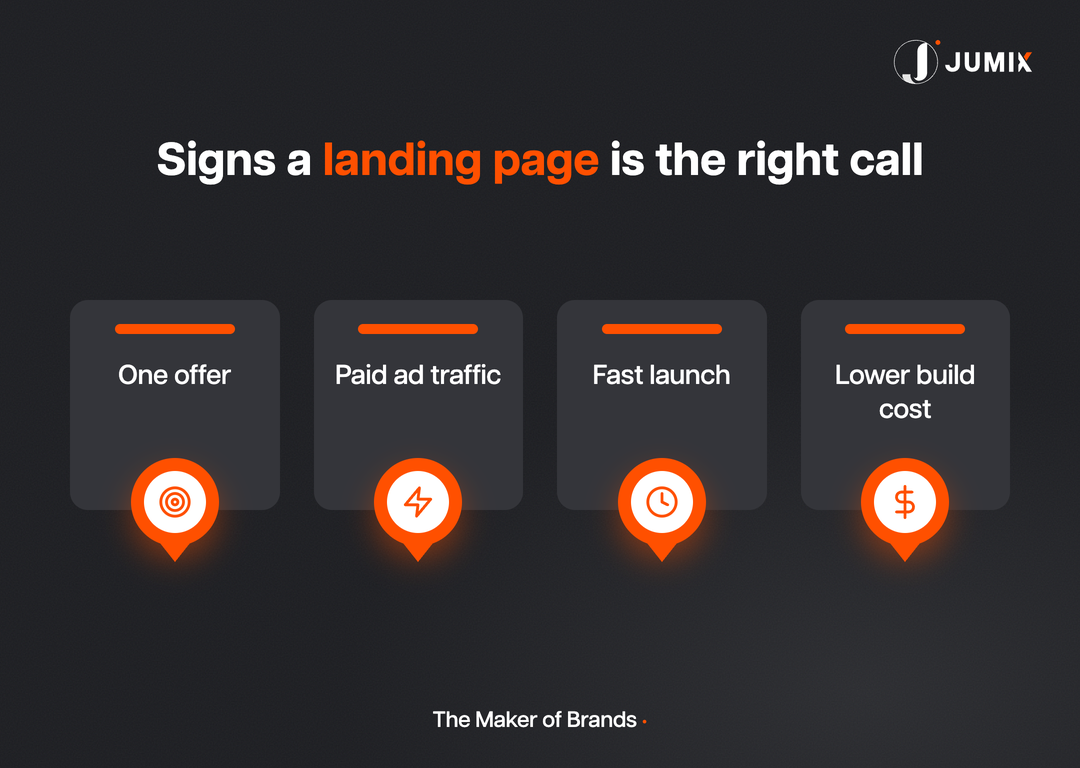
A few signals tell me a client needs a landing page, not a full site.
- You’re running paid ads for one campaign or one product.
- You have a single offer, not a catalogue of services.
- You need to launch fast, not build a brand from scratch.
- You’re testing a new offer before committing to a full site.
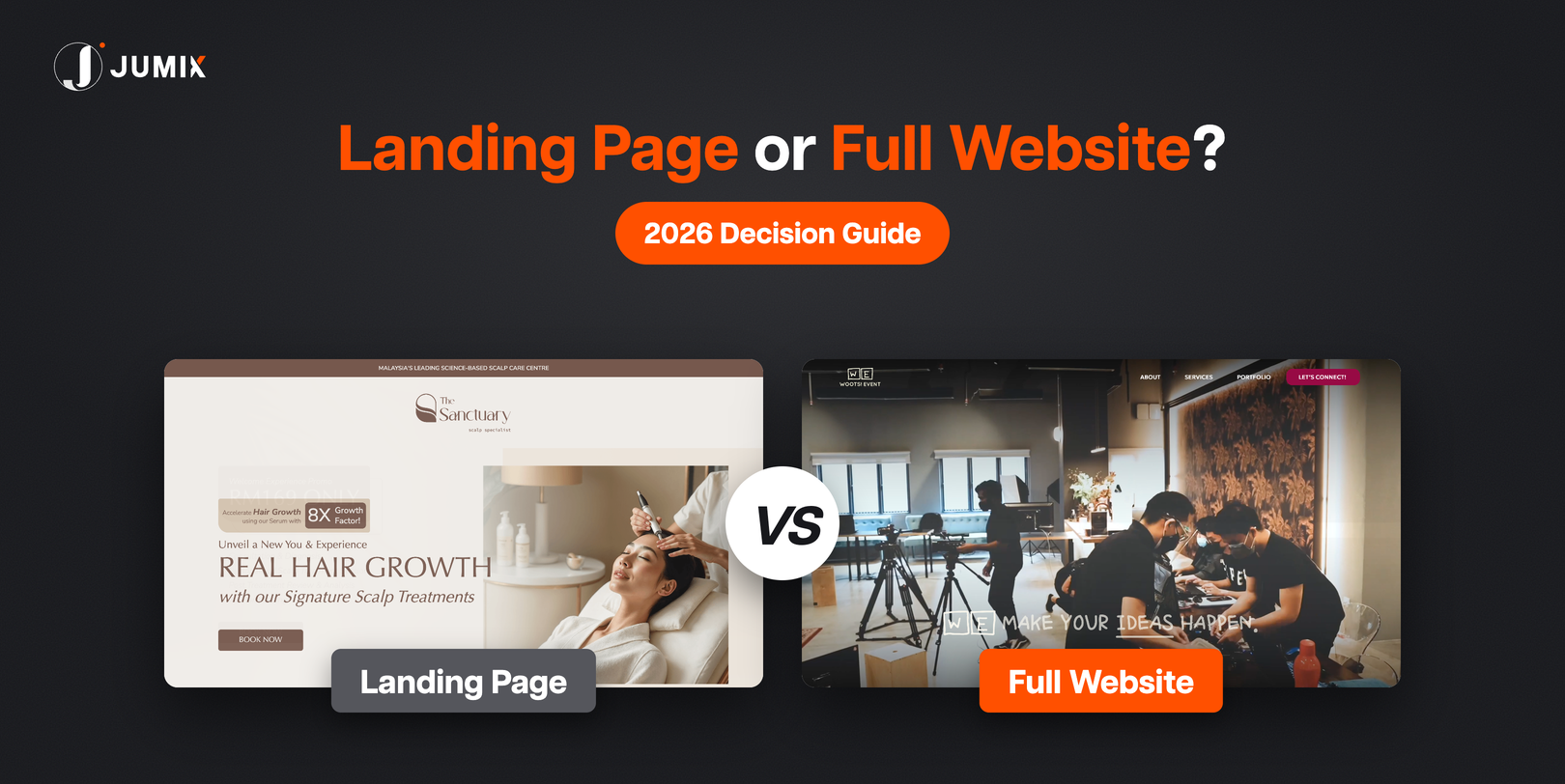
The Sanctuary Scalp is the clearest example I’ve worked on.
Their traffic came almost entirely from Google Ads, promoting one treatment with a specific hair growth claim.
We built one page: founder credibility first, treatment explanation next, objection handling, then a booking form.
No menu to distract a visitor who arrived ready to book.
Send that same ad traffic to a 10-page clinic website instead. Visitors leak into service pages that have nothing to do with the ad they clicked.
Aaron Lee, a real estate lawyer in Penang, had a different problem.
His problem was lead quality, not visibility.
We built a single landing page positioning him as a trusted authority in property law. A qualification form captured case details before the first call.
Fewer enquiries came in. The ones that did were ready to act.
That’s the pattern behind every good landing page. It filters and converts one type of visitor, not everyone.
Signs you need a full website instead
A landing page falls apart the moment your business has more than one story to tell.
- You offer multiple services or products that need separate pages to explain properly.
- You want organic search traffic, not just paid clicks.
- You need to build long-term trust with visitors who aren’t ready to buy today.
Single-page sites cap how many keywords you can rank for. Each page can realistically target one core topic (Source: Search Engine Journal, 2026).
A 10-service business squeezed onto one page ranks for none of those services well.
WootsEvent needed the opposite of a landing page.
An event management company pitching business owners and marketing teams, they had a static site. It gave no sense of the energy they actually deliver.
We rebuilt it with bold visuals across multiple pages: past events, service breakdowns, team, process.
A corporate client evaluating an events partner wants to browse, compare, and come back a week later.
A single page can’t hold that kind of research journey.
If your buyer needs multiple visits and multiple pieces of evidence before they trust you, build the website.
What Malaysian businesses pay for each
Price tells you what you’re actually buying.
A cheap landing page is a template with your logo dropped in.
A properly built one includes copywriting and ad tracking setup, which is where the price climbs.
| Option | Typical RM range | What you’re paying for |
|---|---|---|
| Template landing page | RM800 – RM1,500 | Layout only, minimal copy, no tracking setup |
| Conversion-focused landing page | RM1,500 – RM5,000 | Copywriting, objection handling, ad pixel and analytics setup |
| Basic multi-page website | RM5,000 – RM10,000 | 5 to 8 pages, standard structure, light SEO setup |
| Custom full website | RM10,000 – RM25,000+ | Custom design, content strategy, technical SEO, multiple service pages |
If it were my money, I’d rather launch a plain landing page in a week and start collecting real leads than wait 8 weeks for a 6-page website nobody has clicked on yet.
You can always build the website once the landing page proves the offer works.
A full website also costs more to maintain: more pages to update, more SEO to manage, more content to keep current. See our breakdown of full website costs in Malaysia for the complete picture.
Common mistakes matching the tool to the job
I see the same four mistakes on repeat.
- Sending ad traffic to a homepage. A visitor clicks a discount ad, lands on a generic homepage, and bounces because the offer is nowhere in sight.
- Building a full website before the offer is proven. Businesses can spend RM15,000 or more on a site for a product they haven’t validated with real buyers yet.
- Treating a landing page as a mini-website. Adding a navigation menu, a blog link, and extra CTAs defeats the purpose. Keep it to one page and one action.
- Running a landing page for a business that’s outgrown it. If a one-product landing page is now selling 6 products through the same form, that’s not a landing page anymore.
Every one of these is a mismatch between the tool and the traffic it’s meant to catch.
It’s a website wearing a landing page’s clothes, and visitors can feel the strain even if they can’t name it.
Our piece on why traffic doesn’t turn into sales covers the conversion side of this in more depth.
The upgrade path: landing page now, website later
Most businesses don’t pick one and stop.
They start with a landing page to test an offer, then build the full website once demand is real.
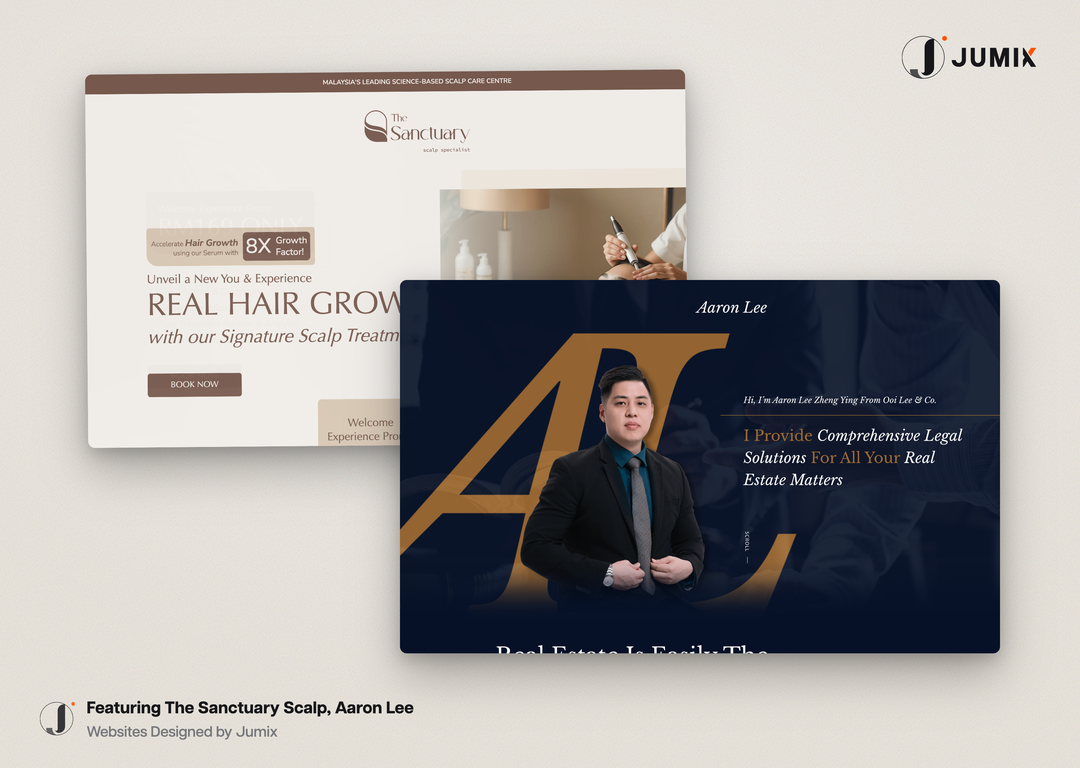
The Sanctuary Scalp and Aaron Lee are proof of the opposite path too.
Both launched with one page built around one offer, and that single page carried the whole result.
A page doesn’t have to grow into a 12-page site just because time passes.
That’s the actual decision framework.
- One offer, paid traffic, fast launch: build a landing page.
- Multiple services, organic search, long-term brand: build a website.
- Not sure yet: start with the landing page. It’s cheaper to be wrong about.
Weighing SEO against paid ads as your first move? Read our take on whether to focus on SEO or paid ads first. The answer shapes which page you build.
If you’re outgrowing an old site rather than starting fresh, our redesign versus new website guide picks up from here.
FAQ
Can a landing page replace a website?
Only for a single offer with paid traffic. Once you offer multiple services or want organic search visibility, a landing page can’t cover it alone.
How long does a landing page take to launch in Malaysia?
A conversion-focused landing page typically takes 1 to 2 weeks, including copywriting and tracking setup. A template version can go live in days.
Do I need both a landing page and a website?
Most growing businesses eventually run both: a website as the permanent brand home, and a landing page for each specific campaign or product launch.
Can I run Google Ads without a landing page?
Yes, but expect a weaker landing page experience score and a higher cost per click. Google factors page relevance into Quality Score (Source: Google Ads Help, 2026).
Does a landing page need to be on my main domain?
No. Many Malaysian businesses run landing pages on a subdomain or a separate URL specifically for a campaign, then keep the main site untouched.
Conclusion
It comes down to what your traffic is doing and what you’re asking it to do next.
One offer and paid clicks means a landing page.
Multiple services, organic search, and long-term trust means a full website.
Get that match wrong and you pay twice. Once in ad spend leaking through the wrong page, then again when you rebuild it anyway.
Jumix builds both, and we’ll tell you honestly which one your business needs first before we build either. Start with our web design service to figure out which one fits your next launch.




Comments are closed for this article!