


A multilingual website in Malaysia works when it targets a specific audience gap, not every visitor at once. Most Malaysian businesses only need two languages done well: English plus either Bahasa Malaysia or Chinese, chosen by who actually buys. Add the third language only when a distinct customer segment cannot convert without it.
- Quick Takeaways
- Do You Actually Need a Trilingual Website?
- Structuring BM, English and Chinese Without Hurting SEO
- Where Translation Quality Makes or Breaks Trust
- Which Industries Get the Biggest Return
- Common Mistakes When Going Multilingual
- FAQ
Quick Takeaways
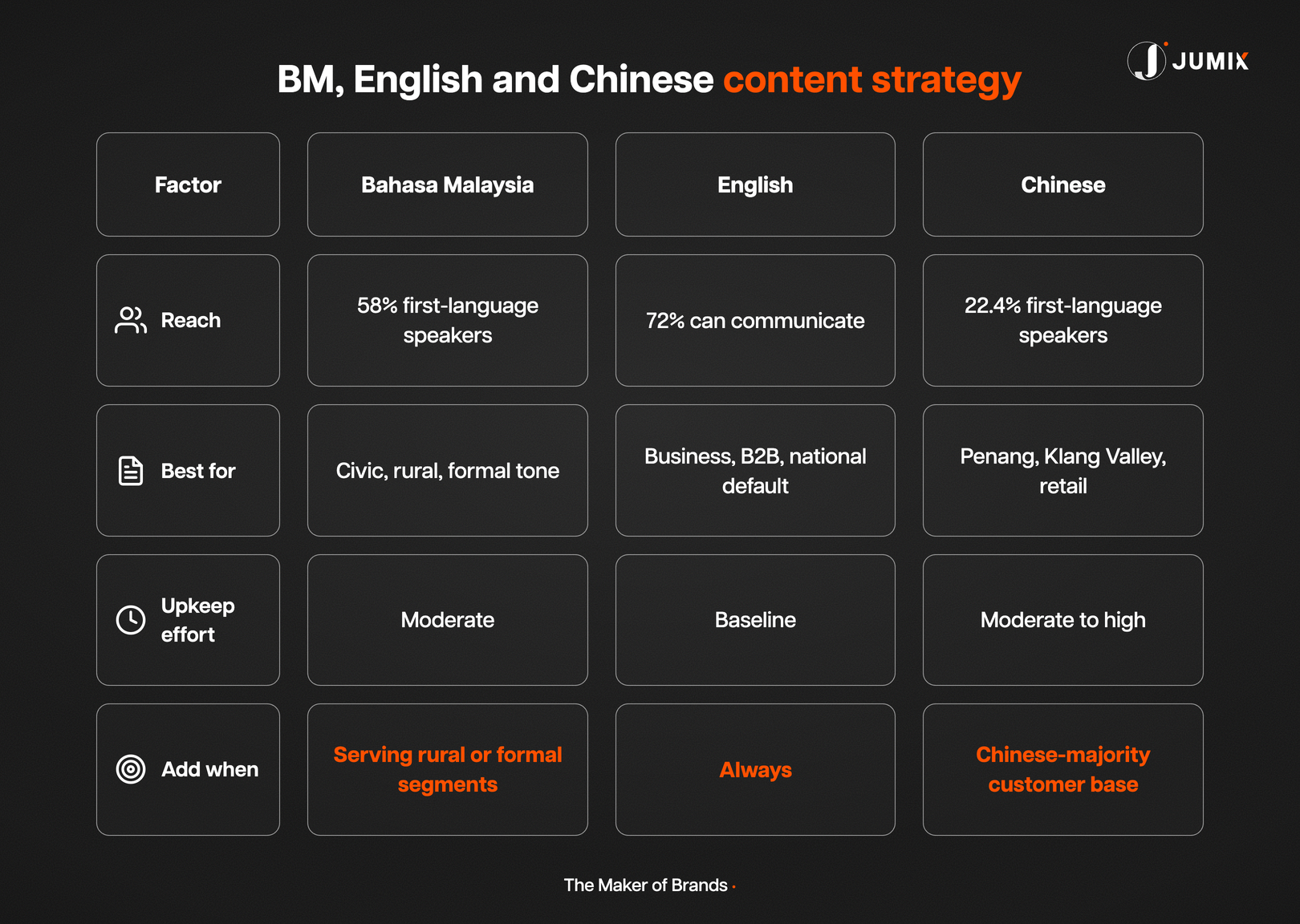
- 19.9 million Malaysians speak Malay as a first language, roughly 58% of the population (Source: DOSM).
- Chinese speakers make up 22.4% of Malaysia’s population, concentrated in Penang, Klang Valley and Johor (Source: DOSM).
- Language selection is one of the factors Malaysian shoppers name when choosing an online store (Source: Journal of Economics and Behavioral Studies).
- Google requires symmetric hreflang tags on every language version, or rankings fragment across regions (Source: Google Search Central).
- Machine-translated Bahasa Malaysia and Chinese content reads as foreign to native speakers, even when grammatically correct.
Every Malaysian business with a website eventually asks the same question.
Should we add Bahasa Malaysia?
Should we add Chinese?
Should we do all three?
The honest answer depends on who buys from you, not on how many languages Malaysia has.
Do You Actually Need a Trilingual Website?

Malay has 19.9 million first-language speakers.
Chinese speakers make up 22.4% of the population.
Roughly 72% of Malaysians can communicate in English to some degree (Source: Languages of Malaysia, Wikipedia summary of census data).
Those numbers do not mean every business needs three languages.
They mean each language unlocks a different segment, and you should only unlock the segment you can serve.
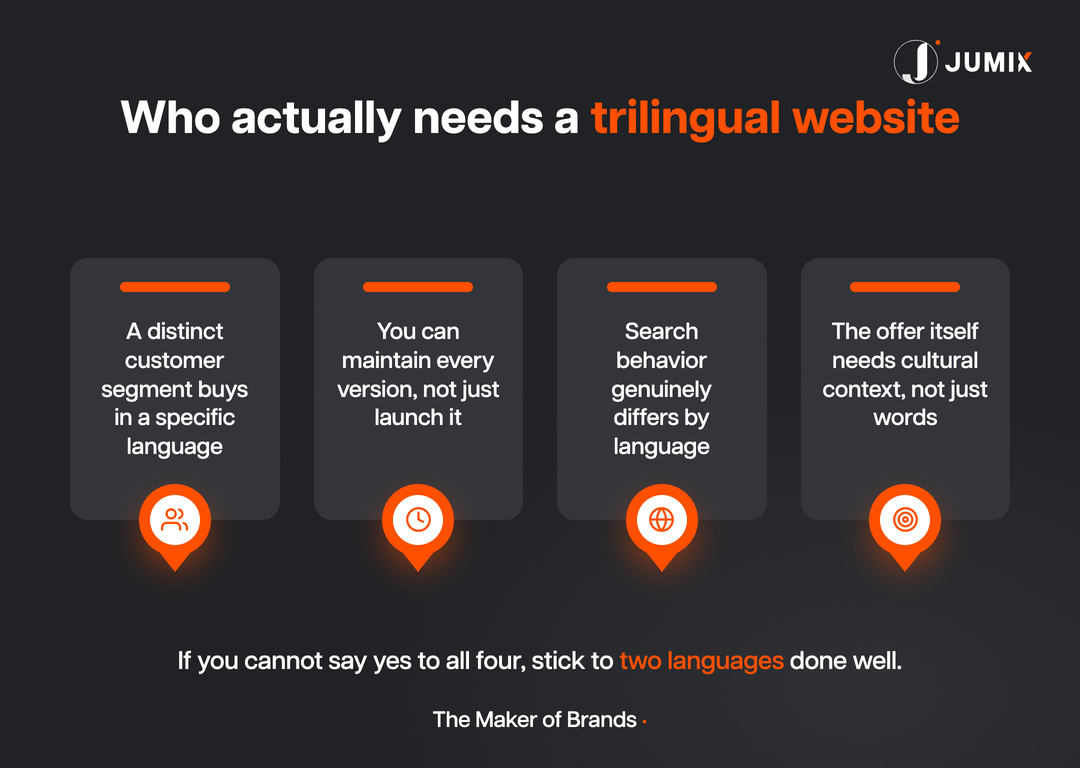
Ask three questions before adding a language.
- Does a meaningful share of my current or target customers prefer this language for buying decisions, not just casual conversation?
- Can I keep this language updated every time I update English content, or will it go stale within a year?
- Does my product or service actually change meaning across cultures, or is it the same offer in different words?
A B2B manufacturer selling to procurement managers rarely needs Chinese.
English carries enough weight in Malaysian business communication.
A preschool in Penang or a retail brand in Klang Valley is a different story.
Parents researching schools, and shoppers comparing prices, often default to the language they trust most, not the language of the ad that brought them there.
A stale language version damages trust faster than no language version at all.
This decision sits inside a bigger set of choices covered in our web design best practices guide for Malaysian businesses.
Visitors read an outdated Chinese page as a sign the business stopped caring about them specifically.
Structuring BM, English and Chinese Without Hurting SEO
Most multilingual SEO failures are not about content quality.
They are technical.
75% of international websites have hreflang errors that fragment their rankings across regions, showing the wrong language version in the wrong market (Source: Google Search Central).
Three rules fix most of that.
- Use subdirectories, not subdomains. /bm/ and /zh/ under your main domain keep link equity together, instead of splitting authority across separate domains.
- Every language version must reference every other version, including itself. A self-referencing hreflang tag on the English page, and matching tags on the BM and Chinese pages, stop Google from guessing which version to rank.
- Set an x-default fallback. Visitors whose browser language does not match any of your three versions still need somewhere to land.
Skip machine-generated language switchers that just append a URL parameter.
Google indexes each language as its own page, and parameter-based switching often confuses that indexing entirely.
Build real, crawlable URLs for every language from the start.
This structure also feeds directly into local SEO for Malaysian businesses, since Google matches language versions to regional searches.
A misconfigured hreflang setup is invisible to your visitors.
It just quietly kills your rankings in the language you built it for.
A working setup looks simple from the outside.
yourbusiness.com for English, yourbusiness.com/bm/ for Bahasa Malaysia, yourbusiness.com/zh/ for Chinese.
Every one of those three pages carries three hreflang tags, one pointing to each version, plus its own self-reference.
Get that wrong on even a handful of pages, and Google starts showing the English page to Chinese-language searchers, or worse, drops the translated pages from the index entirely.
Test the setup with Google Search Console after launch, not just once at the start.
Hreflang errors creep back in every time a developer adds a new page without updating the language map.
Where Translation Quality Makes or Breaks Trust
Direct translation is not localization.
Search behavior changes by language, not just vocabulary.
A Chinese-speaking shopper in Penang does not search the way an English-speaking shopper in Kuala Lumpur does, even for the same product.
We rebuilt Fun Home, a play-based preschool in Kuala Lumpur, around parent trust rather than a generic curriculum listing.
Parents researching preschools want to feel understood before they book a tour.
The same principle applies harder once a second or third language enters the picture.
A literal Bahasa Malaysia translation of an English tagline often reads stiff, or worse, unintentionally comic.
A native copywriter rewrites the intent, not the sentence.
For Fun Home, that meant more than swapping English words for Chinese ones on the programme pages.
Parents scanning a preschool website in their own language expect the same warmth and clarity they get in English.
A cold, literal translation of “play-based learning” undercuts exactly the trust the design was built to create.
The lesson carries beyond education.
Any business selling on emotion, whether it is a clinic, a hotel, or a retail brand, loses that emotion the moment translation feels mechanical.
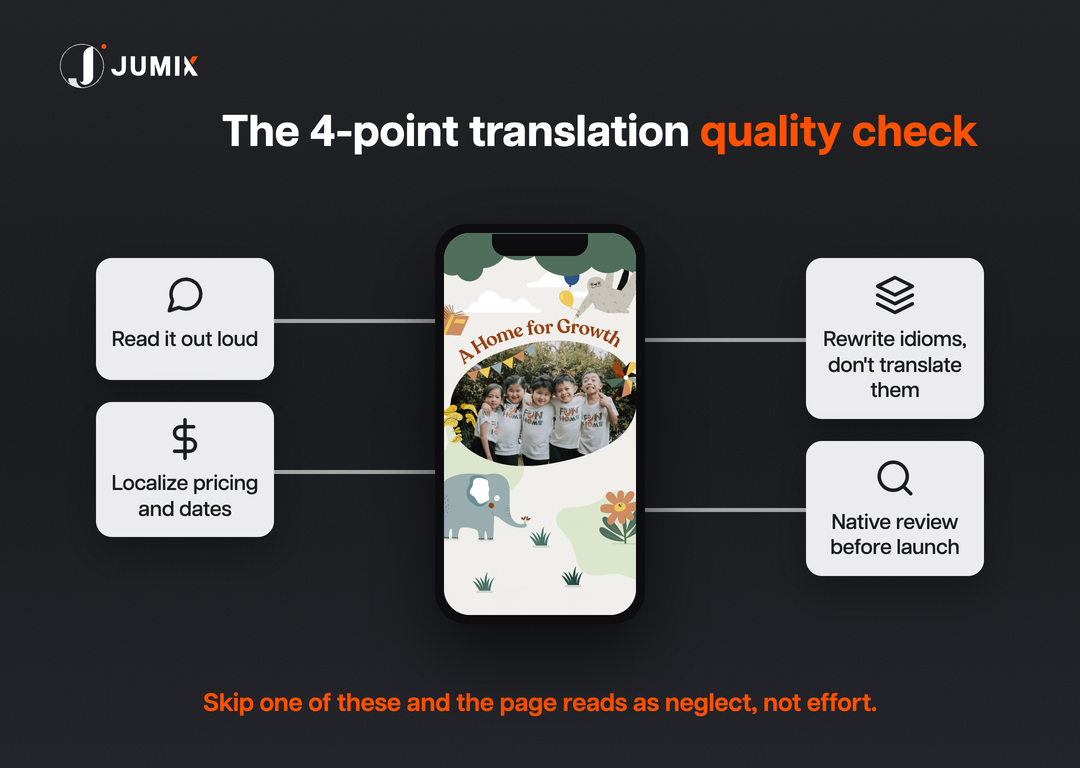
Four checks catch most translation failures before launch.
- Read the translated page out loud. Stiff phrasing sounds wrong before it reads wrong.
- Check pricing and dates are localized, not just the surrounding sentence.
- Confirm idioms and puns are rewritten, not translated word for word.
- Have a native speaker who is not the translator review the final page.
Skip any of these four, and the translated page becomes a trust problem instead of a growth channel.
Which Malaysian Industries Get the Biggest Return
Not every industry gets the same lift from a second or third language.
The table below reflects patterns we see across client industries and language demographics by region (Source: DOSM).
| Industry | Languages that matter most | Why |
|---|---|---|
| Education (preschool, tuition) | English + BM or Chinese | Parents research in the language they trust for their child’s future |
| Retail and F&B (Penang, Klang Valley) | English + Chinese | High concentration of Chinese-speaking buyers in these regions |
| Government-linked or rural-facing services | BM primary, English secondary | Bahasa Malaysia is the default for formal and civic communication |
| B2B manufacturing and industrial | English only, usually | Procurement communication is overwhelmingly conducted in English |
| Healthcare and clinics | English + BM, add Chinese in Chinese-majority areas | Patients want to describe symptoms in their most comfortable language |
Location changes this table more than industry does.
A retail brand based in Penang serves a different language mix than the same brand based in Johor Bahru.
Check your own customer data before assuming the table applies to you directly.
For the AI search angle on top of this, see our guide on winning AEO and GEO in Malaysia, since AI answer engines also weigh language-matched content.
Common Mistakes When Going Multilingual

- Translating the homepage only, then leaving the rest in English. Visitors bounce the moment the language switch turns out to be cosmetic.
- Auto-translating without native review. Machine translation catches grammar, not tone or intent.
- Forgetting to translate metadata. A Chinese page with an English meta title and description confuses search engines and visitors alike.
- Adding a third language before the first two are stable. Half-finished coverage across three languages performs worse than solid coverage across two.
- No plan to maintain every version. A language version updated once a year signals neglect, not inclusion.
Most of these mistakes come from treating translation as a launch task instead of an ongoing commitment.
Budget for upkeep before you budget for the first translation.
Our website development checklist for Malaysian businesses covers the same discipline for launch readiness generally.
FAQ
Do I need a multilingual website if most of my customers speak English?
No. If English genuinely serves your audience, adding BM or Chinese without a real segment behind it adds maintenance cost without adding conversions.
Should I use subdirectories or separate domains for each language?
Subdirectories, in almost every case. They keep your domain authority consolidated instead of splitting SEO equity across separate properties.
Is machine translation good enough for a business website?
Not on its own. Use it as a first draft, then have a native speaker rewrite tone, pricing format, and idioms before publishing.
How much does adding a second language to a website cost in Malaysia?
Translation and native review for a mid-size site typically runs a few thousand ringgit, on top of the development work to build the language-switching structure correctly.
Which language should I add first, Bahasa Malaysia or Chinese?
Whichever language your highest-value customer segment actually uses to make buying decisions. Check your own enquiry and sales data instead of guessing from national demographics.
The Bottom Line
A multilingual website is not a box to tick.
It is a commitment to a specific audience, maintained at the same standard as your main site.
Start with the language your best customers actually use.
Build the hreflang structure correctly from day one, so search engines reward the effort instead of splitting it apart.
Add a third language only once the first two run without gaps.
Jumix builds Malaysian business websites, including multilingual structures done right the first time. Our web design service handles the technical setup, the translation review process, and the ongoing maintenance so no language version goes stale.




Comments are closed for this article!