




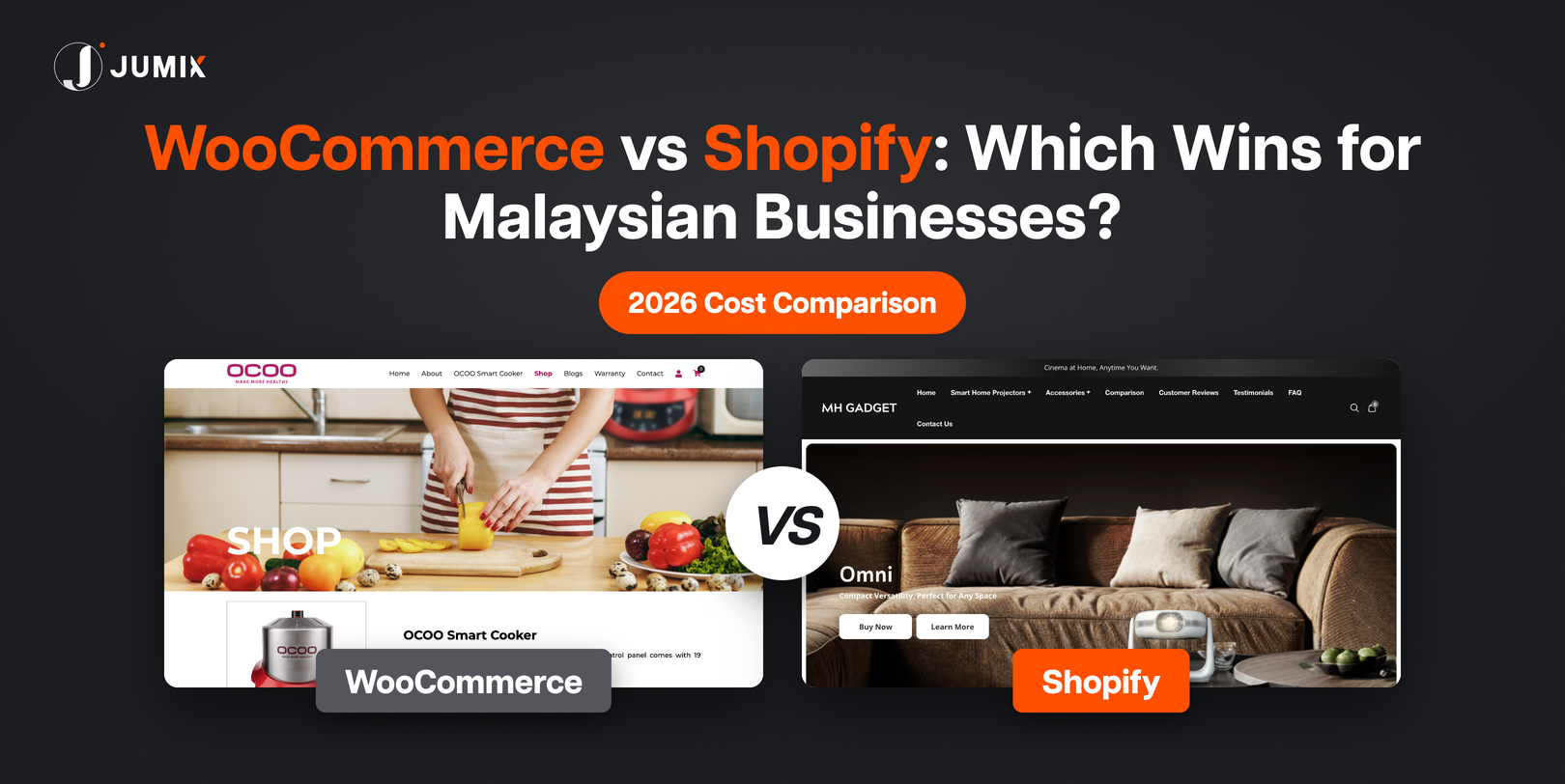
Shopify costs more upfront but less to run. WooCommerce is free to install but needs RM4,000 to RM6,000 a year in hosting, plugins and developer time. For most Malaysian businesses under RM50,000 monthly revenue, Shopify wins on total cost. Above that, WooCommerce’s flexibility starts paying for itself.
- Quick Takeaways
- What WooCommerce and Shopify Actually Are
- The Real 3-Year Cost Breakdown
- Payment Gateways in Malaysia
- Maintenance Burden: Who Manages What
- Which Platform Fits Your Business Stage
- Common Mistakes Malaysian Sellers Make
- FAQ
Quick Takeaways
- Shopify’s cheapest usable plan runs $25 a month (about RM115), but Malaysian stores pay an extra 0.6% to 2% transaction fee since Shopify Payments isn’t available here.
- WooCommerce has no license fee, but real 3-year cost lands between RM12,000 and RM42,000 once hosting, security patching and developer time are counted.
- Malaysian gateways like Fiuu and Adaptis don’t publish flat rates. Expect a quote in the 1.8% to 3.5% range once you factor in cards, FPX and e-wallets (Source: Airwallex payment gateway guide, 2026).
- Stores under RM50,000 a month usually save money and time on Shopify. Stores with complex catalogs or existing WordPress content usually save more on WooCommerce.
- The platform is rarely the reason a Malaysian store fails to grow. Poor product-market fit and weak checkout UX cost more than any monthly plan.
Every Malaysian founder building an online store asks the same question eventually.
WooCommerce or Shopify?
Most comparisons online answer with feature checklists. Checkout customization. App marketplaces. Theme flexibility. None of that tells you what you’ll actually pay in year one, year two, and year three, in ringgit, once you factor in Malaysian payment gateways and the hosting and developer costs nobody puts on the pricing page.
We’ve built stores on both platforms for Malaysian brands. This breaks down the real cost, the payment gateway reality, and who each platform actually suits.
What WooCommerce and Shopify Actually Are

WooCommerce is a free plugin that turns WordPress into a store.
You own the code. You choose the hosting. You install every payment gateway, security patch, and backup system yourself, or pay someone to.
Shopify is a hosted platform. You rent the infrastructure.
Servers, SSL, CDN, uptime and PCI compliance are handled for you. You pay a monthly subscription and, in Malaysia, a small transaction fee on top because Shopify Payments doesn’t operate here (Source: Airwallex Malaysia, 2026).
That single difference, hosted versus self-hosted, drives almost every cost and maintenance decision that follows.
The Real 3-Year Cost Breakdown
Shopify’s Basic plan is $25 a month, roughly RM115 (Source: Shopify official pricing, 2026).
WooCommerce’s plugin costs RM0. On paper, WooCommerce wins immediately.
In practice, the sticker price is 5% to 15% of what you’ll actually spend over three years.
WooCommerce needs hosting (RM50 to RM400 a month for anything that won’t crash during a sale), premium plugins for shipping and tax, security monitoring, and a developer on standby when a plugin update breaks your checkout. Add it up and real-world WooCommerce total cost of ownership tends to land between RM4,300 and RM14,100 a year after the first year of setup, depending on store size.
Shopify bundles hosting, security and scaling into the subscription. Equivalent Shopify setups typically run RM2,700 to RM11,400 a year for stores at a similar size.
| Cost item (yearly) | WooCommerce | Shopify (Basic) |
|---|---|---|
| Platform / license | RM0 | ~RM1,380 |
| Hosting | RM600–RM4,800 | Included |
| Security & SSL | RM300–RM1,200 | Included |
| Premium plugins / apps | RM800–RM3,600 | RM0–RM2,400 |
| Developer maintenance | RM2,000–RM6,000 | RM0–RM1,500 |
| Estimated yearly total | RM4,300–RM14,100 | RM2,700–RM11,400 |
The crossover point matters more than either total.
Below roughly RM50,000 in monthly revenue, Shopify’s bundled costs beat WooCommerce’s developer invoices almost every time. Past that revenue level, or once you need custom logic Shopify’s app store can’t cheaply replicate, WooCommerce’s ownership starts paying for itself. Our Shopify cost breakdown for Malaysia covers the design and setup side of this budget in more depth.
Payment Gateways in Malaysia
Neither platform solves your payment gateway for you. This is where most cost comparisons written for a US audience fall apart for a Malaysian store.
Shopify Payments, the built-in option most global comparisons assume you’ll use, isn’t available in Malaysia. You connect a third-party gateway like Fiuu or Adaptis instead, and Shopify charges an extra transaction fee for the privilege: 2% on Basic, dropping to 0.6% on Advanced (Source: Shopify official pricing, 2026).
WooCommerce has no such penalty. Any Malaysian gateway plugs in directly, and you keep whatever rate you negotiate.
- Fiuu covers cards, FPX and e-wallets under one integration, but doesn’t publish its rates. You register through its merchant portal or contact sales for a quote.
- Adaptis (the merged iPay88 and eGHL platform) takes a similar quote-based approach, with setup and annual fees layered on top of percentage-based charges for stores with heavier card and e-wallet volume (Source: Airwallex payment gateway guide, 2026).
Both integrate cleanly with WooCommerce and Shopify. The gateway fee, not the platform fee, is usually the bigger line item once you’re doing real volume. See our full Malaysian ecommerce payment gateway guide for setup steps on each provider.
Maintenance Burden: Who Manages What
This is the cost that never shows up on a pricing page.
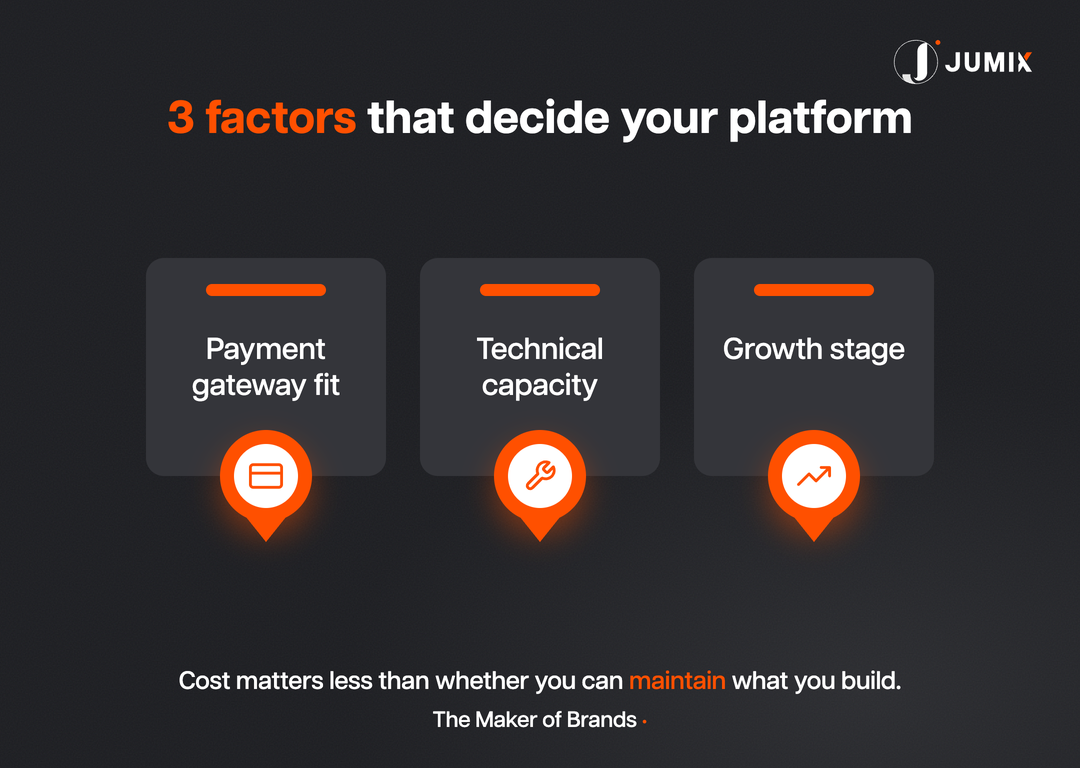
WooCommerce runs on WordPress, and WordPress is the most attacked CMS on the internet purely because of how widely it’s used. Every plugin is a potential vulnerability. Every core update can break a theme. Someone has to own that, every month, indefinitely.
We’ve seen Malaysian store owners try to run WooCommerce without a maintenance plan. It works fine for four, five months. Then a plugin conflict takes checkout down during a campaign, and nobody notices for two days.
Shopify removes that layer entirely. Updates, uptime, and PCI compliance are Shopify’s problem, not yours. You still need someone who understands the platform for theme edits, app conflicts and checkout customization, but the failure mode is smaller.
If you don’t have in-house technical capacity and don’t want to hire for it, that gap alone often decides the platform question before cost even enters the conversation.
Which Platform Fits Your Business Stage
Thirtydots, a sleepwear brand launching from zero, needed to look premium on day one without a development team behind it. We built their store on Shopify. A clean checkout, fast page speed and zero server management meant they could focus entirely on product photography and launch, not plugin updates.
Mofu Mofu Pet Food moved off Shopee and Lazada entirely onto a Shopify DTC store to escape marketplace fees and own their customer data. For a founder-led team without an internal developer, Shopify’s bundled maintenance was the difference between shipping a store in weeks versus months.
Neither business needed WooCommerce’s deeper customization. That’s the pattern we see most often, and it echoes what we’ve watched happen as Malaysian sellers move off marketplaces onto their own stores: speed to launch usually beats platform depth for a first store.
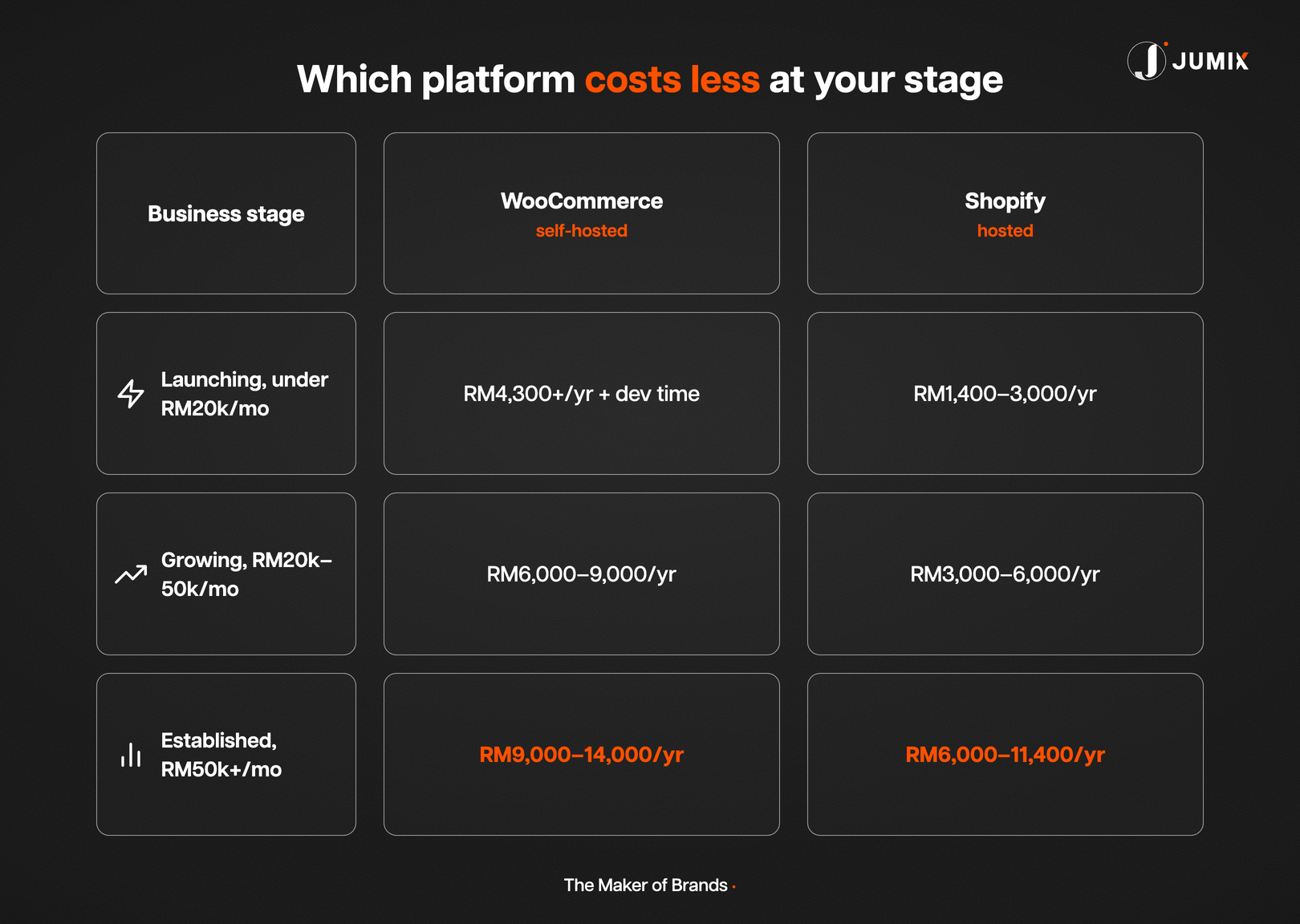
- Choose Shopify if you’re launching new, have no in-house developer, or need to move fast on a tight team.
- Choose WooCommerce if you already run a WordPress site with real content and SEO equity, need deep catalog logic Shopify apps can’t cheaply replicate, or have a developer on retainer already.
- Revenue past RM50,000/month with complex operations tips the long-term math toward WooCommerce, provided you already have technical support in place.
Common Mistakes Malaysian Sellers Make

Choosing WooCommerce to save RM115 a month, then paying a freelancer RM500 every time something breaks. Over a year, that’s more expensive than Shopify ever would have been.
Choosing Shopify’s cheapest plan, then getting stuck on the 2% third-party gateway fee at real volume without ever checking whether upgrading to a higher plan would pay for itself through the lower rate.
Ignoring the payment gateway entirely until launch week, then discovering FPX approval takes two to three weeks and missing a planned launch date.
Treating the platform choice as permanent. It isn’t. Migrating from WooCommerce to Shopify or back causes real downtime and rework, but it’s not rare, and it’s far less costly than staying on the wrong platform for two years.
FAQ
Is WooCommerce really free?
The plugin is free. Hosting, premium plugins, security and developer time are not. Budget RM4,000 to RM14,000 a year for a real, maintained store.
Why does Shopify charge extra fees in Malaysia?
Shopify Payments isn’t available here, so you connect a third-party gateway like Fiuu or Adaptis. Shopify charges 2% to 0.6% extra on transactions when you use a third-party processor, scaling down as you move to higher plans.
Can I switch from WooCommerce to Shopify later?
Yes. Product data, customer records and order history can be migrated. Expect to rebuild custom logic and lose some SEO equity during the transition, so plan the switch outside peak sale periods.
Which platform is better for SEO in Malaysia?
WooCommerce has an edge for content-heavy SEO strategies because it inherits WordPress’s blogging and plugin ecosystem directly. Shopify’s SEO has improved significantly and is fully capable for a standard product-led store, just less flexible for large content operations.
Do I need a developer for either platform?
WooCommerce effectively requires ongoing developer access. Shopify can be run by a non-technical owner day-to-day, but still benefits from professional setup to avoid the common mistakes above.
Choosing the Platform That Fits Your Business
The platform debate gets more attention than it deserves.
Shopify wins on speed and lower maintenance for most Malaysian businesses starting out or running lean. WooCommerce wins for stores that already have WordPress equity, complex catalogs, or a developer on hand to justify the extra control.
What decides success afterward isn’t the platform. It’s whether the store is built around how Malaysian customers actually pay, browse and trust a brand online.
Jumix builds both WooCommerce and Shopify stores for Malaysian businesses, and helps you pick the one that fits your stage, not just your budget. Explore our Shopify development service to see how we approach platform selection and build.




Comments are closed for this article!