





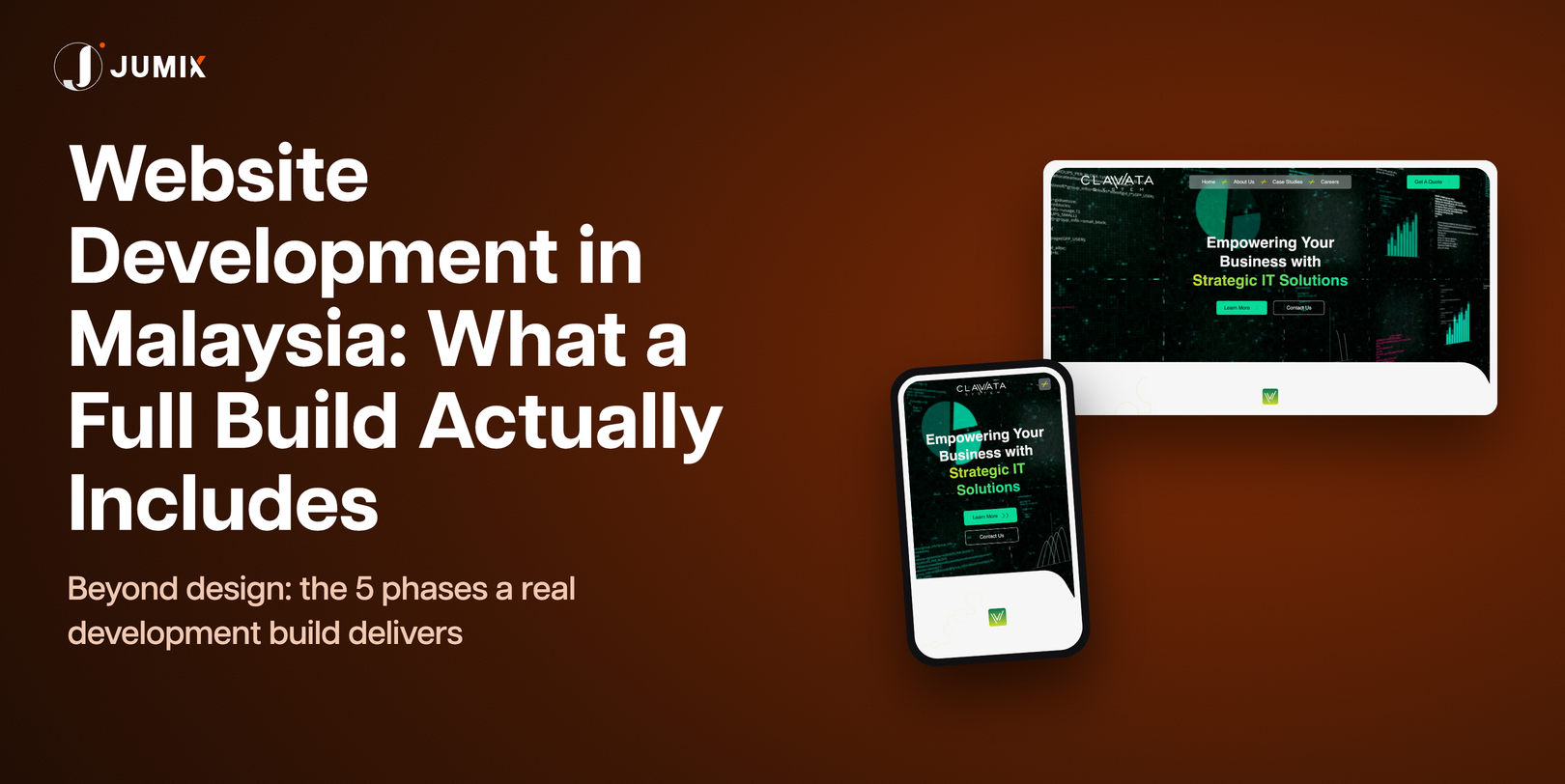
Website development in Malaysia means the coding, CMS setup, integrations and testing that turn an approved design into a working site, not the visual design itself. A full build runs 5 phases: discovery, front-end build, back-end and CMS setup, QA testing, and hosting plus launch, typically taking 4 to 10 weeks and costing RM3,000 to RM30,000 or more depending on scope.
- Quick Takeaways
- What “Website Development” Actually Means
- 5 Phases of a Website Development Build in Malaysia
- Website Builder vs WordPress vs Custom Code
- What a Full Build Costs in Malaysia
- Testing and Launch: What “Done” Actually Means
- Mistakes That Turn a Build Into a Rebuild
- FAQ
Quick Takeaways
- “Website design” and “website development” are different jobs. Design is the look. Development is the working code, CMS and integrations behind it.
- A full build runs 5 phases: discovery, front-end build, back-end and CMS setup, QA testing, and hosting plus launch.
- WordPress covers most small and mid-sized Malaysian business builds. Custom code only pays off past a certain complexity.
- Full builds in Malaysia typically run RM3,000 to RM30,000 or more and take 4 to 10 weeks.
- Skipping QA testing or launch handover is the most common way a new build turns into a rebuild within 2 or 3 years.
Someone signs a website contract every day in Malaysia.
Half of them think “design” and “development” mean the same job.
Design is the layout and the visuals. Development is the code, the database, the CMS, and every button that has to actually work.
27.3% of Malaysian business establishments still had no web presence in 2023 (Source: Department of Statistics Malaysia, Malaysia Digital Economy 2025).
For the rest, the gap is usually a scoping problem. Nobody explained what a full build actually includes.
Here’s what you’re actually paying for.
What “Website Development” Actually Means

Web design and web development are two different jobs bundled into one quote.
Design covers layout, color, typography, and user experience: how the site looks and feels.
Development covers everything that makes those design files function: front-end code, the content management system, database structure, forms, payment integrations, and hosting.
A design mockup in Figma is just a picture of a website. Development turns that picture into something a customer can click, fill in, and buy from.
In practice, “development” covers a specific set of tasks:
- Writing the front-end code that makes the design responsive on every screen size
- Setting up and configuring the CMS so your team can edit content without touching code
- Connecting payment gateways, booking systems, or a CRM to the site
- Structuring the database behind product catalogs, bookings, or enquiry forms
- Setting up SSL, backups, and basic security hardening before launch
None of that shows up in a design mockup. All of it decides whether the site actually runs your business.
Different businesses need different development work behind the same-looking homepage. An IT solutions provider like Clavata System needs a back-end that supports technical documentation and enterprise enquiries. A bistro’s site just needs a menu, a map, and a booking form.
Some agencies quote “web design” and deliver a template with your logo swapped in. No custom development, no CMS training, no integration testing.
For a simple brochure site, that can be a fair trade.
Just know which one you’re paying for.
5 Phases of a Website Development Build in Malaysia
A proper build runs through 5 phases, whether the agency calls them that or not.
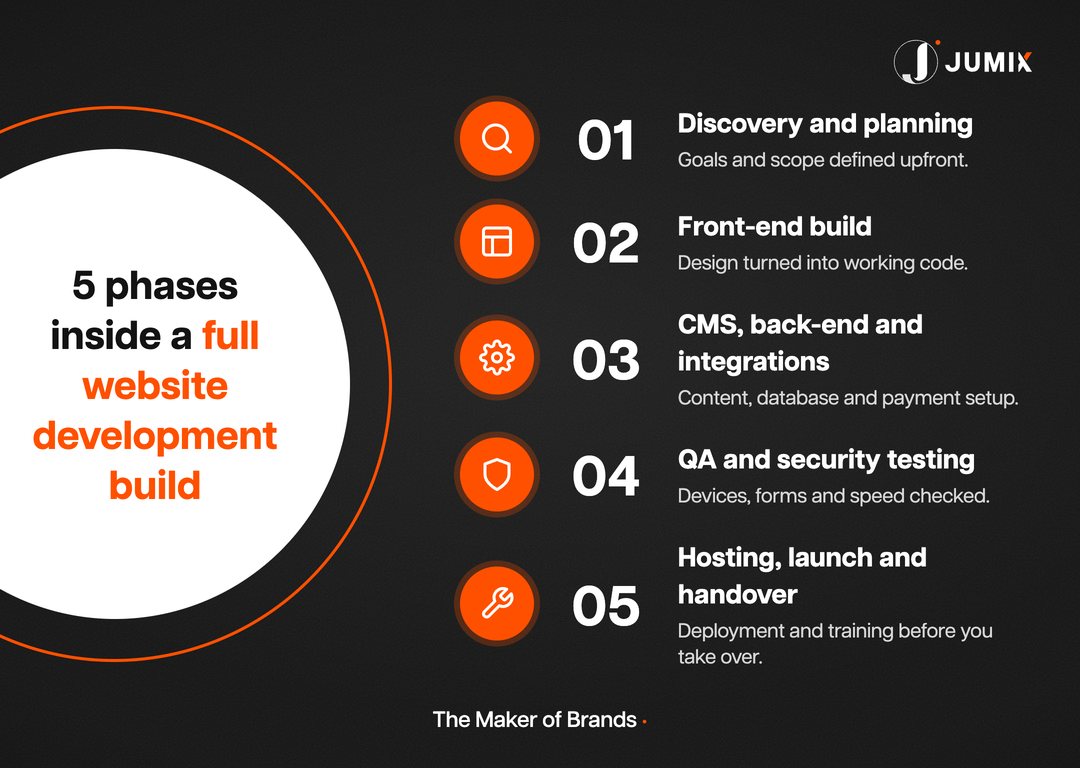
Discovery and planning (usually 3 to 7 days). Goals, target customers, page structure, and content requirements get mapped out before anyone touches code.
Front-end build (1 to 3 weeks). Approved designs get turned into working code, responsive across phone, tablet, and desktop.
Back-end, CMS, and integrations (1 to 4 weeks). This is where the CMS gets configured, the database gets structured, and payment gateways, booking systems, or CRMs get connected. Complex integrations are usually what stretches a timeline, not the design.
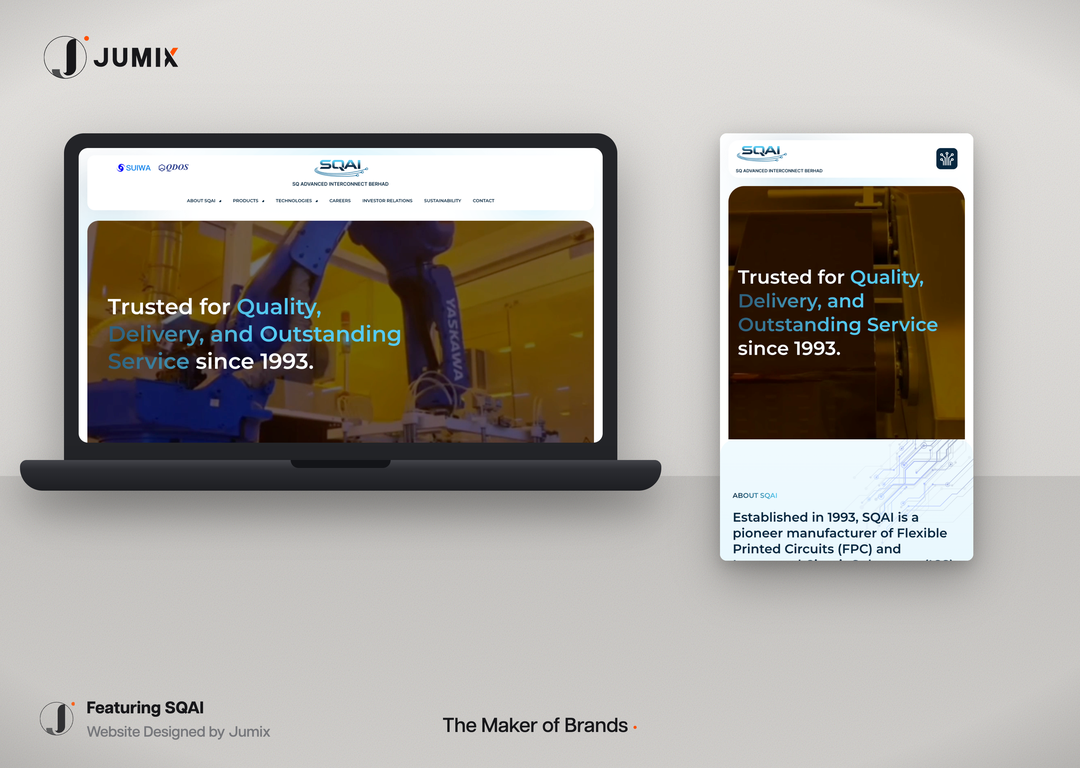
SQAI needed exactly this kind of back-end. A holding company with subsidiaries already online, but no cohesive corporate platform of its own. The site had to structure content across multiple business units, not just serve a homepage.
QA and security testing (3 to 7 days). Every form, link, and payment flow gets tested across browsers and devices before launch, not after a customer complains.
Hosting, launch, and handover (1 to 3 days). The site goes live on real hosting, DNS gets pointed, and someone on your team gets shown how to update it without calling the developer every time.
Skip any one of these and the site either breaks quietly or turns into a rebuild within 2 years.
Website Builder vs WordPress vs Custom Code
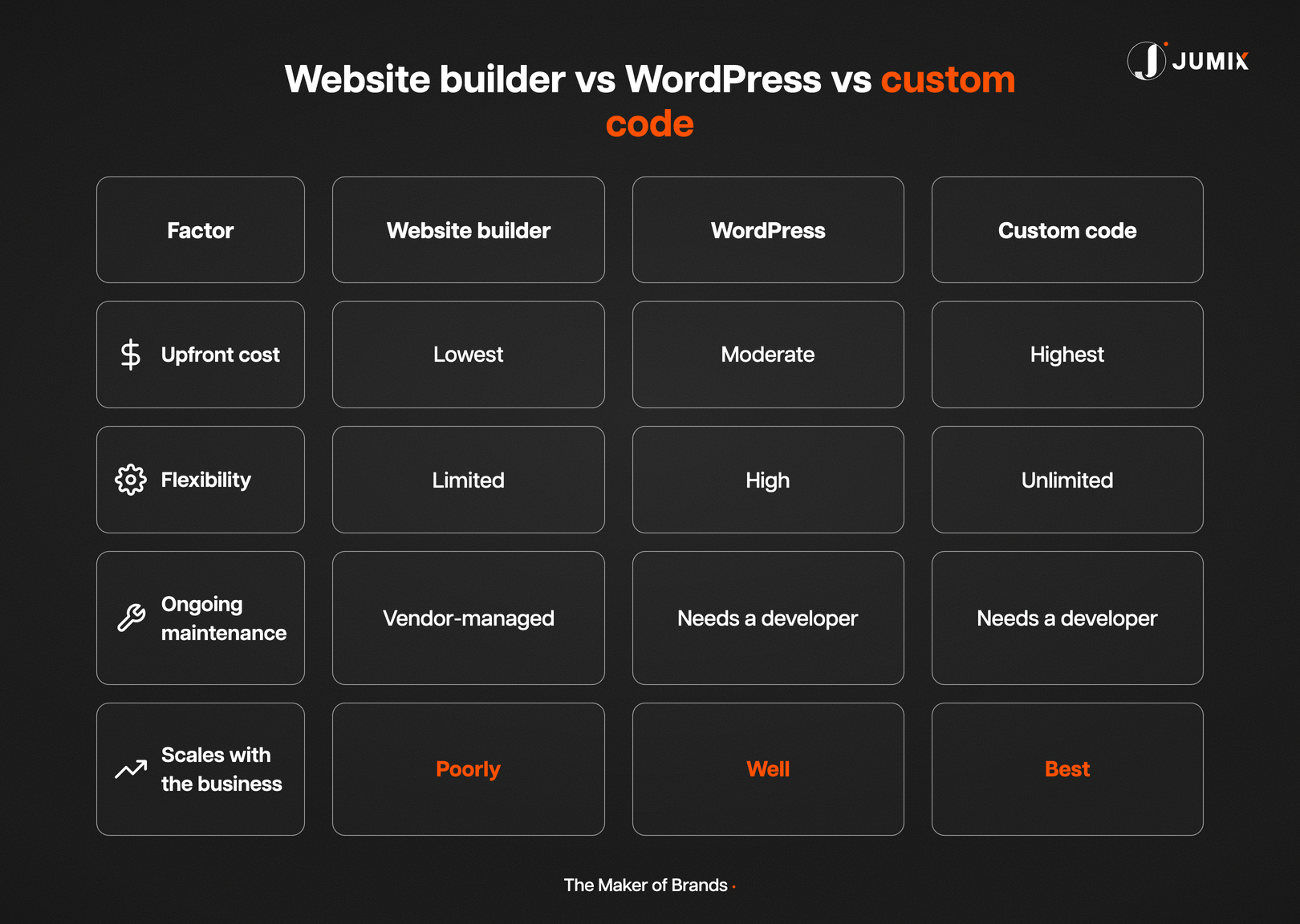
The CMS you pick decides how much freedom, and how much maintenance, you’re signing up for.
A drag-and-drop builder gets a business online fastest, but it’s the most limited once you outgrow the template.
WordPress covers the vast majority of small and mid-sized Malaysian business sites. Enough flexibility for custom features, without the cost of building everything from scratch.
Custom-coded platforms make sense once a business needs something plugins can’t handle cleanly: complex booking logic, custom internal dashboards, or high-traffic e-commerce.
Hosting requirements scale with the platform too. A brochure site on WordPress runs fine on shared hosting. A custom-coded platform with a large database usually needs cloud hosting built for the traffic and queries it handles.
| Factor | Website builder | WordPress | Custom code |
|---|---|---|---|
| Upfront cost | Lowest | Moderate | Highest |
| Flexibility | Limited | High | Unlimited |
| Ongoing maintenance | Vendor-managed | Needs a developer | Needs a developer |
| Scales with the business | Poorly | Well | Best |
We’ve compared WordPress and Shopify in more depth in our WooCommerce vs Shopify breakdown if e-commerce is the deciding factor.
What a Full Build Costs in Malaysia
Cost follows scope, not page count.
A brochure site on WordPress with standard features runs roughly RM3,000 to RM8,000. Add custom functionality, integrations, or a bigger content library, and that climbs to RM8,000 to RM20,000. Fully custom-coded platforms with complex back-end logic start around RM20,000 and climb from there.
3 things move that number beyond the page count.
The number of integrations: a payment gateway, a booking system, and a CRM each add development and testing hours. The volume of content that needs migrating from an old site. And whether CMS training runs for one session or several, so your team can actually run the site after handover.
We’ve broken down redesign-specific pricing in our website redesign cost guide, and hosting and domain costs separately in our hosting and domain pricing guide.
Neither of those replaces this one. This is the build itself, not what comes after.
Testing and Launch: What “Done” Actually Means

A polished screenshot on your laptop doesn’t test anything.
Readiness means the site works across the browsers and devices your customers actually use.
In Malaysia, that means Chrome and Safari above everything else. Chrome holds 56% of mobile browser share here, Safari 37% (Source: Statcounter, 2026).
Speed matters just as much. Google’s thresholds for a good page experience are Largest Contentful Paint under 2.5 seconds, Interaction to Next Paint under 200 milliseconds, and layout shift under 0.1 (Source: Google Search Central, 2026).
We cover these benchmarks in more detail in our 2026 website speed guide.
QA should also cover every form submission, every payment flow, and every link on the site. Test them before launch, not after a customer emails you about it.
Security checks belong in the same phase, not a separate one. An SSL certificate, a working backup schedule, and spam protection on every form are the baseline, not extras to add later.
A site that passes design review but skips this phase looks ready. It works right up until the first real customer breaks it.
Mistakes That Turn a Build Into a Rebuild
Treating design as the whole project is the most common one.
A beautiful homepage with no CMS training behind it means every future update needs a developer, forever.
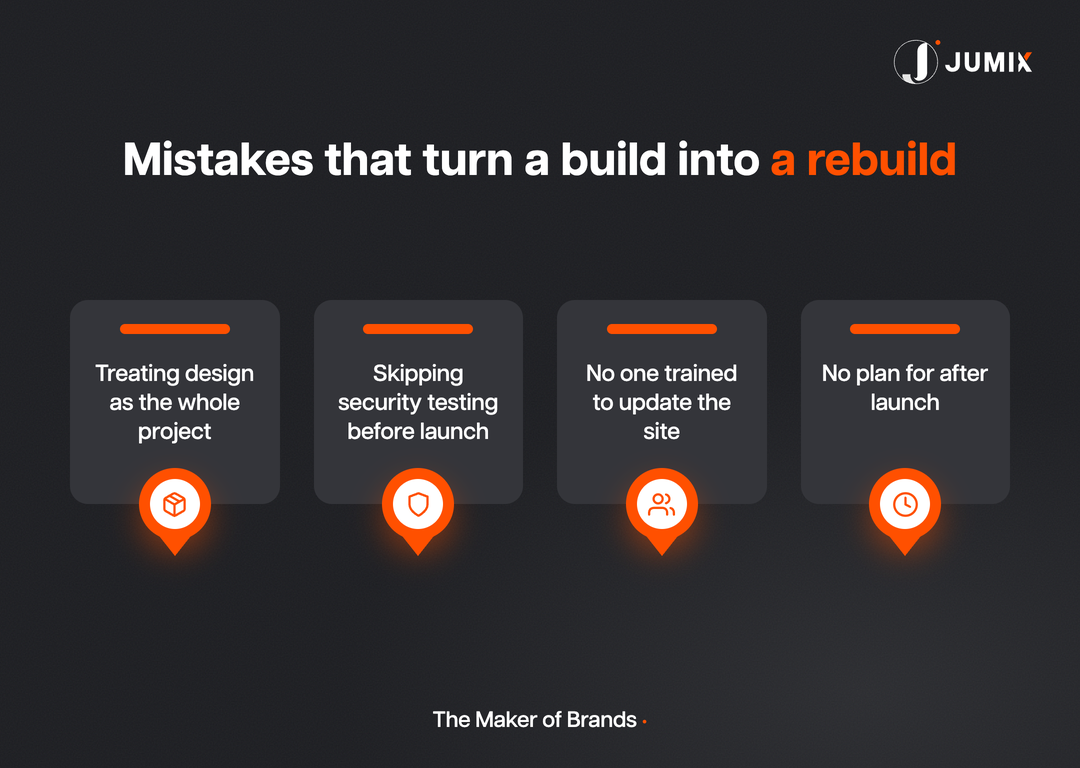
Skipping security testing is the second. An unpatched plugin or an exposed admin login turns into a hacked site within months.
No one trained to update the site is the third. If only the developer knows how to change a price or add a product, the business doesn’t own its own website.
And no plan for after launch. A site with no maintenance, no backups, and no one watching for issues degrades quietly until something breaks in public.
We’ve written a full recovery framework for businesses stuck in that exact position in what to do when your web designer disappears.
The cheapest proposal often becomes the most expensive decision. I’ve seen businesses rebuild within 2 or 3 years because the first build wasn’t scoped for where they were headed.
FAQ
What’s the difference between web design and web development?
Design is the visual layout: colors, typography, and user experience. Development is the code, CMS, and integrations that make that design actually function as a working site.
How long does a full website development build take in Malaysia?
A standard WordPress build takes 4 to 6 weeks. Custom-coded platforms with complex integrations can run 8 to 12 weeks or longer, depending on scope.
Do I need a custom-coded website, or is WordPress enough?
WordPress covers most small and mid-sized business needs. Custom code only pays off once you need functionality plugins can’t handle cleanly, like custom booking logic or high-traffic e-commerce.
What happens after my website launches?
A responsible build includes handover training so your team can make basic updates, plus a plan for backups, security patches, and ongoing maintenance.
How much does website development cost in Malaysia?
Standard WordPress builds run RM3,000 to RM20,000 depending on features. Fully custom-coded platforms typically start around RM20,000.
Buy the Build, Not Just the Look
Website development in Malaysia is the code, CMS, and testing behind every site that actually works, not just the design layer on top of it.
Before you sign anything, ask which of the 5 phases your quote actually covers.
If the answer stops at design, you’re paying for a picture of a website. The working thing needs the other 4 phases too.
At Jumix, our web design and development team scopes every build around all 5 phases from the start, because a site that only looks finished isn’t finished.







Comments are closed for this article!