



Quick Takeaways
- Shopify’s monthly plan is the entry ticket. Total cost runs 3 to 4x higher once you add everything up.
- Themes, apps, transaction fees, and setup costs all stack. None of them are optional if you’re serious.
- Shopify charges a transaction fee on every sale, on top of your payment gateway fee. Shopify Payments isn’t available in Malaysia, so this hits every order.
- A poorly chosen theme or app costs more to undo than to get right the first time.
- Pick the wrong Shopify partner and you’ll spend twice to rebuild what they got wrong.
- The real cost of a Shopify website
- The 5 layers of Shopify website cost in Malaysia
- Layer 1: Shopify subscription plan
- Layer 2: Shopify theme cost
- Layer 3: Shopify apps (the subscription that grows)
- Layer 4: Transaction fees
- Layer 5: Website design and setup cost
- What is the total Shopify cost in Malaysia?
- How to choose the right Shopify partner in Malaysia
- Frequently Asked Questions
- Conclusion
The real cost of a Shopify website
Most people Google “Shopify price Malaysia” and find one number: the monthly plan.
They sign up expecting to pay USD 39 a month. Then the bills start arriving.
A theme here. An app there. Payment gateway fees. Transaction fees on top of that. A designer to make it look like an actual store. Suddenly the “affordable” platform costs three times what they budgeted.
Shopify documents all of these costs. They’re just spread across the pricing page, the app store, and the payment settings. Nobody puts them in one place and adds them up.
This article does.
If you’ve already decided that eCommerce is the right move for your business, here’s exactly what you need to budget for before you launch a single product.
The 5 layers of Shopify website cost in Malaysia
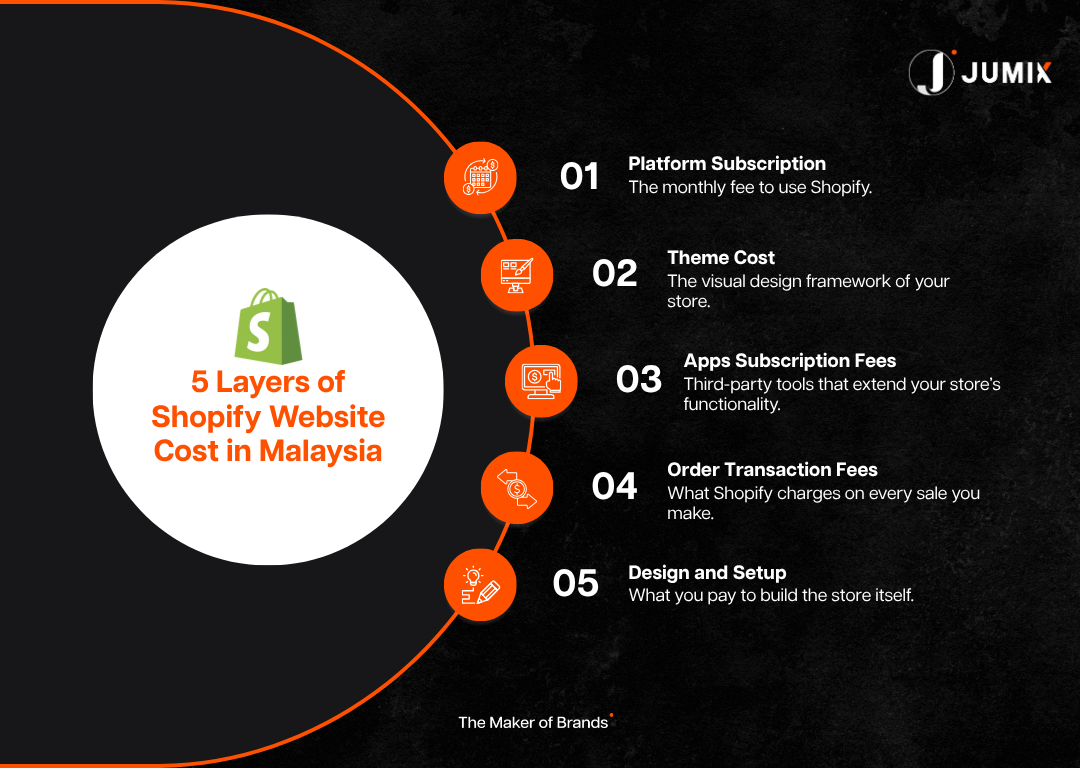
Your Shopify cost breaks into 5 separate layers:
- Platform subscription: the monthly fee to use Shopify
- Theme: the visual design framework of your store
- Apps: third-party tools that extend your store’s functionality
- Transaction fees: what Shopify charges on every sale you make
- Design and setup: what you pay to build the store itself
Each layer is real. Ignore any one of them and your budget will break.
Layer 1: Shopify subscription plan
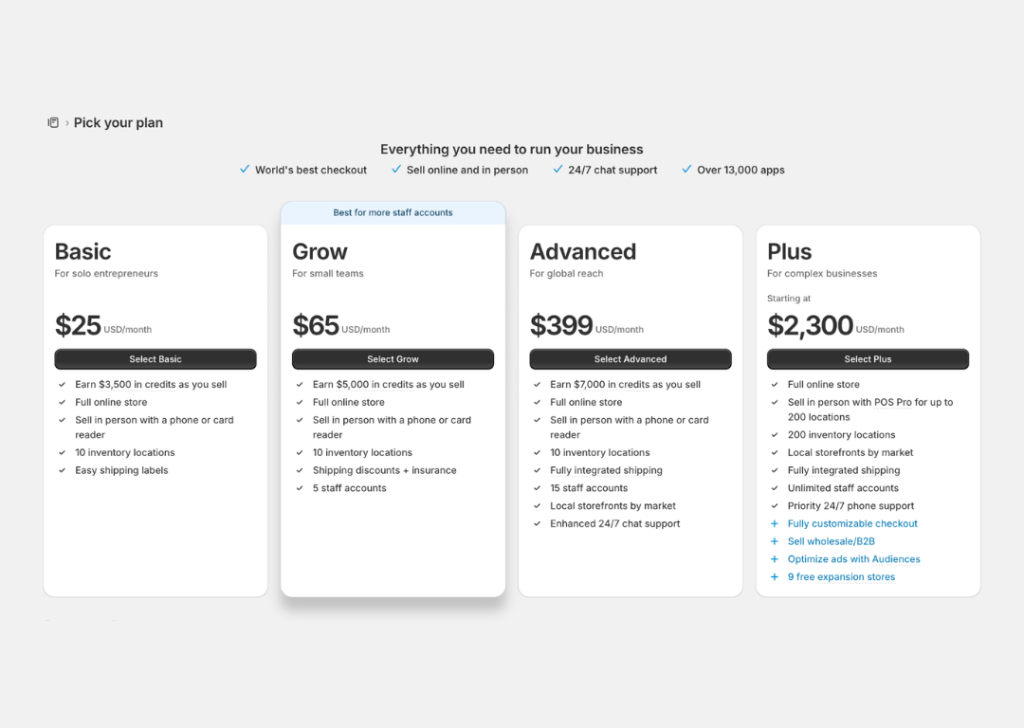
Shopify price plan. Source: Shopify
Shopify’s three main plans:
- Basic: USD 39/month (billed monthly) or USD 29/month (billed annually)
- Shopify: USD 105/month or USD 79/month annually
- Advanced: USD 399/month or USD 299/month annually
In ringgit at current exchange rates, Basic runs roughly RM 180 per month. The Shopify plan sits around RM 490. Advanced hits RM 1,860 and above.
Annual billing saves about 25%. For most Malaysian stores just starting out, committing to annual from day one is worth it.
Which plan do most Malaysian stores actually need?
Start with Basic. It covers unlimited products, 2 staff accounts, and all core selling features. The main reason to upgrade is lower transaction fees and better reporting, both of which matter more once your sales volume grows.
Don’t over-invest in plan tier early. Get your first sales first.
Layer 2: Shopify theme cost
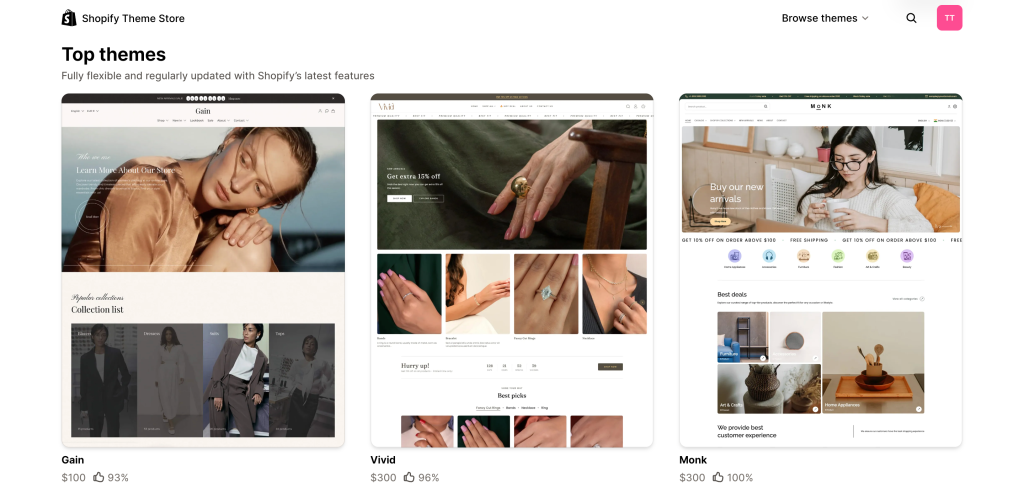
Shopify theme store. Source: Shopify
Your theme controls layout, fonts, product page structure, and how your brand looks to every visitor. It’s the visual skeleton everything else sits on.
Shopify’s free themes are functional. They’re also used by tens of thousands of stores worldwide, and it shows.
Free themes make sense when:
- You’re testing a product idea before committing to a full build
- You plan to customise heavily with a developer anyway
Paid themes run USD 180 to USD 350, as a one-time purchase. They give you more design flexibility, better mobile performance, and far fewer layout limitations.
The most common mistake: buying a theme before you understand your store’s actual requirements. A theme built for a fashion brand doesn’t work for a B2B parts supplier. Get clear on your product type and customer before selecting anything.
A good theme reduces the custom development you need later. A wrong theme creates problems that cost more to fix than the theme itself.
Layer 3: Shopify apps (the subscription that grows)
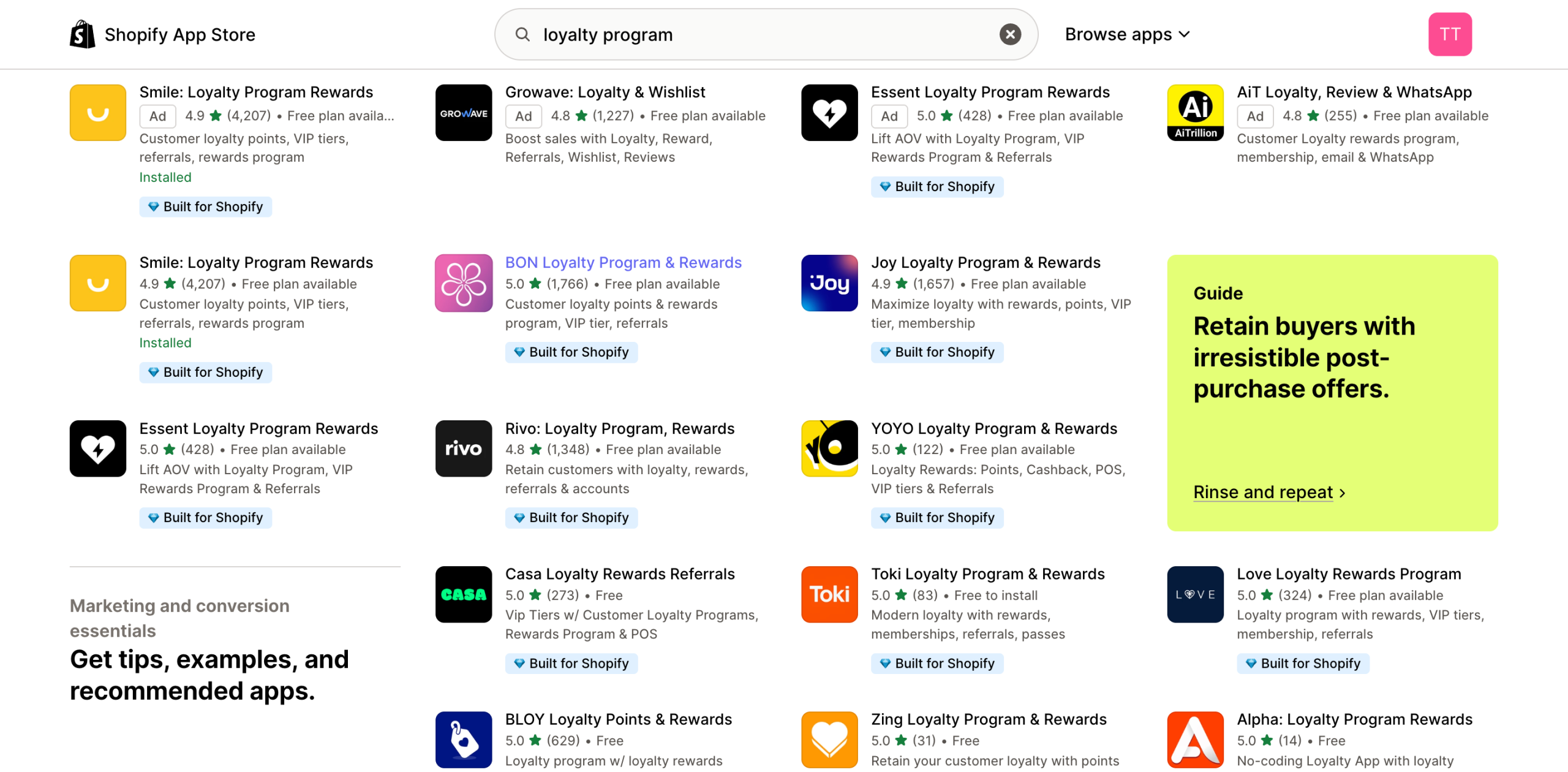
Shopify app store. Source: Shopify
This is the cost that catches almost every new store owner off guard.
Shopify’s core platform is deliberately lean. Features most serious stores need are not built in: product reviews, loyalty programmes, upsell popups, advanced shipping rules, WhatsApp chat, back-in-stock alerts. Each one comes from a third-party app with its own monthly fee.
Common apps Malaysian Shopify stores install:
| App type | Estimated monthly cost |
|---|---|
| Product reviews (e.g. Judge.me, Loox) | RM 0 – RM 90 |
| WhatsApp / live chat integration | RM 45 – RM 150 |
| Upsell and cross-sell | RM 90 – RM 200 |
| Loyalty and rewards programme | RM 90 – RM 200 |
| Shipping and fulfilment rules | RM 45 – RM 150 |
| Email marketing (e.g. Klaviyo) | RM 100 – RM 400+ |
| SEO optimisation tools | RM 45 – RM 150 |
A store running 5 to 8 apps (typical) pays RM 400 to RM 1,000 per month in app fees alone.
That cost is recurring. It runs from the day you install each app, whether you’re making sales or not.
Start lean. Identify what’s essential at launch and what can wait. Add apps only when you can justify them against actual sales data.
Building on a weak foundation always costs more to fix later, and that applies to app strategy just as much as design.
Layer 4: Transaction fees
This is the cost most articles skip. It’s also the one that hurts most at volume.
Shopify charges a transaction fee on every order processed through a third-party payment gateway. In Malaysia, that’s every order. Shopify Payments isn’t available here.
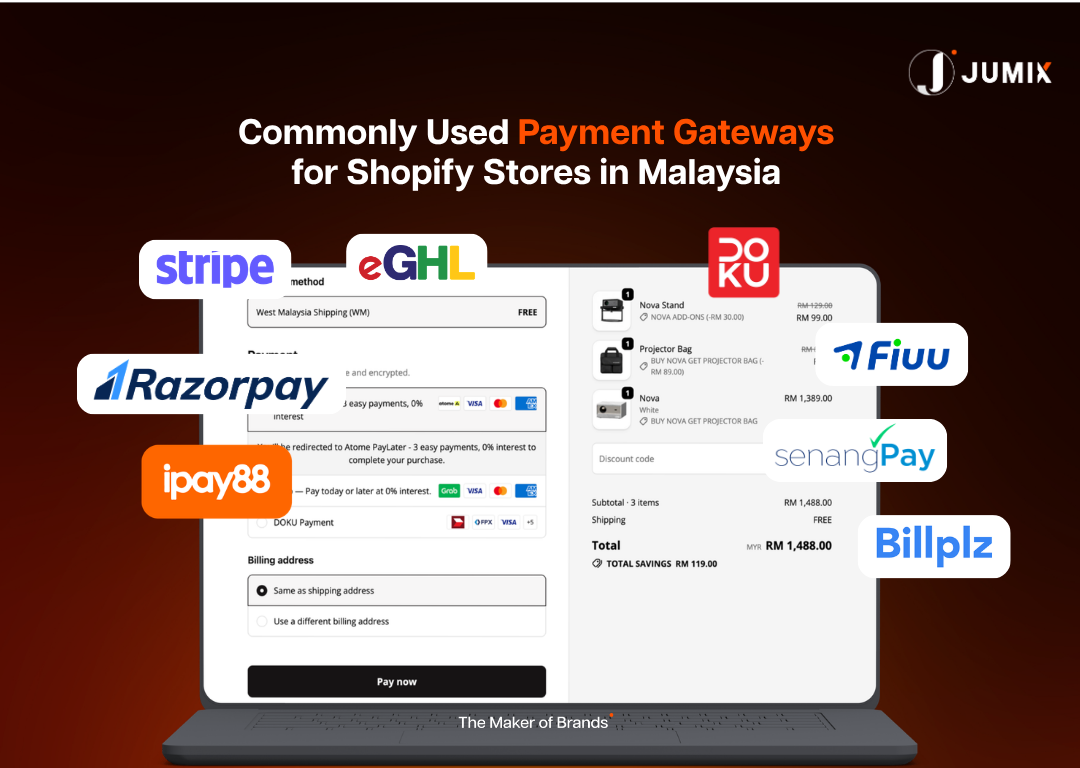
Malaysian stores typically use iPay88, Billplz, Stripe, or Razer Pay. They’re all third-party gateways. All of them trigger Shopify’s transaction fee on top of the gateway’s own processing fee.
Shopify transaction fees by plan:
| Plan | Shopify transaction fee |
|---|---|
| Basic | 2.0% per transaction |
| Shopify | 1.0% per transaction |
| Advanced | 0.5% per transaction |
Your payment gateway charges its own fee separately, typically 1.5% to 3% depending on the provider.
Real example: A store on Basic processes RM 20,000 in sales in a month.
- Shopify transaction fee (2.0%): RM 400
- Payment gateway fee (2.0%): RM 400
- Total payment cost: RM 800
That same store on the Shopify plan pays RM 200 in Shopify fees instead of RM 400. The RM 200 saving partially offsets the higher monthly plan cost.
At higher sales volumes, the plan upgrade pays for itself through lower transaction fees. Run the numbers for your projected monthly revenue before picking a plan.
Factor this into your margin calculations before you price your products.
Layer 5: Website design and setup cost
The platform is ready. The theme is chosen. Now someone has to build the actual store.
You’ve got two options: do it yourself, or hire a professional.

DIY Shopify setup:
- Cost: free (beyond the platform fees above)
- Reality: hours of learning curve, and most self-built stores look and perform below standard
- Risk: a mediocre store at launch teaches your first customers to see your brand as amateur
Hiring a Shopify agency or freelancer in Malaysia:
- Cost: RM 3,000 to RM 15,000 depending on scope
- Typically included: theme setup and customisation, homepage design, product page setup, payment gateway integration, basic app configuration, mobile testing
- Usually extra: custom app development, content writing, product photography, SEO setup, email marketing flows
The gap in results between a DIY store and a professionally built one is significant.
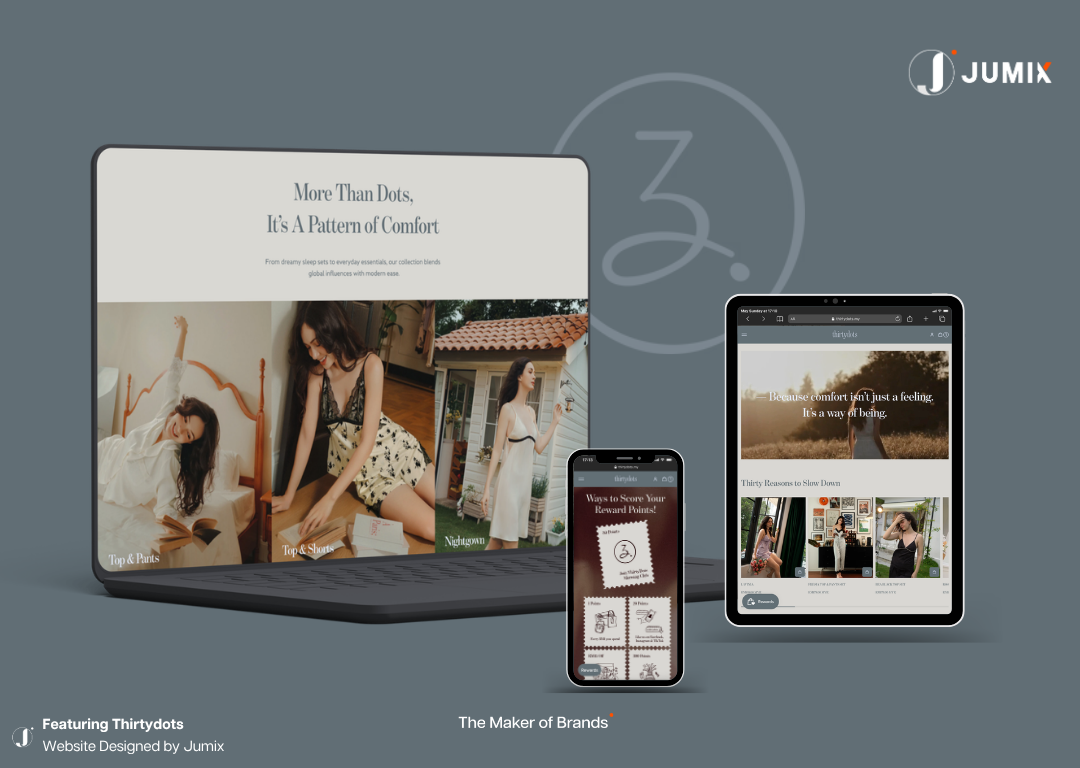
Thirtydots, a sleepwear and underwear brand, launched with zero existing customers and zero brand recognition. They invested in a proper Shopify build from day one. Clean layout, solid mobile UX, a checkout that didn’t lose people halfway through. That store positioned them correctly in the market before a single customer left a review.
A rushed self-built store does the opposite. It tells your first visitors you’re not serious, and first impressions in eCommerce stick.
A strong eCommerce website builds the trust that converts browsers into buyers from the first visit, but only if the foundation is solid.
What is the total Shopify cost in Malaysia?
Here’s what two types of stores realistically cost in Year 1.
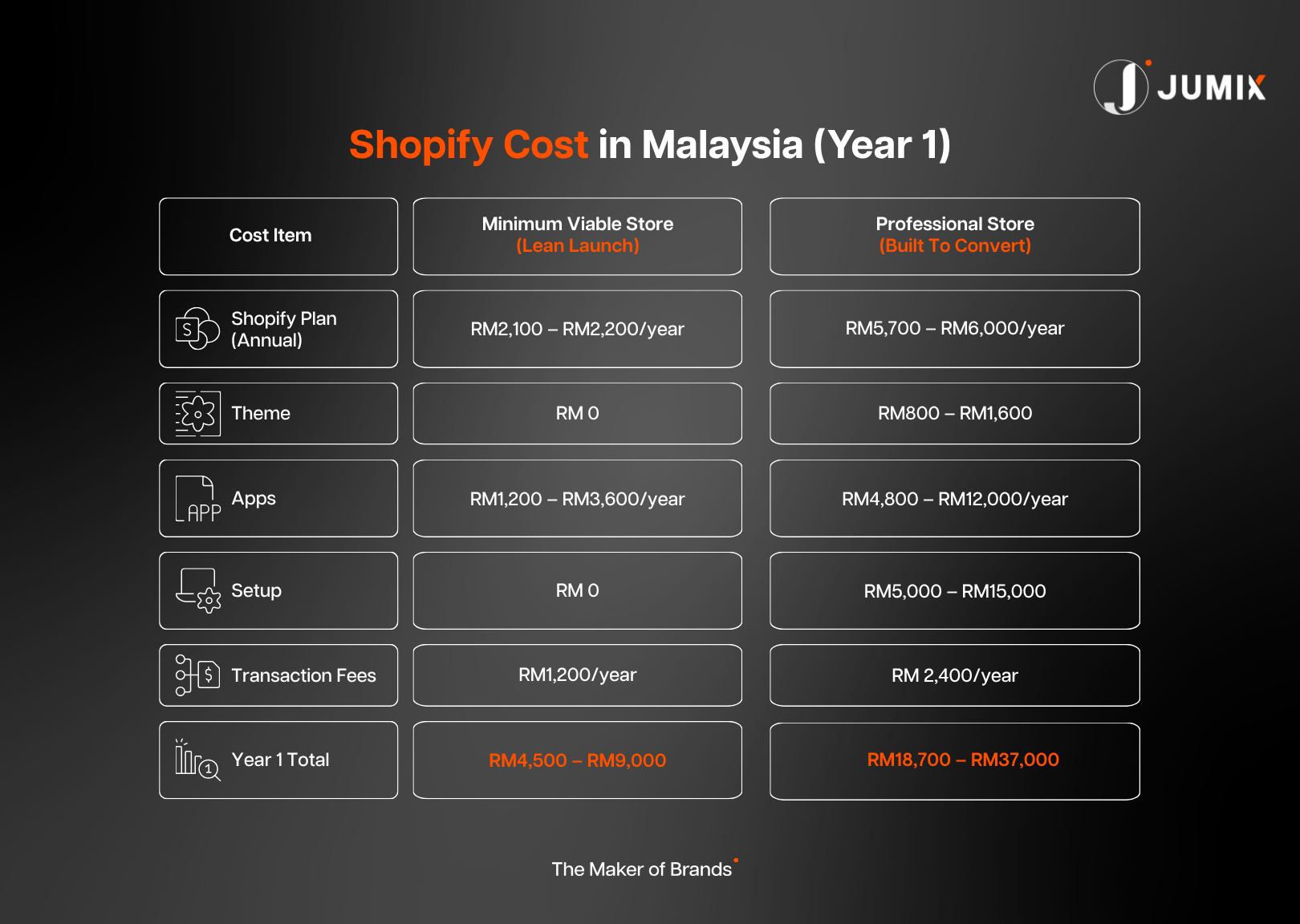
Minimum viable store (lean launch):
| Cost item | Estimated cost |
|---|---|
| Shopify Basic (annual) | RM 2,100 – RM 2,200/year |
| Free theme | RM 0 |
| Essential apps (2–3) | RM 1,200 – RM 3,600/year |
| DIY setup | RM 0 |
| Transaction fees (est. RM 5,000/month sales) | RM 1,200/year |
| Year 1 total | RM 4,500 – RM 9,000 |
Professional store (built to convert):
| Cost item | Estimated cost |
|---|---|
| Shopify plan (annual) | RM 5,700 – RM 6,000/year |
| Paid theme (one-time) | RM 800 – RM 1,600 |
| Full app stack (5–8 apps) | RM 4,800 – RM 12,000/year |
| Agency design and setup | RM 5,000 – RM 15,000 |
| Transaction fees (est. RM 20,000/month sales) | RM 2,400/year |
| Year 1 total | RM 18,700 – RM 37,000 |
The professional store costs more and generates more. It’s built to convert from day one.
The lean store works for testing a product concept. The professional store is for a real business launch. Know which one you’re building before you start.
How to choose the right Shopify partner in Malaysia
Your Shopify agency or developer determines how well your store performs and how much you spend fixing mistakes.
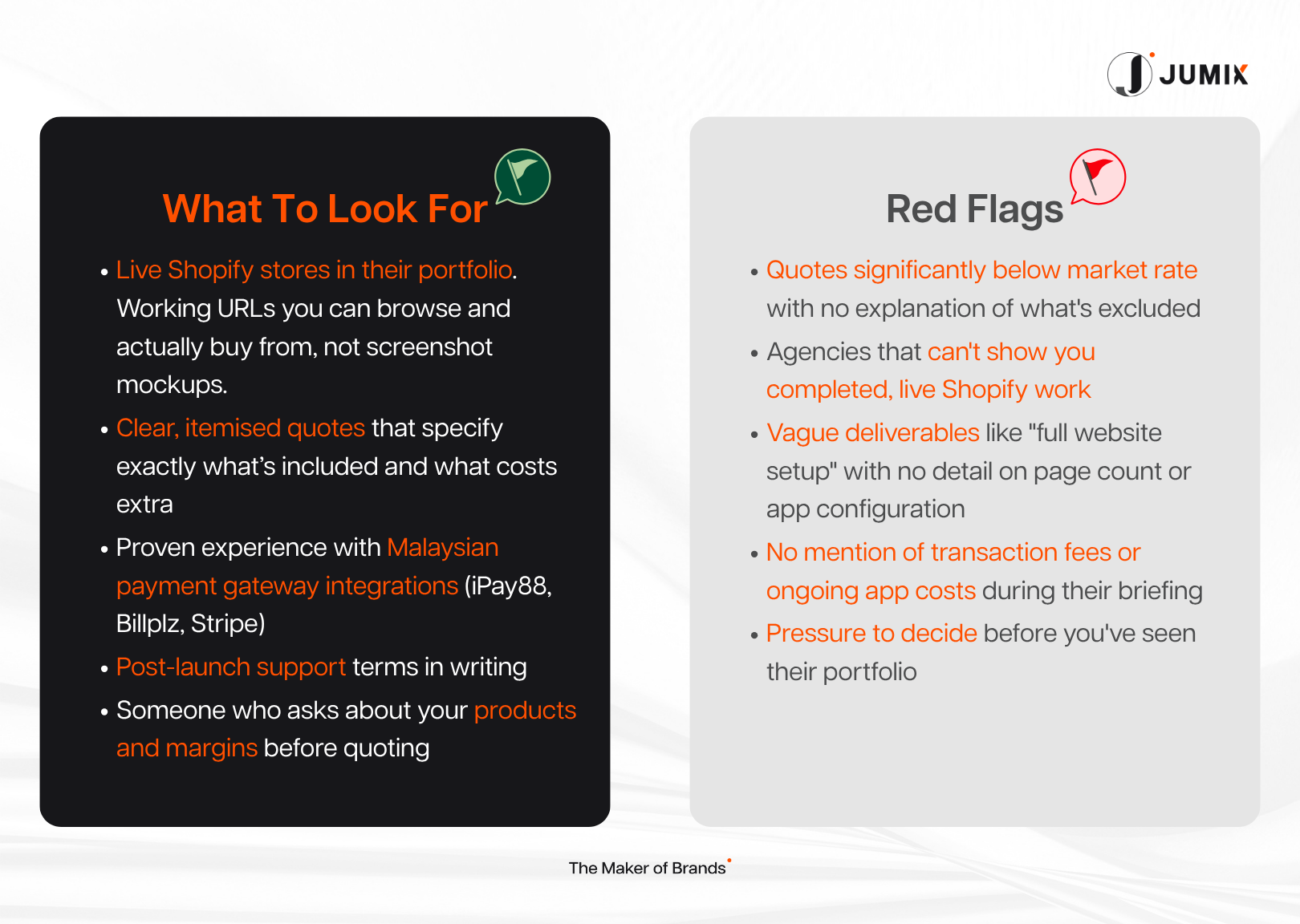
What to look for:
- Live Shopify stores in their portfolio. Working URLs you can browse and actually buy from, not screenshot mockups.
- Clear, itemised quotes that specify exactly what’s included and what costs extra
- Proven experience with Malaysian payment gateway integrations (iPay88, Billplz, Stripe)
- Post-launch support terms in writing
- Someone who asks about your products and margins before quoting
Red flags:
- Quotes significantly below market rate with no explanation of what’s excluded
- Agencies that can’t show you completed, live Shopify work
- Vague deliverables like “full website setup” with no detail on page count or app configuration
- No mention of transaction fees or ongoing app costs during their briefing
- Pressure to decide before you’ve seen their portfolio
The warning signs when choosing a web design agency in Malaysia apply equally to Shopify partners. A cheap quote that excludes critical deliverables always costs more in the end.
The right partner will walk you through all 5 cost layers before you sign anything. If the conversation only covers design, you’re not getting the full picture.
Frequently Asked Questions
Can I build a Shopify store myself in Malaysia?
Yes. Shopify is built for non-technical users and a basic store can go live without a developer. The real question is whether a self-built store will perform well enough to justify the time. For testing a product idea on a tight budget, DIY is fine. For a real brand launch, professional setup produces significantly better results.
Is Shopify worth it compared to other platforms?
For most Malaysian eCommerce businesses, yes. Shopify is reliable and has the largest app ecosystem of any eCommerce platform. WooCommerce is cheaper to start but requires more technical management. Lazada and Shopee offer traffic but zero brand ownership and high commission fees. Shopify is the right platform when you want a store you fully control. You pay more for that control, but it compounds over time.
All documented in Shopify’s terms. Just buried where most people don’t look before signing up. Transaction fees, app subscriptions, and payment gateway fees are real costs that most first-time store owners discover only after launch. That’s the gap this article closes.
How long does it take to launch a Shopify store in Malaysia?
A DIY basic store can go live in days. A professionally built store takes 4 to 8 weeks depending on scope: product catalogue size, custom design requirements, app configuration, and content readiness. The timeline is usually set by how quickly the store owner can supply product information, photography, and approvals.
Which Shopify plan should I start with in Malaysia?
Start with Basic if your monthly sales are under RM 15,000. The transaction fee difference between Basic and the Shopify plan becomes meaningful above that volume. Calculate your projected monthly revenue, multiply by the 1% fee difference, then compare that saving against the plan upgrade cost. Let the numbers tell you.
Know what you’re paying for before you launch
Shopify is a serious platform. The cost reflects that.
A properly built Shopify store, with the right plan, a solid theme, the right apps, and professional setup, is a real investment. It’s also a revenue-generating asset that pays back over time.
The businesses that struggle with Shopify are rarely the ones who spent too much. They’re the ones who underspent on setup, missed the transaction fees until they hurt, and launched with a store that couldn’t convert.
Go in with clear numbers. Know all 5 cost layers before you sign anything.
If you’re ready to launch a Shopify store in Malaysia and want to get it right the first time, Jumix’s Shopify web design service is built for Malaysian eCommerce businesses: store setup, theme customisation, payment gateway integration, and conversion-focused design. See our Shopify pricing for a transparent breakdown of what’s included.





Comments are closed for this article!