




Shopee seller fees in Malaysia rose three times in 2026. A new 5% technical support fee started in February, commission rates went up the same month, then rose again in May. Stack commission, SST, the transaction fee and the technical fee on a RM100 electronics order, and Shopee now keeps RM13.64 before you spend a ringgit on ads.
Quick takeaways
- Shopee added a 5% technical support fee on completed orders in Malaysia starting 1 February 2026 (Source: Shopee Seller Education Hub).
- Marketplace commission rates rose twice in 2026: first on 1 February, then again on 21 May (Source: Zetpy).
- Commission still varies by category, roughly 2% to 6% of product price after discounts, and every commission fee carries an extra 8% SST.
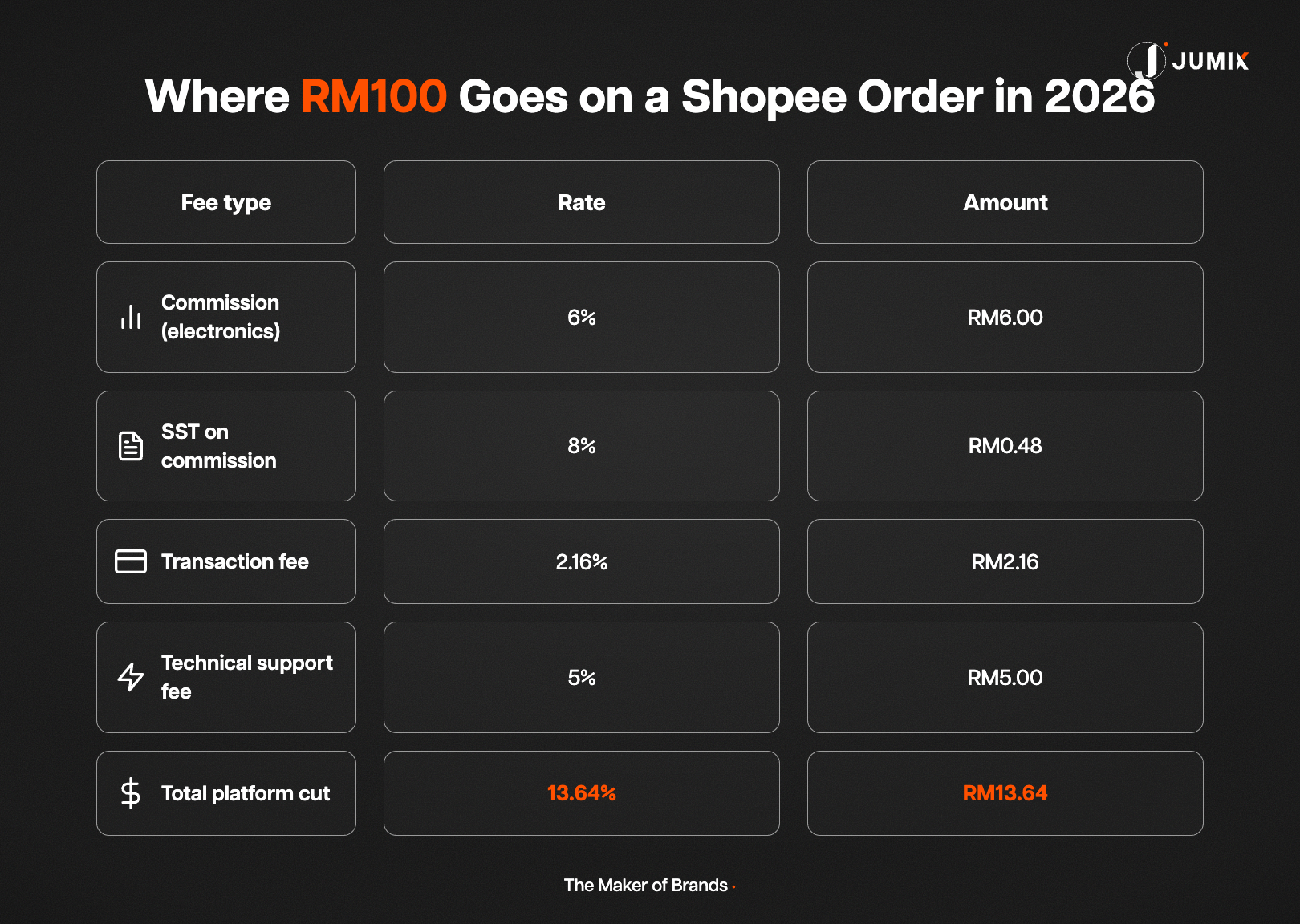
- On a RM100 electronics order, commission, SST, the 2.16% transaction fee and the new technical fee now total RM13.64 in platform cuts alone.
- Shopee offered advertising credits worth up to 5% of order value to cushion the rollout, but only for a limited transition window.
What changed with Shopee seller fees in Malaysia
Shopee seller fees in Malaysia got heavier fast this year.
Three separate changes landed within four months.
First, a 5% technical support fee. It started 1 February 2026, across Malaysia, Singapore, Thailand and Vietnam.
It applies to every completed order. Local sellers, cross-border sellers, official stores, third-party fulfillment. No exceptions.
The fee gets deducted automatically once an order completes. Refund an item after that, and the fee doesn’t come back.
Second, marketplace commission rates went up the same month. Rates already varied by category. Electronics sellers, for example, moved to a 6% commission on product price after discounts and vouchers.
Third, Shopee revised commission fees again on 21 May 2026. Barely four months after the first hike (Source: Zetpy).
Every commission fee also carries 8% SST on top, calculated after seller discounts and vouchers are deducted.
Stack it up: technical fee, commission, SST on that commission, and the existing transaction fee. Four separate deductions on a single sale.
Shopee did offer a cushion. Advertising credits worth up to 5% of order value, for eligible sellers during the rollout.
Credits run out. Fees don’t.
Shopee Mall sellers aren’t spared either. The technical support fee and the commission revisions apply to Mall stores on top of their existing Mall commission tier, not instead of it.
Mall sellers already paid a steeper baseline before any of this. Mall commission runs 4% to 6% before SST, well above the roughly 2% rate ordinary marketplace sellers paid once they passed 100 completed orders.
None of these fees replace another. Each one calculates on a slightly different base, then lands on the same order.
The real RM math on a Shopee order
Percentages hide the damage. RM figures don’t.
Take a RM100 order in the electronics category, one of Shopee’s biggest verticals in Malaysia.
Commission at 6%: RM6.00.
SST on that commission at 8%: RM0.48.
Transaction fee at 2.16%: RM2.16.
Technical support fee at 5%: RM5.00.
Total platform cut: RM13.64. Before packaging, before delivery, before a single ringgit spent on ads.
That number doesn’t move for a repeat customer. It doesn’t shrink because someone bought from you three times last year.
Add Shopee Ads or the Free Shipping program, and RM13.64 climbs fast.
Now scale it. A seller moving RM20,000 a month through Shopee in electronics loses roughly RM2,728 a month to platform fees alone.
That’s RM32,736 a year. Gone before cost of goods, packaging, staff, or a single click of paid traffic.
Fashion and lifestyle categories sit closer to the 2% end of the commission range, so the total cut is lower. Electronics, appliances and higher-value categories sit closer to 6%, so the cut bites harder.
RM13.64 is the entry fee. Everything else on Shopee costs more.
Why sellers are building their own store
Fees are only half the problem.
Shopee owns the customer, not the seller. You can’t email a buyer after the sale. You can’t retarget them without paying for another ad.
Every repeat purchase still costs a fresh commission, a fresh technical fee, a fresh SST charge. Loyalty earns you nothing on the fee line.
An owned store flips that. Once a customer buys once, you can email them, WhatsApp them, or retarget them for close to nothing.
The second sale costs you a fraction of what the first one did. On Shopee, the second sale costs exactly the same as the first.
Mofu Mofu Pet Food ran into exactly this. They sold 100% through Shopee and Lazada. High fees, no control over promotions, no way to explain why their slow-baked kibble process matters more than a cheaper bag on the next listing.
We built them a Shopify store instead, structured around educating pet parents on that process before they ever compared prices. They kept both channels.
But pricing, promotions and customer data now sit with them, not the platform.
Malaysian businesses are already moving from Shopee to their own online store, and 2026’s fee stack is the reason more will follow.
Own the fee structure, or keep renting it forever.
What Malaysian sellers should do next
Reacting order by order won’t fix this. A plan will.
Start with your margin, not your traffic. Pull your last three months of Shopee orders. Subtract commission, SST, the transaction fee and the new technical fee from each one.
What’s left is your real margin. Not the one on your spreadsheet.
Keep Shopee. Don’t quit it. It’s still where most Malaysian shoppers browse and compare prices.
But stop treating it as your only channel.
Build an owned store alongside it. Whether that’s Shopify or WooCommerce, the setup cost is fixed. Shopee’s fees are not.
Four moves make this manageable instead of overwhelming.
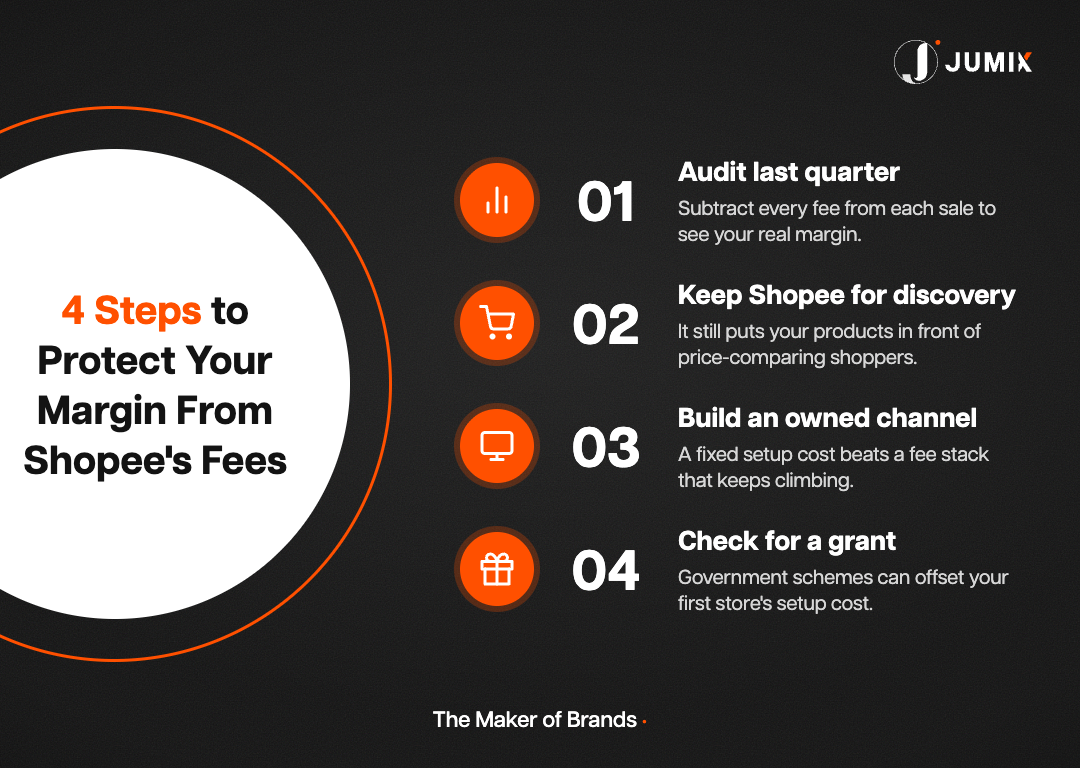
- Audit last quarter’s orders. Subtract commission, SST, the transaction fee and the technical support fee from each sale to see your real margin.
- Keep Shopee for discovery. It still puts your products in front of shoppers who are already comparing prices.
- Build an owned channel in parallel. A fixed setup cost beats a fee stack that keeps climbing every few months.
- Check for a digitalization grant. Several government schemes offset part of the setup cost for a first proper online store.
Run both channels for three to six months before you shift priority. Long enough to migrate repeat customers without losing this month’s sales.
Every RM13.64 you keep out of Shopee’s cut on a repeat sale is RM13.64 you never had to re-earn.
FAQ
What is Shopee’s 5% technical support fee?
It’s a platform fee Shopee started charging on completed orders in Malaysia from 1 February 2026. It applies to local and cross-border sellers, covering direct shipping, official warehouse and third-party fulfillment stores (Source: Shopee Seller Education Hub).
How much commission does Shopee charge sellers in Malaysia in 2026?
Commission varies by category, roughly 2% to 6% of the product price after discounts. Electronics sellers sit at 6%. Rates rose in February 2026, then again on 21 May 2026.
Do all Shopee sellers pay the new fees?
Yes. The technical support fee and commission apply across seller types: local, cross-border, Shopee Mall and third-party fulfillment. There’s no opt-out.
Is it worth moving from Shopee to your own online store?
For sellers with repeat customers or thin margins, yes. An owned store removes per-order commission and technical fees, and keeps customer data for remarketing. Most Malaysian sellers keep Shopee for discovery and run their own store for margin and loyalty.
Shopee’s 2026 fee changes aren’t a one-time bump. They’re a pattern: three increases in four months, with SST stacked on every layer.
Sellers who only sell on Shopee will keep absorbing every future increase, with no say in the matter.
The fix isn’t dramatic. Run the numbers on your last quarter of orders. Keep Shopee for what it does well: discovery and volume. Then build a channel Shopee can’t tax.
At Jumix, we’ve helped Malaysian sellers make that shift, from Mofu Mofu Pet Food’s DTC launch to dozens of other e-commerce builds. If your margin is shrinking faster than your sales are growing, our e-commerce team can help you build the store that keeps the fee.





Comments are closed for this article!