




Most website design Malaysia pitches lean on vague, reassuring language like “all-inclusive,” “unlimited revisions,” or “SEO-friendly” that hides what’s actually excluded. The way to evaluate a quote is to ask what’s NOT included, who owns the files after launch, and what support looks like after month one. A confident pitch and a complete pitch are not the same thing.
- Quick Takeaways
- The gap shows up after you sign
- The phrases that sound like a deliverable but aren’t
- What “all-inclusive” packages quietly leave out
- Real deliverables vs decoration
- The questions that expose a weak pitch in under 5 minutes
- Frequently Asked Questions
- Conclusion
Quick takeaways
- Words like “all-inclusive” and “SEO-friendly” sound like deliverables but describe nothing specific.
- The most common exclusions hide in hosting renewal, photography, content writing, and what happens after launch.
- A weak pitch answers your budget question in minutes. A real one asks about your business first.
- Ask for an itemised scope in writing before you compare any two quotes on price alone.
- Who owns your files after handover matters more than almost anything else in the contract.
The gap shows up after you sign

Every agency pitch sounds confident. Polished deck, clean portfolio, a price that fits your budget.
The problem rarely shows up on the sales call. It shows up three weeks in, when you ask for a second round of revisions and find out you’d already used your only one.
Shopping for website design Malaysia quotes means reading two pitches side by side that sound nearly identical, even though one covers half of what the other does. The difference is buried in language built to sound complete without actually being specific.
This post breaks down the phrases to watch for, what gets quietly left out of “all-inclusive” packages, and the questions that separate a real proposal from a confident guess.
None of this is about distrusting every agency you talk to. Most aren’t trying to trick you.
The pitch language has just become so standard across the industry that nobody questions it anymore, including the agencies using it.
The phrases that sound like a deliverable but aren’t
Some words in a pitch deck describe a feature. Others describe a feeling. Learn to tell them apart.
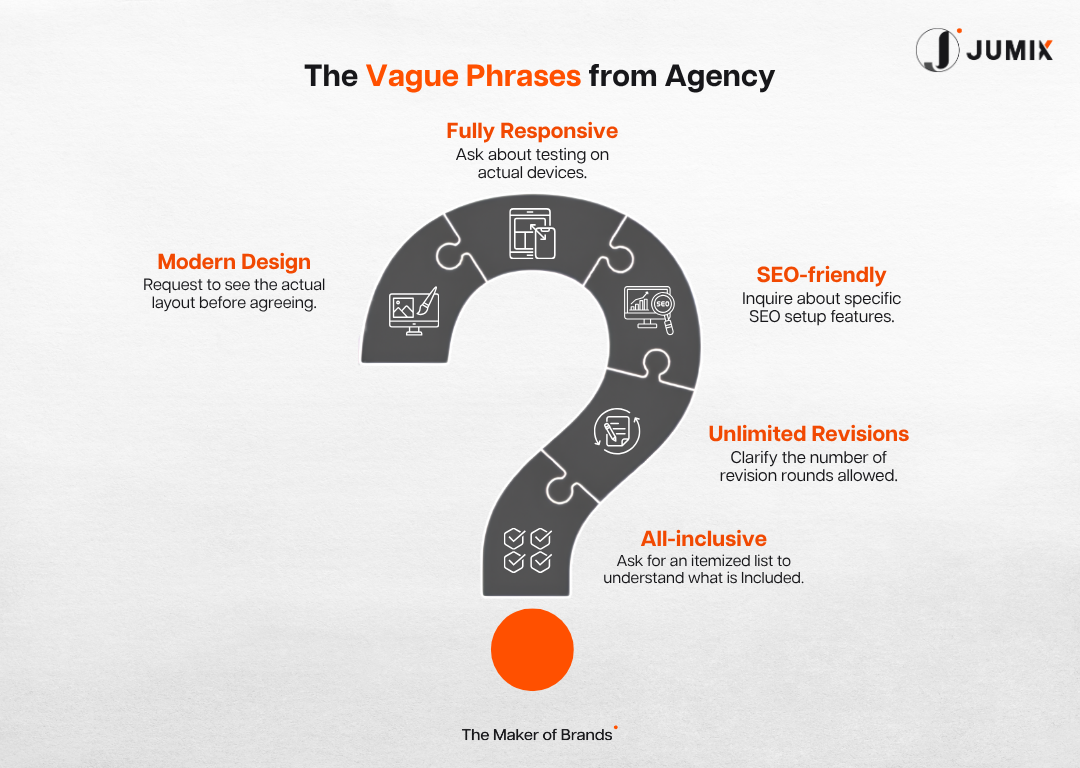
- “All-inclusive”: inclusive of what, exactly? Ask for the itemised list, not the adjective.
- “Unlimited revisions”: usually capped by round, not by count, and the cap is rarely stated upfront.
- “SEO-friendly”: often means the theme isn’t actively broken. Not the same as an SEO setup.
- “Fully responsive”: every theme claims this. The real question is whether it was tested on actual devices, not just resized in a browser.
- “Modern design”: not a deliverable. It’s a description. Ask to see the actual layout before you agree to it.
None of these phrases are lies. They’re just vague enough to mean almost anything, which is exactly the point.
The red flags worth watching for when choosing a web design agency usually hide behind language like this, not in anything an agency says outright.
The fix is simple. Every time you read one of these phrases in a proposal, stop and ask what it would look like if it were specific. “Unlimited revisions” becomes “how many rounds, and what counts as a round.” “SEO-friendly” becomes “what exactly gets set up before launch.”
If the agency can’t turn the adjective into a number or a list, the phrase was decoration.
What “all-inclusive” packages quietly leave out
Ask any agency what’s excluded, not what’s included. The answer tells you more.
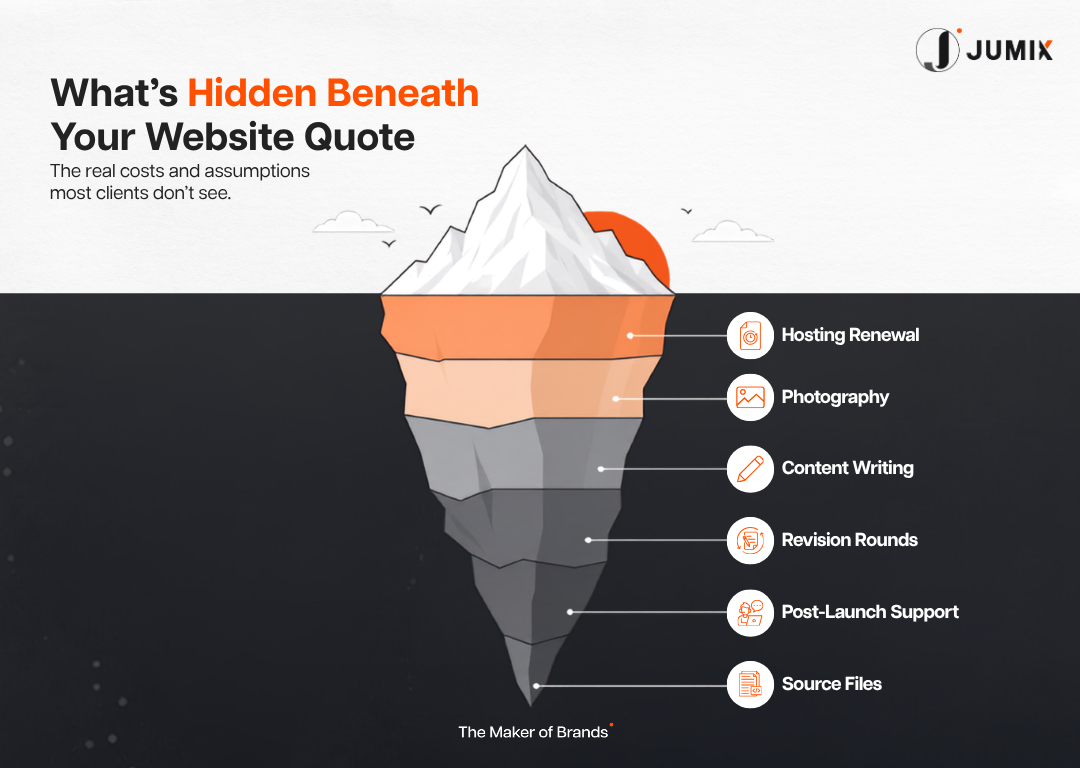
- Hosting and domain renewal: often free for year 1, quietly billed from year 2 onward
- Photography: stock images by default, custom photography usually costs extra
- Content writing: many quotes assume you supply finished copy, not a writer
- Revision rounds: typically capped at 1 or 2, after which changes are billed hourly
- Post-launch support: often limited to 30 days, then you’re on your own or paying a retainer
- Source files and admin access: not every agency hands these over without being asked
None of this makes a package dishonest. It makes the fine print worth reading before you sign, not after.
The real gap between cheap and proper website design packages in Malaysia usually lives in exactly these line items, not the headline price.
Real deliverables vs decoration
A real deliverable is something you can point to, count, or test. Decoration is everything that sounds good but disappears the moment you ask for specifics.
Before you compare two quotes, ask for an itemized scope in writing: number of pages, number of revision rounds, who writes the copy, who owns the files after handover, and what happens if you want to switch agencies down the line.
That last point matters more than most business owners realise. If an agency builds your site in a way that locks you into their hosting or their proprietary system, leaving later costs you a full rebuild, not a simple transfer.
The right questions to ask before hiring a web designer exist for exactly this reason: a written scope protects you from a pitch that sounded complete but wasn’t.

Take a real example. Two agencies quote a similar price for a 6-page business website. One scope sheet lists exact deliverables: page count, 2 revision rounds, stock photography, 30 days of post-launch support, full file handover.
The other says “complete website design package” with a single line item and a total.
Same price, completely different risk. You only find out which one you actually bought after the contract is signed.
The questions that expose a weak pitch in under 5 minutes
You don’t need a contract lawyer to spot a weak pitch. You need 4 direct questions.
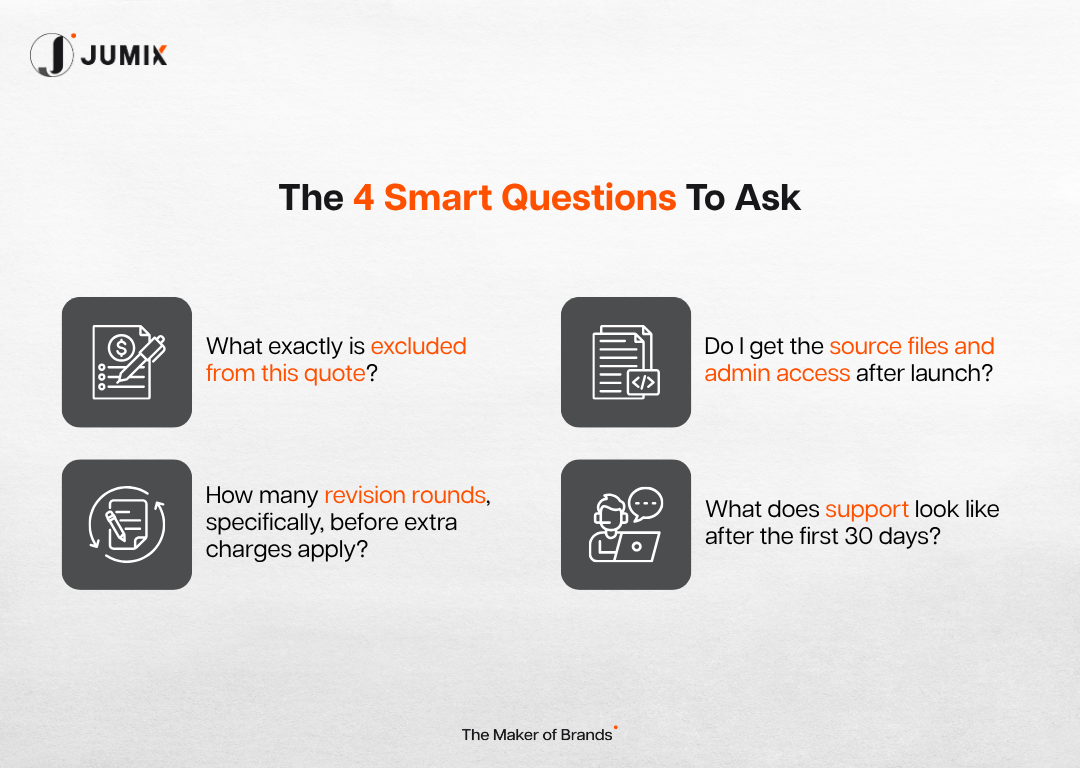
- “What exactly is excluded from this quote?”
- “How many revision rounds, specifically, before extra charges apply?”
- “Do I get the source files and admin access after launch?”
- “What does support look like after the first 30 days?”
A weak pitch answers vaguely, or pivots back to the design portfolio. A solid agency answers all 4 without hesitation, because they already know the answer and aren’t hiding it.
This isn’t about catching agencies being dishonest. Most aren’t. It’s about making sure the confident language in the pitch matches an actual, countable deliverable. What to look for in a web design company goes further into the traits that separate a strong partner from a good sales deck.
Frequently Asked Questions
What does “unlimited revisions” actually mean in practice?
In most contracts, it means unlimited revisions within a defined round, not unlimited rounds. Ask how many rounds are included and what counts as a new round versus a small tweak. Without that detail, “unlimited” can mean almost anything.
How long should an agency take to send a proper quote?
A generic quote can land in minutes because it’s copy-pasted from a template. A real quote takes a day or two, because the agency is asking about your business, your goals, and your competitors before pricing anything. Speed isn’t a green flag here. It’s usually the opposite.
Why do some quotes not mention hosting or domain renewal?
Because year 1 is often bundled into the build cost, making the headline price look lower. From year 2, hosting and domain renewal usually become a separate annual charge. Ask for that figure upfront so it doesn’t surprise you 12 months later.
Is a detailed written proposal a red flag or a green flag?
Green flag, almost always. An agency willing to itemise scope, timeline, and exclusions in writing has nothing to hide. The agencies that avoid putting specifics on paper are usually the ones counting on you not to ask later.
What’s a fair number of revision rounds to expect?
2 structured rounds is standard for most small business websites: one after the first draft, one after the agency applies your feedback. More than that usually signals scope creep on your end, not generosity on theirs. Either way, get the exact number in writing before the project starts.
Confident and complete are not the same thing
A good pitch deck is easy to make. A good website is not.
The agencies worth hiring aren’t necessarily the ones with the slickest deck or the fastest reply. They’re the ones willing to tell you exactly what’s included, what isn’t, and what happens after launch, in writing, before you sign anything.
Read every quote for what it excludes, not just what it promises. That single habit will save you more money than any amount of price negotiating.
If you want a quote that spells out exactly what you’re getting, no vague language required, Jumix’s web design service starts with a written scope before a single design decision gets made.




Comments are closed for this article!