





Web hosting in Malaysia typically runs RM30 to RM200 a month for shared hosting, or RM45 to RM700 a month for a VPS, depending on power and support level. A .my domain runs roughly RM80 to RM100 a year, and .com.my costs about RM60 to RM80 a year. Most small business sites need only the cheapest shared plan and a domain, around RM250 a year total.
- Quick Takeaways
- Web hosting Malaysia prices: what a .my domain and hosting actually cost in 2026
- Shared hosting vs cloud hosting vs VPS: what your site needs
- Should your host be in Malaysia, Singapore, or the US?
- Who should actually own your domain and hosting account
- Common domain and hosting mistakes Malaysian businesses make
- Uptime, backups and support: what to check before you sign
- FAQ
- The bottom line
Quick Takeaways
- A .my domain typically costs RM80 to RM100 a year. A .com.my domain runs about RM60 to RM80 a year.
- Shared cPanel hosting in Malaysia typically ranges from RM30 to RM200 a month, depending on sites and storage.
- NVMe VPS plans typically start around RM45 a month for entry-level specs, up to RM700 a month for high-spec plans with double-digit vCPUs and RAM.
- A Singapore server reaches Kuala Lumpur in 6 to 10 milliseconds. A US server adds 150 to 250 milliseconds (Source: DedicatedCore, 2026).
- Most small business sites need shared hosting only. Skip VPS until traffic or app complexity actually demands it.
Web hosting Malaysia prices: what a .my domain and hosting actually cost in 2026

Two invoices show up every year: the domain, and the hosting.
A .my domain typically costs RM80 to RM100 a year through most registrars. A .com.my domain runs about RM60 to RM80 a year.
Since June 2024, anyone worldwide can register a plain .my domain. No Malaysian presence needed anymore.
.com.my is different. You need SSM registration papers (Borang 9 or Borang D) to get one (Source: MYNIC).
A .com.my domain signals a real, registered Malaysian business, which international .com domains can’t prove.
Hosting spreads across a much wider range, because it scales with what you’re actually running.
| Item | Price range | Notes |
|---|---|---|
| .my domain | RM80 to RM100/year | Open worldwide, no local presence required |
| .com.my domain | RM60 to RM80/year | Requires SSM registration documents |
| Shared cPanel hosting | RM30 to RM200/month | Handful to unlimited websites, tens to hundreds of GB NVMe storage |
| NVMe VPS (self-managed) | RM45 to RM700/month | Entry-level to double-digit vCPU/RAM tiers |
| Managed VPS | From roughly RM200/month | Provider handles server admin and patching |
For a typical SME brochure site or a WordPress site with modest traffic, the cheapest shared plan covers it. That’s roughly RM30 a month, RM360 a year.
NVMe VPS plans scale from around RM45 a month for entry-level specs, up to roughly RM700 a month for high-spec plans with double-digit vCPUs and RAM.
Domain plus hosting, all in, lands around RM250 to RM450 a year for most small businesses. Anyone quoting RM2,000 a year for the same setup is charging for something else.
Setting up an online store on top of this foundation also means picking the right payment gateway, which has its own separate cost stack.
Watch the renewal price too, not just the year-one number. Domain registrars often discount the first year, then bill the standard rate from year two.
WHOIS privacy protection is worth paying for if it isn’t already bundled. Without it, your name, phone number and address sit on a public database anyone can search.
Shared hosting vs cloud hosting vs VPS: what your site needs
Three hosting types cover almost every business website. Picking the wrong one wastes money in both directions.
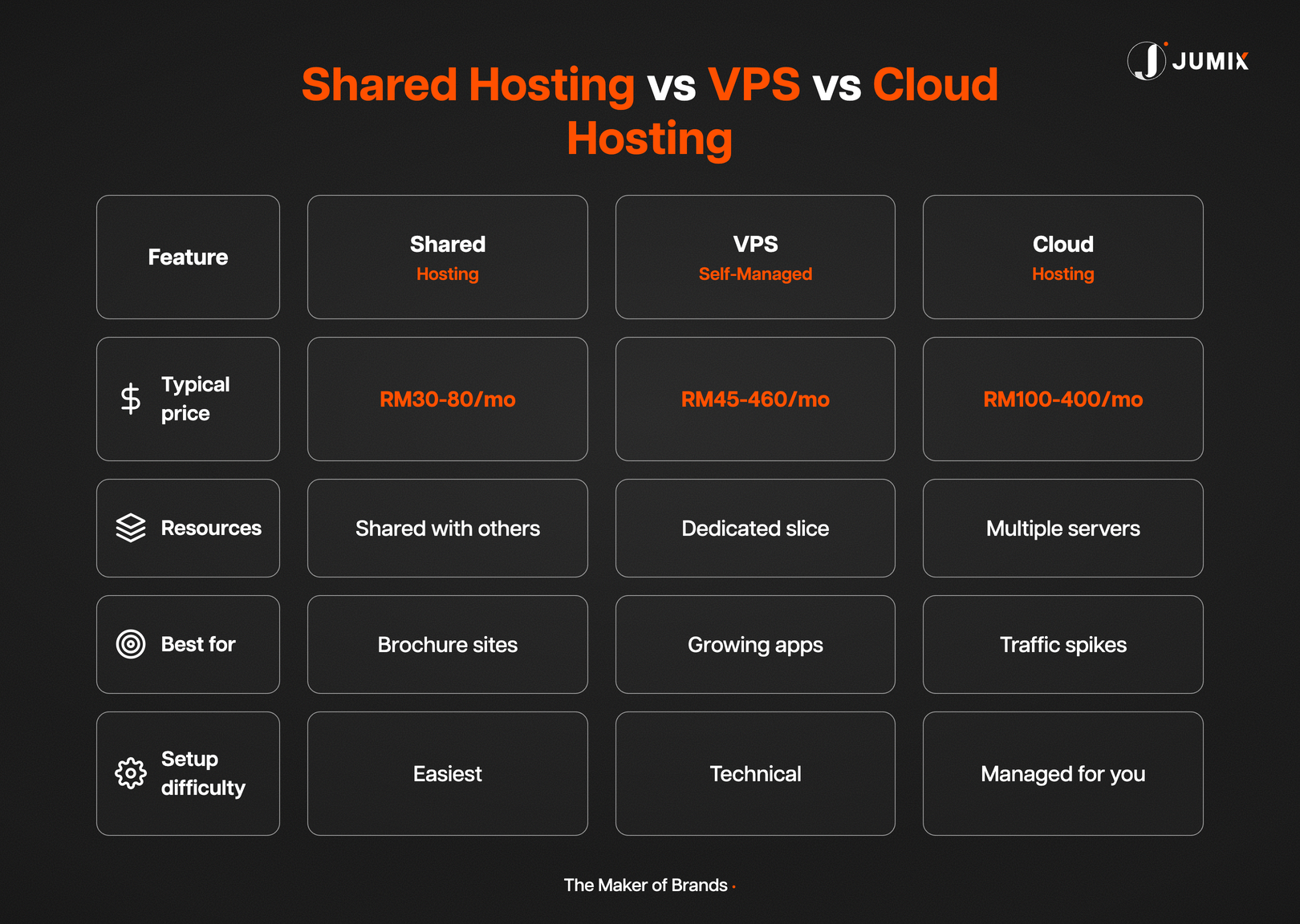
Shared hosting puts your site on a server with hundreds of other sites. You share resources, so it’s cheap. It’s also the most common trap: a slow neighbour on the same server can drag your load time down too.
VPS (virtual private server) gives you a dedicated slice of a physical server. Your resources are yours alone. You pay more, and on a self-managed plan, you patch and secure it yourself.
Cloud hosting spreads your site across multiple servers instead of one. If a single server fails, another picks up the load. It scales up automatically when traffic spikes, which shared hosting can’t do.
Most brochure sites, clinics and F&B websites never outgrow shared hosting. The traffic simply doesn’t justify more.
Ecommerce stores running WooCommerce with real order volume are the usual exception. A checkout that times out during a sale costs more than a year of VPS hosting.
If your traffic is steady and predictable, shared hosting wins on cost. If it spikes hard around campaigns or festive sales, cloud hosting earns its price.
One more distinction matters here: managed versus self-managed. Self-managed VPS is cheaper, but you’re the one applying security patches and fixing a broken server at midnight.
Managed hosting costs more, but the provider handles the server admin. Unless you have a technical person on staff, pay for managed. The price gap is smaller than the cost of a hacked, unpatched server.
Should your host be in Malaysia, Singapore, or the US?

Server location decides how fast your site reaches its visitors, and Malaysian mobile networks don’t forgive a slow first byte.
A server in Singapore reaches Kuala Lumpur in 6 to 10 milliseconds. A server in the US adds another 150 to 250 milliseconds on top of that (Source: DedicatedCore, 2026).
That gap is invisible on a good office WiFi connection. It’s very visible on a shaky 4G connection at a mamak, which is where a lot of your customers actually are.
Google doesn’t rank a page higher because the server sits in Malaysia. It ranks pages higher when they load fast, and server location is one lever behind that.
My rule: Malaysia or Singapore data centres for a Malaysia-only audience. Reach for anything further only if most of your customers actually live there too.
Who should actually own your domain and hosting account
This is the part that gets skipped in every price comparison, and it’s the one that actually matters.
Your business should own the domain registration and the hosting account. Not your freelancer. Not your agency. You.
I’ve watched this go wrong more times than I’d like. A designer registers the domain under their own account “to make setup easier,” then disappears, changes jobs, or simply stops replying.
Suddenly the business that paid for the site doesn’t hold the keys to it. We’ve written the full recovery steps in our guide for businesses whose web designer went dark, but the cheaper fix is never letting it happen.
The setup that avoids all of it: register the domain under your own SSM-verified account, pay for hosting on your own card, and give your agency admin access instead of ownership.
Admin access lets an agency build and maintain your site fine. Ownership is different. Ownership is the thing you never hand to anyone outside your company.
Common domain and hosting mistakes Malaysian businesses make
Four patterns show up again and again, across almost every industry we’ve worked with.
Buying every domain variation “just in case.” .my, .com, .com.my, .net, ten years of renewals nobody uses. Buy the one you’ll actually put on your signage and business cards.
Choosing hosting based on storage alone. A business site rarely runs out of storage. It runs out of speed and support when something breaks.
Letting the domain auto-renew on a card nobody checks. Business cards expire, get cancelled, or get replaced. A failed auto-renewal quietly takes your whole site offline.
Never testing the support line before you need it. Send a test question during signup week. If the reply takes 3 days, that’s your answer for how fast they’ll move during an outage.
Uptime, backups and support: what to check before you sign
Price is the easy number. These four checks decide whether a cheap plan turns out expensive later.
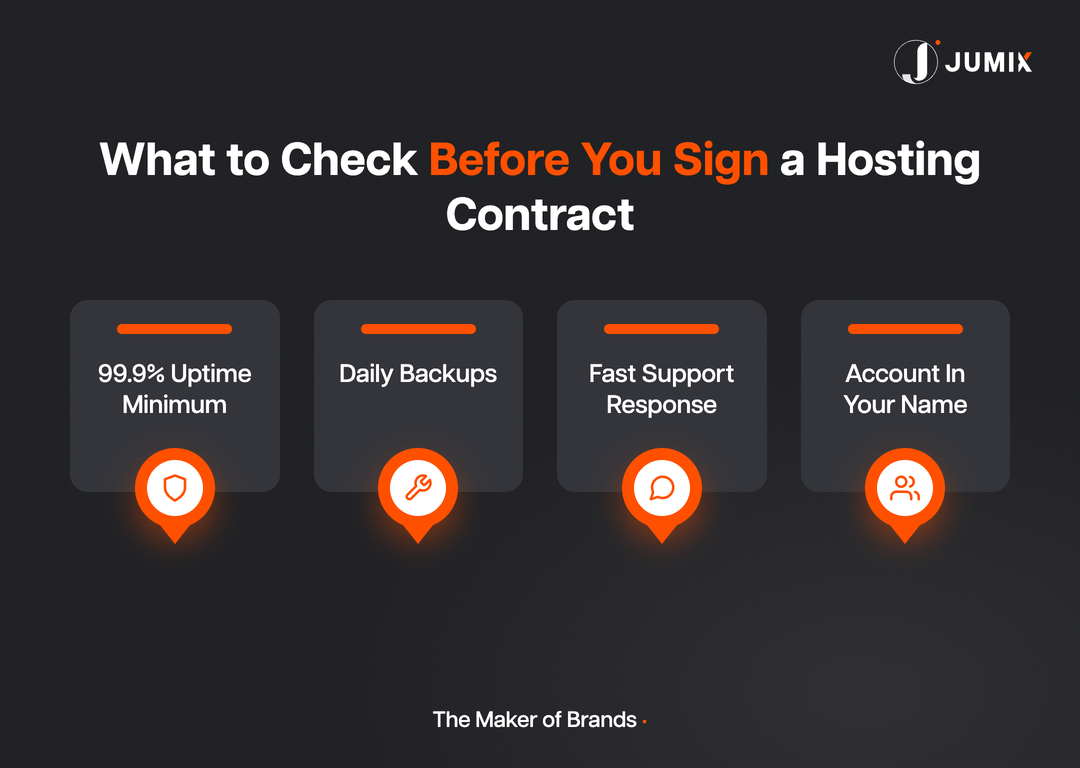
Uptime guarantee. 99.9% uptime is the standard floor across Malaysian hosts. Anything advertised lower isn’t worth the discount.
Backup frequency. Weekly backups are the minimum. Daily backups matter more once you’re taking orders through the site, not just displaying a catalogue.
Support response time. A host with no phone number and a 48-hour ticket queue is fine, until your site goes down on a Friday night.
Renewal price. Read the renewal rate, not just the signup promo. Some hosts double the price after year one, buried in the fine print.
None of these show up on the pricing page’s headline number. All of them show up the day something breaks.
A hosting upgrade often gets bundled into a bigger conversation anyway, once you’re already pricing out a website redesign budget. Plan for both together.
FAQ
Do I need a .my domain, or is .com fine for a Malaysian business?
.com works fine for most businesses and costs less globally. A .com.my domain adds a Malaysian trust signal, since it requires proof of SSM registration to obtain.
How much should a small business budget for domain and hosting each year?
RM250 to RM450 a year covers a domain plus entry-level shared hosting for most brochure and small ecommerce sites. Ecommerce stores with real order volume should budget for cloud hosting instead, closer to RM600 to RM1,500 a year.
Can I move my domain and hosting to a new agency later?
Yes, if you own the accounts. A domain transfer takes about 5 to 7 days. Moving hosting is faster, usually a same-day migration if the new host handles it for you.
Is the free hosting bundled with website builders good enough?
It’s fine for testing an idea. It’s a poor long-term choice for a business site, since you can’t export the domain or hosting to your own account if you outgrow the platform.
What happens if I forget to renew my domain?
Your site and business email go offline immediately. Most registrars give a short grace period to renew before the domain becomes available for anyone else to register.
Do I need cPanel, or does any hosting control panel work?
cPanel isn’t required, but it’s the standard most Malaysian developers and agencies already know. Choosing an unfamiliar control panel makes it harder to find help or switch providers later.
The bottom line
Domain and hosting are the smallest line item in your website budget, and the easiest one to get wrong.
Pay RM250 to RM450 a year for a domain and shared hosting that fit your actual traffic. Skip the VPS until you can prove you need it.
More than the price, own the accounts yourself. It’s the cheapest insurance policy your website will ever have.
At Jumix, we set every client up on their own domain and hosting accounts from day one, then handle the build on top. If you’re planning a new site or a rebuild, our web design service starts with getting that foundation right.





Comments are closed for this article!