



Shopee and Lazada are best for discovery and fast reach with no upfront cost, but they take 25% or more of each order and own the customer relationship. Shopify costs a flat monthly fee and gives you full ownership of branding, pricing, and customer data. For most Malaysian sellers, the right answer isn’t Shopify vs Shopee Malaysia as an either-or. It’s knowing when to add your own store on top of the marketplace you already have.
- Quick Takeaways
- The question every growing seller hits
- What Shopee and Lazada are actually good at
- What marketplaces quietly cost you
- Where Shopify changes the equation
- Side-by-side comparison
- So where should you actually sell?
- Frequently Asked Questions
- Conclusion
Quick takeaways
- Shopee and Lazada win on discovery. They put your product in front of buyers who weren’t looking for your brand specifically.
- Both platforms take a cut of every sale and keep the customer relationship for themselves, not you.
- Shopify costs a flat monthly fee with no per-sale commission, and every buyer’s data belongs to your business.
- You don’t have to pick one. Most Malaysian sellers run a marketplace and their own Shopify store side by side.
- The right time to add Shopify is once you have repeat buyers worth keeping in touch with directly.
The question every growing seller hits
Orders are coming in steadily on Shopee. Maybe Lazada too. Revenue looks healthy on the dashboard.
Then someone asks: should you build your own website?
It’s the wrong frame. The real comparison isn’t Shopify vs Shopee Malaysia as a fight to the death. It’s understanding what each platform is built to do, and when your business has outgrown relying on one alone.
This post breaks down what Shopee and Lazada actually do well, what they quietly cost you, and where Shopify fits once you’re ready to sell online Malaysia on your own terms instead of someone else’s marketplace.
None of this means abandoning the channels that got your business this far. It means knowing exactly what each one is for, so you stop expecting a marketplace to do a job it was never built to do.
What Shopee and Lazada are actually good at
Give credit where it’s due. Shopee and Lazada solve a real problem: getting your product in front of buyers who weren’t searching for your brand by name.
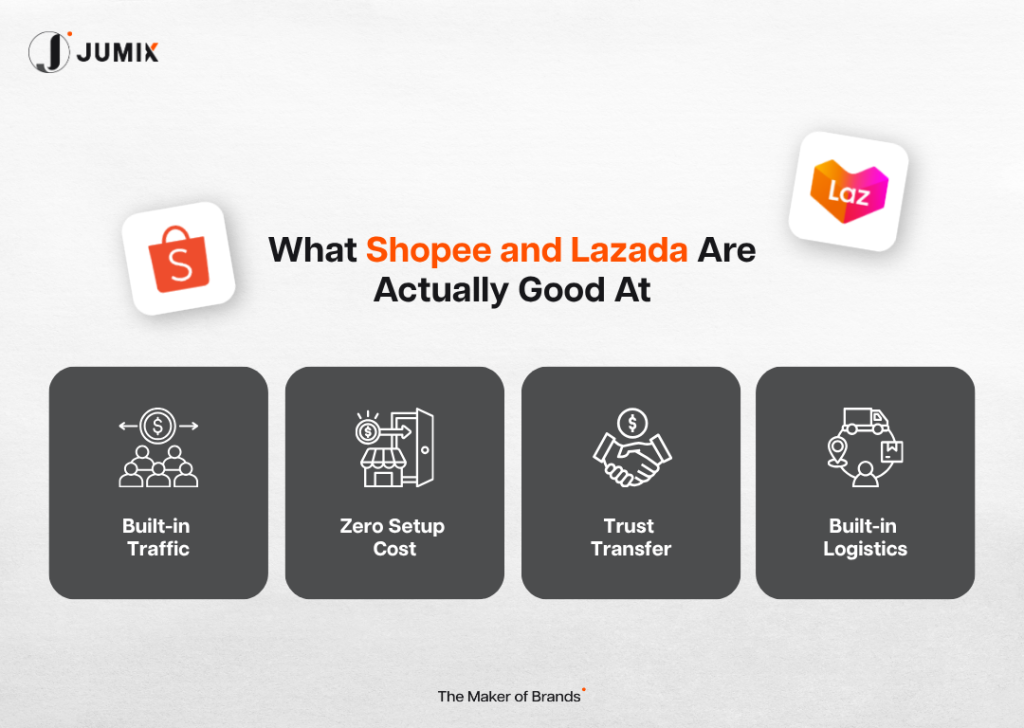
- Built-in traffic. Millions of shoppers browse daily without you spending a ringgit on ads to get the first sale
- Zero setup cost. List a product in minutes, no website, no developer
- Trust transfer. Buyers trust the platform’s checkout and buyer protection more than an unfamiliar brand
- Built-in logistics. Shipping, returns, and payment collection are handled for you
For a brand-new product with zero track record, that’s a genuinely good deal. The signs it’s time to invest in eCommerce usually show up first on a marketplace, long before a business is ready to build its own store.
Think of a small skincare brand testing 3 new products. Listing on Shopee costs nothing and gives instant access to buyers actively searching for “serum” or “moisturiser” that week. No website, no domain, no waiting for Google to notice you exist. That speed is the entire value of a marketplace.
The problem isn’t using a marketplace to start. It’s staying there once the business has outgrown what the marketplace can give back.
What marketplaces quietly cost you
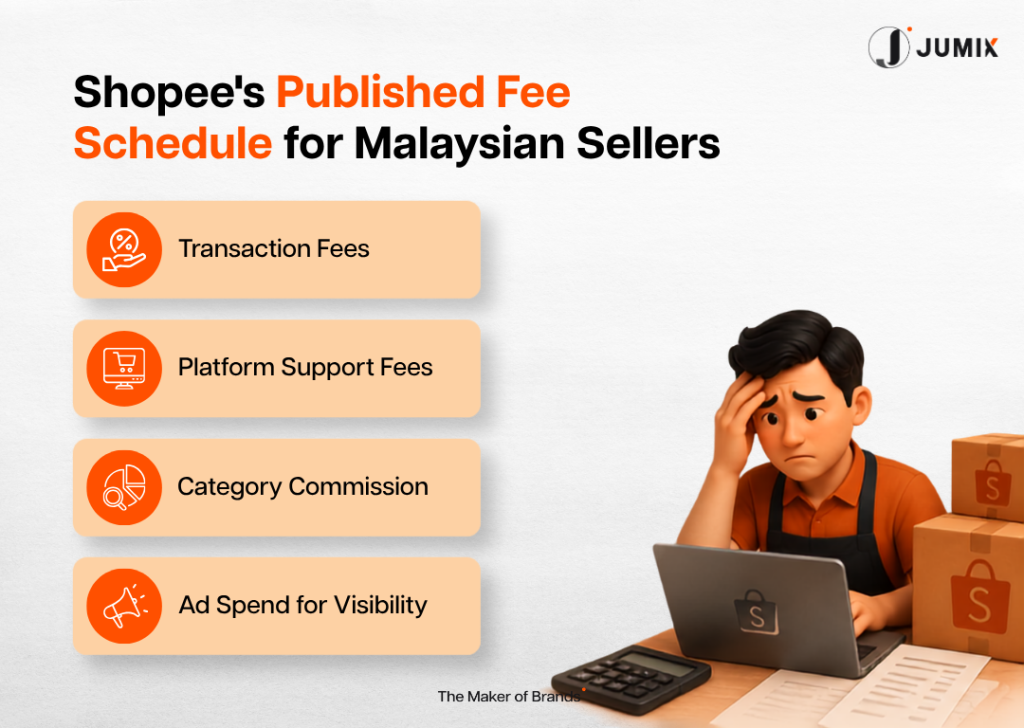
Shopee’s published fee schedule for Malaysian sellers stacks transaction fees, platform support fees, category commission, and ad spend needed just to stay visible (Source: Shopee Seller Education Centre). Combined, sellers typically lose 25% to 40% of order value before counting cost of goods.
Lazada follows a similar shape: category-based commission, payment processing fees, and the same pressure to spend on sponsored placements once your listing isn’t the first thing buyers see.
Fees are only half the story. The bigger issue is who owns the customer.
Every buyer on Shopee or Lazada is the platform’s customer first. You can’t email them after the sale. You can’t retarget them with ads.
When they want to reorder, they open the app and search your category, where your listing sits next to a dozen near-identical competitors on price.
We’ve covered the full Shopee fee breakdown and why Malaysian brands are moving off it in more depth elsewhere. The short version: the cost isn’t just the commission. It’s never getting to build a customer list of your own.
Where Shopify changes the equation
A Shopify store flips the fee structure. You pay a flat monthly subscription and a payment gateway fee, typically 1% to 2%. No category commission stacked on top of every order.
The bigger shift is customer data. Every buyer who checks out on your own store hands you their email and order history. You can follow up, build a loyalty program, and bring back anyone who hasn’t ordered in 90 days.
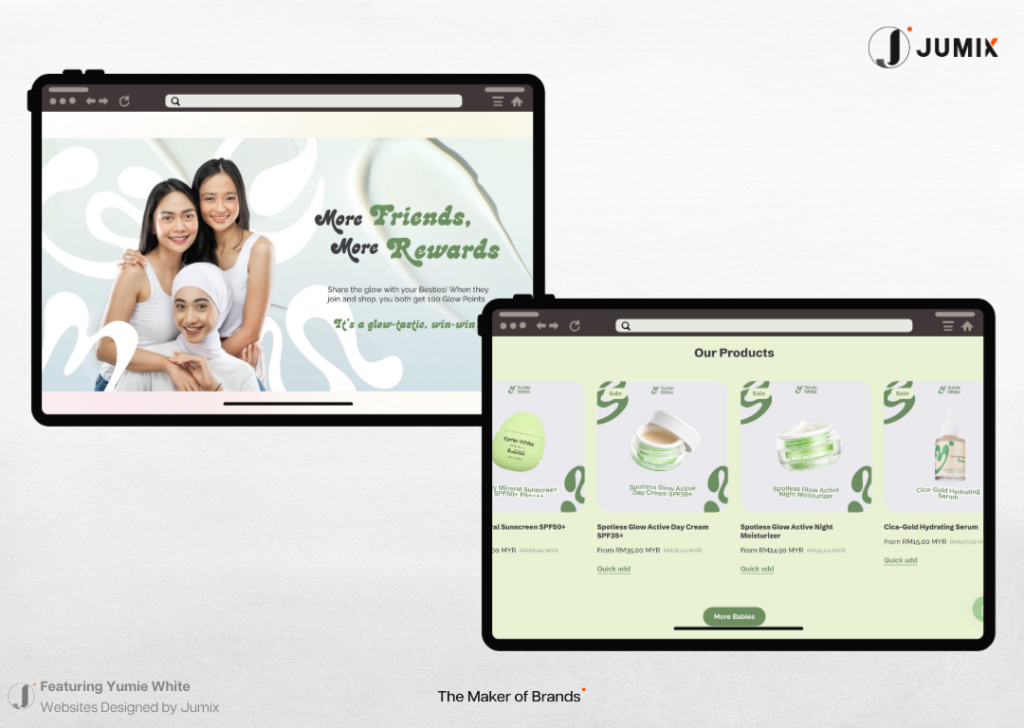
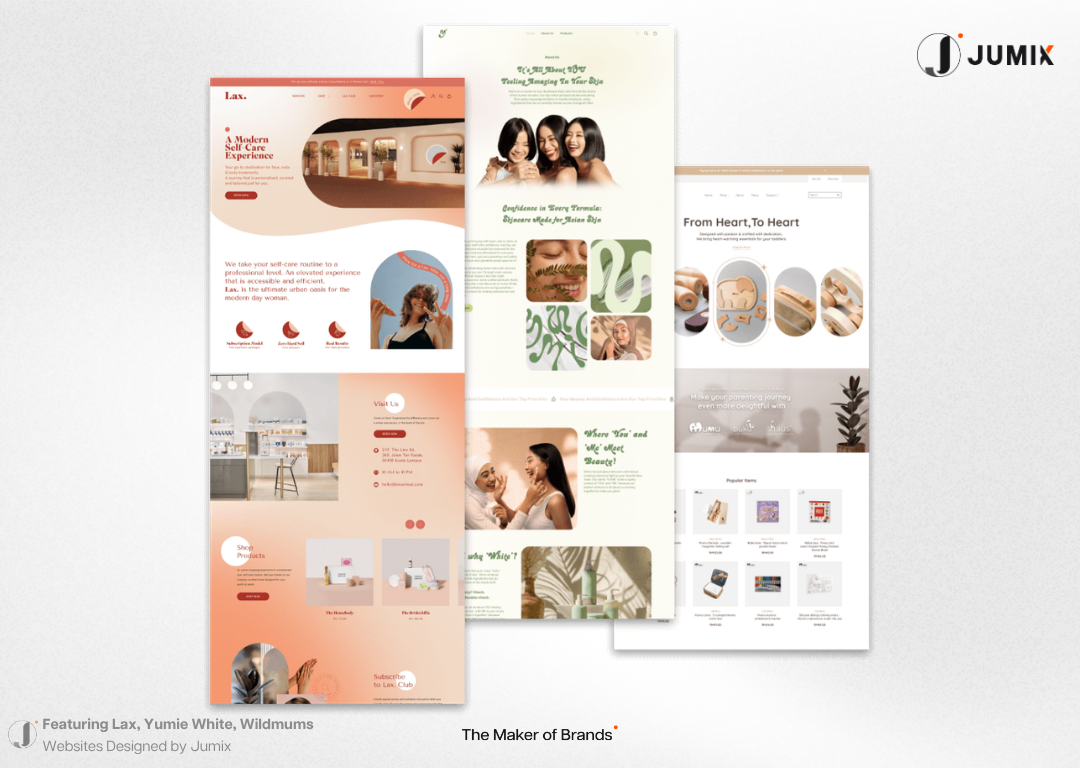
Your brand also gets room to breathe. On a marketplace, every listing looks the same: thumbnail, price, star rating. On Shopify, you control the photography, the product story, and the reason someone pays RM89 for yours instead of RM55 for a near-identical competitor.
That margin recovery compounds. How a website protects your profit margin is the calculation most sellers only run after watching a quarter of fees disappear into a marketplace.
Side-by-side comparison
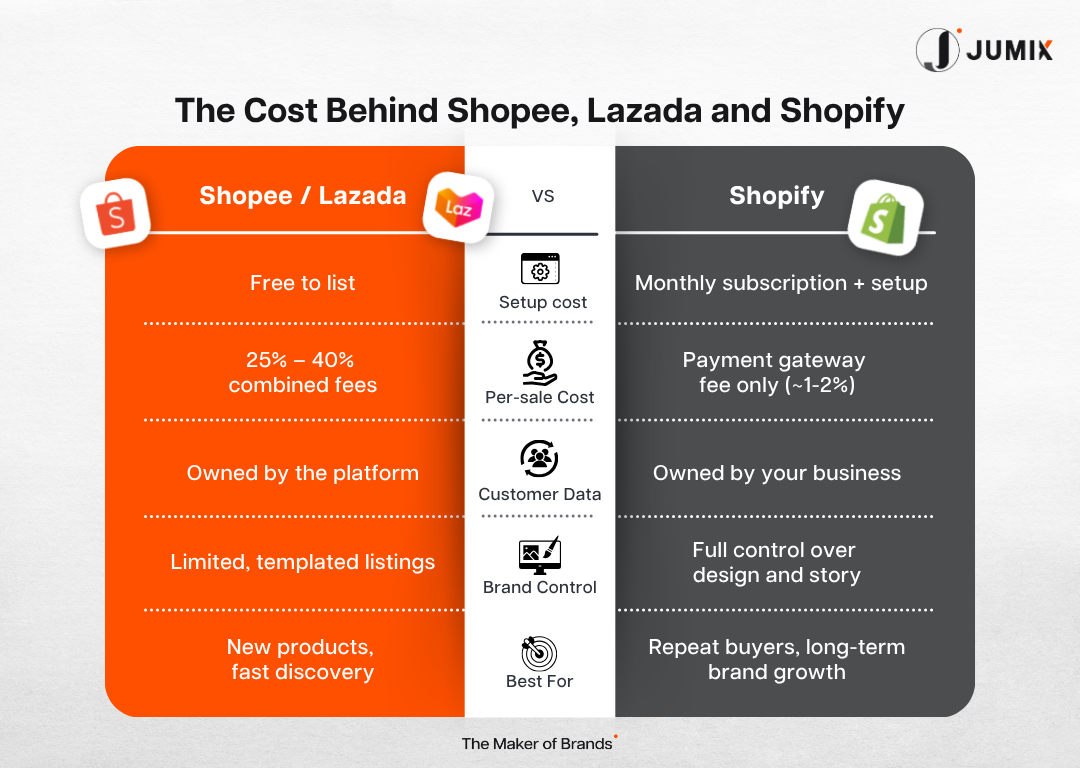
| Shopee / Lazada | Shopify | |
|---|---|---|
| Setup cost | Free to list | Monthly subscription + setup |
| Per-sale cost | 25% – 40% combined fees | Payment gateway fee only (~1-2%) |
| Customer data | Owned by the platform | Owned by your business |
| Brand control | Limited, templated listings | Full control over design and story |
| Best for | New products, fast discovery | Repeat buyers, long-term brand growth |
Neither column is “wrong.” They’re built for different stages of the same business. The common mistakes Malaysian eCommerce businesses make almost always come from picking one column and assuming it covers everything.
So where should you actually sell?
If you’re still validating whether people want your product, start on Shopee or Lazada. Don’t spend on a custom store before you know the product sells.
If you already have repeat buyers, a recognisable brand, or products people search for by name, you’re leaving margin and customer data on the table by staying marketplace-only.
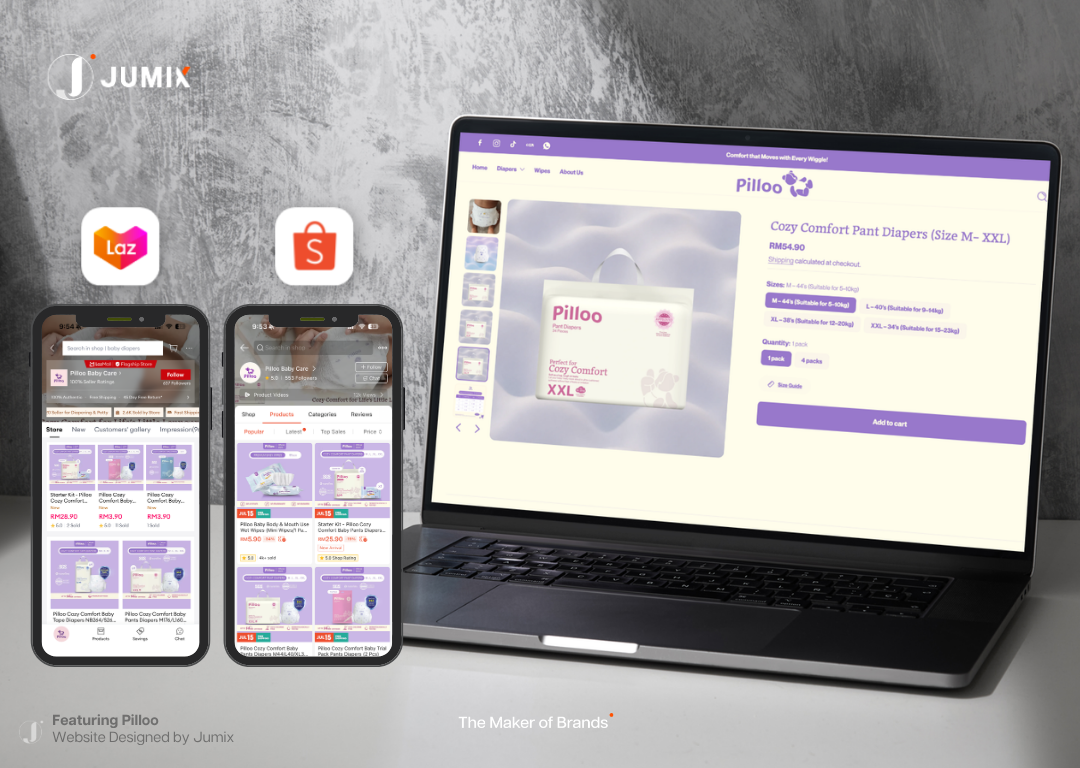
You don’t need to choose one and abandon the other. Most Malaysian sellers who make the jump keep their marketplace shop running for discovery while building their own Shopify store as the primary, higher-margin channel. Over time, organic search traffic to your own store grows for free.
SEO tips for your eCommerce store covers how to set that up from day one instead of bolting it on later.
A simple way to test readiness: pull your last 3 months of marketplace orders and check how many came from repeat buyers instead of first-time discovery. If repeat purchases make up a meaningful share, those are customers you’re currently renting back from Shopee or Lazada every single time, instead of owning outright.
Frequently Asked Questions
Should I close my Shopee or Lazada shop if I open a Shopify store?
No. Run both. Keep the marketplace open for discovery while your Shopify store builds its own traffic and repeat-customer base. Most sellers run both for 3 to 6 months before shifting primary focus to their own store.
Which is cheaper to start, Shopify or Shopee?
Shopee is cheaper upfront since listing is free. Shopify costs a monthly subscription from day one. But Shopee’s per-sale fees stack up fast at volume, while Shopify’s flat cost stays the same whether you sell 10 orders or 1,000.
Can I sell the same products on all three at once?
Yes, and many Malaysian brands do exactly this. Just keep pricing consistent across platforms. Buyers compare prices across apps, and a cheaper price on Shopee than your own store undercuts the reason to buy direct.
Does Lazada or Shopee help my SEO or Google visibility?
Not really. Marketplace listings rarely rank for your brand or product keywords on Google. A Shopify store, set up properly, ranks on Google over time, giving you a traffic source the marketplace can’t take away.
How much does it cost to set up a Shopify store in Malaysia?
The Shopify subscription itself starts at around RM85 to RM90 a month. A professionally built store on top of that typically runs RM3,000 to RM15,000, depending on catalogue size and how much custom design and integration work you need.
Marketplaces rent you customers. Your own store keeps them.
Shopee and Lazada are good at one thing: putting your product in front of people fast. They were never built to hand you the customer relationship.
Shopify does the opposite. Slower to get initial traffic, but every customer who buys becomes someone you can reach again, market to, and build a real brand around.
The smartest move isn’t abandoning the marketplace that got you here. It’s adding the store that lets you keep what the marketplace can’t give you: the customer.
If you’re ready to build a Shopify store that turns marketplace buyers into direct, repeat customers, Jumix’s Shopify web design service is built for exactly this transition.




Comments are closed for this article!